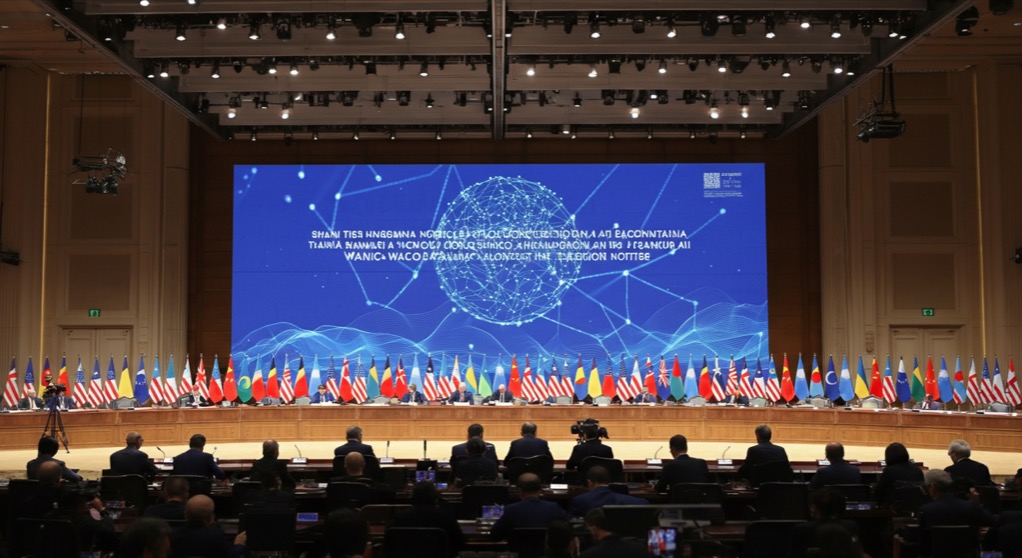
On July 16, 2026, twenty-nine countries signed an agreement in Shanghai to establish the World AI Cooperation Organization (WAICO), the first permanent multilateral institution dedicated to global AI governance. The signing, which took place during the World AI Conference 2026, marks a fundamental shift from the fragmented, national-level regulatory approach that has characterized AI policy since 2023. For AI founders building products that cross borders, this changes the compliance calculus entirely.
The agreement establishes a standing body headquartered in Shanghai with a mandate to create shared standards for AI safety testing, cross-border research collaboration, and emergency response protocols for AI incidents. The founding members include China, Indonesia, Thailand, Malaysia, Vietnam, Singapore, Pakistan, Saudi Arabia, the United Arab Emirates, Brazil, South Africa, Turkey, and sixteen other nations spanning Asia, Africa, the Middle East, and South America. Notably absent are the United States, the European Union, the United Kingdom, and Japan.
What the Agreement Actually Does
The WAICO agreement moves AI governance from ad-hoc summits to a permanent institution with three core functions. First, it establishes a framework for mutual recognition of AI safety testing and evaluation benchmarks. Instead of every country developing its own certification requirements, WAICO member states agree to accept standardized testing protocols developed by the organization. For AI companies operating across multiple member countries, this means a single safety certification could satisfy requirements across all twenty-nine nations, reducing the compliance burden of operating in those markets.
Second, the agreement creates a mechanism for cross-border AI research collaboration, including shared access to training datasets, compute resources, and evaluation infrastructure. This is a direct challenge to the current model where frontier AI research is concentrated in the United States and China, with most other countries relegated to being consumers rather than participants in AI development. For founders in WAICO member states, this could mean access to compute resources that were previously out of reach.
Third, WAICO establishes emergency response protocols for AI incidents. If a model deployed in one member country causes harm or exhibits dangerous behavior, the organization can coordinate a response across all member states. This provision, while vague in its current form, signals that the signatories expect AI incidents to be a cross-border problem requiring cross-border solutions. For companies deploying AI in multiple WAICO countries, this means a single incident could trigger coordinated regulatory scrutiny across nearly thirty jurisdictions.
The Geopolitical Context
The agreement was accompanied by Chinese President Xi Jinping's speech at WAIC 2026, in which he called for a symphony of global collaboration on AI and criticized efforts to monopolize AI development. Xi's framing positions China as the champion of open, inclusive AI governance, contrasting with the more restrictive approaches of US export controls and the EU AI Act's tiered compliance framework. This is a departure from China's previous posture of engaging with Western-led governance initiatives like the Bletchley Summit, and it raises the prospect of a divided global AI governance landscape.
The timing of the agreement is notable. It comes just weeks after the EU AI Act faced its first major rewrite, and as the United States still lacks a comprehensive federal AI law. The absence of major Western economies from WAICO suggests the world is moving toward two or more competing AI governance blocs, each with its own standards for safety testing, model evaluation, and data sharing. For AI companies operating globally, this bifurcation creates real operational complexity. A model certified under WAICO standards may not satisfy requirements in the EU or US, and vice versa.
Five ASEAN countries joined WAICO as founding members, signaling that Southeast Asia is aligning with China's AI governance framework rather than waiting for Western standards. This geographic alignment matters for AI companies because the region is one of the fastest-growing markets for AI adoption, with rapidly expanding digital infrastructure and a young, tech-savvy population.
What This Means for AI Startups
The creation of WAICO has three immediate implications for AI founders. First, compliance costs are likely to increase in the short term as companies navigate overlapping regulatory frameworks. If you sell AI products in both the EU, which has the AI Act, and WAICO member states, which will develop their own standards, you may need to satisfy two separate certification processes. This is particularly relevant for AI safety testing, model evaluation, and incident reporting requirements, which differ significantly between regimes.
Second, the agreement creates new opportunities for AI companies based in WAICO member states. The shared research infrastructure, compute access, and evaluation tools that WAICO promises to deliver could lower the barriers to AI development in countries that currently lack the resources to compete with US and Chinese frontier labs. For founders in Southeast Asia, the Middle East, Africa, and South America, WAICO membership could mean access to training compute, evaluation datasets, and regulatory pathways that were previously unavailable. This could accelerate the emergence of regional AI ecosystems outside the US-China axis.
Third, the emergence of WAICO accelerates the trend toward AI governance fragmentation that has been building since the Bletchley Summit in 2023. The EU has the AI Act. The US has executive orders and state-level regulation. China has its own AI governance framework. Now WAICO adds a fourth major regime. For AI founders, the winning strategy is to build compliance into the product architecture from day one, designing model evaluation, documentation, and incident response processes to satisfy multiple regimes simultaneously rather than retrofitting after the fact.
What Founders Need to Do
First, determine whether your target markets include any of the 29 WAICO founding member states. If you sell AI products or services in Southeast Asia, the Middle East, Africa, or South America, you need to track WAICO's standard-setting process closely from day one. Second, build modular compliance documentation. Design your model cards, safety evaluations, and incident response protocols to accommodate multiple regulatory frameworks rather than optimizing for a single regime. Third, monitor WAICO's technical standard-setting process. The organization's first deliverables are expected within 12 months, and early engagement with the standard-setting process gives a competitive advantage. Fourth, consider that WAICO's shared research infrastructure could be a strategic asset. If you are building an AI company in a WAICO member state, the compute access and evaluation tools the organization promises could meaningfully reduce your operating costs and accelerate your development timeline.