
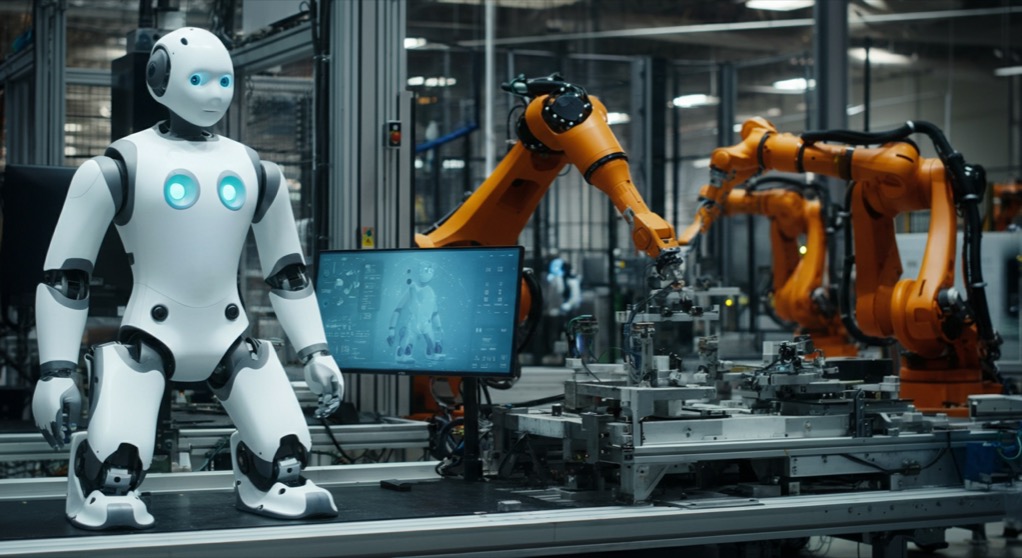
Ten thousand humanoid robots per year. That is the production target Agility Robotics set for its new 100,000 square foot manufacturing facility in Georgetown Texas, roughly thirty miles from Tesla's Austin headquarters. The company has raised one hundred eighty million dollars total including a one hundred fifty million dollar Series B in twenty twenty four led by DCVC. Digit, its flagship humanoid, already moves totes at Amazon and Spanx warehouses. Now the question shifts from whether humanoids work to whether they can be built at automotive scale.
What makes this factory different from the robotics pilots in Boston or Pittsburgh is not just square footage. It is the software stack running the production line. Agility uses AI driven simulation to validate every assembly step before a single physical part moves. Digital twins of each Digit unit run through thousands of simulated pick and place cycles in Nvidia Isaac Sim before the real robot ever powers on. This sim to real pipeline cuts integration time from weeks to days. For a company targeting ten thousand units annually, that compression is the difference between a pilot line and a production line.
From Lab Demos to Assembly Line Throughput
Humanoid robotics has lived in research labs for a decade. Boston Dynamics' Atlas backflips. Figure's coffee demos. Tesla Optimus folding shirts. The pattern was consistent: impressive videos, limited volume. Agility broke that pattern by securing paying warehouse customers first. Amazon tested Digit at a Seattle fulfillment center in twenty twenty three. Spanx deployed units for tote transport in twenty twenty four. These deployments generated real telemetry: cycle times, failure modes, battery degradation curves, and the long tail of edge cases that only appear in production.
That telemetry feeds directly into the Texas factory. Every Digit shipped carries sensors that stream performance data back to Agility's simulation environment. When a wrist joint shows premature wear in a Georgia warehouse, the digital twin in Texas updates its wear model. The next production batch gets a revised actuator spec. This closed loop between deployed fleet and manufacturing line is what automotive OEMs spent decades building. Agility is compressing that timeline into years by leveraging simulation infrastructure that did not exist five years ago.
Why Texas and Why Now
The location decision reveals the strategic calculation. Boston and Pittsburgh built the robotics talent pool. Texas builds the supply chain. Within a fifty mile radius of Georgetown sit Tesla's Gigafactory, SpaceX's Starbase supply network, and Apptronik's Austin headquarters. Actuator suppliers, harmonic drive manufacturers, and lithium cell pack assemblers have clustered around automotive production. Agility can source harmonic drives from a vendor that also supplies Tesla rather than importing from Japan with six month lead times.
Labor economics matter too. A humanoid assembly line needs technicians who understand both mechanical assembly and ROS2 control stacks. Texas universities graduate more mechatronics engineers per capita than any state outside Michigan. The cost per square foot for industrial space in Georgetown is roughly one third of Boston's Seaport district. For a capital intensive hardware company targeting unit economics that compete with human labor, these margins compound.
The AI Stack That Makes Volume Possible
Agility's simulation stack runs on Nvidia Omniverse with Isaac Sim physics. Each Digit unit has a digital twin that accumulates simulated hours at a thousand to one speedup. Before a physical robot leaves the factory, its twin has completed fifty thousand pick cycles across varied lighting, payload, and floor conditions. The sim data trains the vision policies that run onboard. Domain randomization covers the gap between perfect simulation and messy reality. When the real robot encounters a torn tote or a wet floor, the policy has seen ten thousand variations in sim.
Fleet management software completes the loop. Warehouse operators do not want to manage robots one by one. Agility's Arc platform treats the fleet as a single addressable resource. Task allocation, charging schedules, and traffic routing run as a centralized optimization problem. When a new Digit joins the fleet, it downloads the current world model and policy weights over the air. The Texas factory burns the latest firmware image onto each unit during final test. The time from production completion to productive work in a customer facility is measured in hours not weeks.
What This Means for Founders Building Embodied AI
The Texas factory signals that the bottleneck for humanoid robotics has shifted. The hard problem is no longer making a robot walk. The hard problem is making ten thousand robots walk reliably for five years at a unit cost below thirty thousand dollars. That is a manufacturing problem wrapped in a data problem wrapped in a supply chain problem.
For AI founders, three implications stand out. First, simulation infrastructure is now a competitive moat. Companies that can validate hardware changes in sim before cutting steel will iterate faster. Second, fleet data is the new training data. Every deployed robot generates the telemetry that improves the next generation. The company with the largest deployed fleet accumulates a compounding data advantage. Third, the supply chain for humanoid components is maturing. Harmonic drives, torque sensors, and high torque density actuators now have multiple suppliers in North America. New entrants do not need to vertically integrate every component.
Key Lessons for Founders
Simulation first hardware development wins. Agility validates every design change in digital twin before physical prototyping. Founders building hardware should invest in sim infrastructure before building the first prototype.
Deploy early to learn fast. Agility put robots in Amazon warehouses before the product was perfect. Real world telemetry beats lab data every time. Ship to friendly customers who tolerate iteration.
Cluster near your supply chain. The Texas robotics cluster exists because automotive manufacturing created component density. Founders in hardware should locate where their bill of materials lives.
Fleet software is product. Single robot demos impress investors. Fleet management software retains customers. Build the orchestration layer alongside the hardware.
Unit economics drive everything. Ten thousand units per year at thirty thousand dollars each is a three hundred million dollar revenue run rate. That number only works if the bill of materials drops below fifteen thousand dollars. Design for cost from day one.