
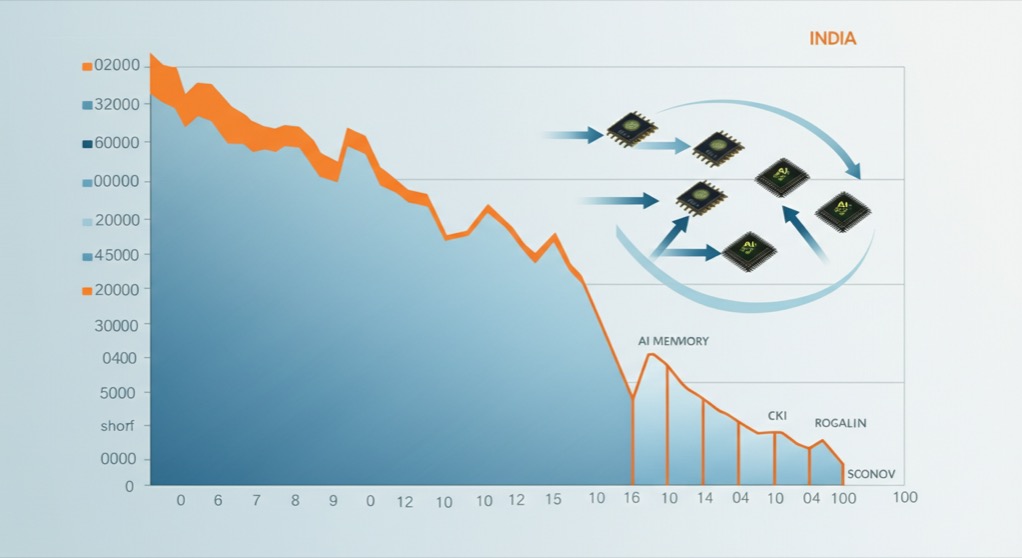
India's smartphone market just recorded its steepest June-quarter decline in six years, and the culprit is not a recession or a supply chain disruption from a geopolitical shock. It is the global AI boom itself. As Samsung, SK Hynix, and Micron shift production capacity toward high-bandwidth memory for AI data centers, the supply of standard RAM and storage components for consumer electronics has tightened, sending prices soaring. In India, where roughly 60 percent of smartphones sell for under $210, the impact has been seismic: shipments fell 10 percent year-over-year in the April-June quarter, according to Counterpoint Research, with prices on some models climbing by as much as 68 percent. This is the first clear signal that AI's infrastructure buildout is creating real-world scarcity for the devices billions of people use every day.
The AI Memory Trade-Off Hits the Mass Market
The economics behind this shift are straightforward. High-bandwidth memory chips used in AI accelerators generate far higher margins per wafer than the DDR and NAND chips that go into smartphones. Manufacturers like Samsung, SK Hynix, and Micron have been reallocating production lines accordingly, leaving less capacity for the standard memory components that power phones, laptops, and other consumer devices. The result is a supply crunch for DRAM and NAND that has pushed component costs higher across the board. While this dynamic was widely predicted by analysts earlier this year, India is providing the hardest evidence that the trade-off is not theoretical. The sub-$150 segment of India's smartphone market saw shipments crash by 45 percent year-over-year in Q2. Even the sub-$210 segment, which represents the bulk of the market, is feeling intense pressure as brands pass component cost increases to consumers. Tarun Pathak, vice president of research at Counterpoint, told TechCrunch that consumers are increasingly delaying upgrades, with replacement cycles stretching from roughly 3.5 years to around four years. For a market that has grown steadily for over a decade, this pause is significant.
Who Wins and Who Loses in the Memory Crunch
The pain is not distributed evenly. Samsung was the only major brand to post shipment growth in India in Q2, with volumes rising 2 percent year-over-year, because its portfolio leans more heavily toward premium devices where margins are thicker and customers are less price-sensitive. Apple saw a 3 percent decline, though that was attributed more to supply constraints than demand weakness. The real damage has been concentrated among Chinese brands that dominate the entry-level and mid-range segments. Their combined market share in India fell to its lowest level for a second calendar quarter since 2020. OnePlus made headlines this week by announcing it would stop launching new products in Europe and North America while maintaining its India business, a strategic retreat that underscores how thin margins have become. Counterpoint data shows China now accounts for 74 percent of OnePlus's global shipments, up from 59 percent a year earlier, while India's share dropped to 19 percent from 30 percent. The pattern is likely to repeat across other budget-focused brands as the margin math becomes unsustainable. As Pathak put it, running multiple sub-brands only makes financial sense if each one sells enough volume to cover shared costs, and that arithmetic breaks down once margins shrink to razor-thin levels.
What This Means for Indian Founders Building AI Products
For founders building consumer AI applications in India, this memory crunch creates a hard constraint on product strategy. The narrative around on-device AI assumes that users will have phones capable of running large language models locally. That assumption does not hold for the vast majority of the Indian market today. With 75 percent of smartphones sold in India featuring 6-8GB of RAM, and prices rising further, the on-device AI future for Indian consumers is at least two to three years away at current trends. The strategic implications are clear. First, founders should prioritize cloud-first AI architectures with optional on-device fallback using small models like Phi-3-mini or Gemma-2B that can run within a 2-4GB memory budget. Second, the current market dislocation creates an opening for AI model compression tools and edge inference optimization services targeted specifically at this price-sensitive segment. Third, the AI phone narrative is currently a premium-segment story in India. Founders who ignore that reality and build purely for on-device inference are designing for a market that does not yet exist at scale. The good news is that the memory crunch will not last forever. Kaur at IDC expects elevated prices to persist through at least the end of 2027, but the pace of increases should moderate as consumers adjust to a new normal and as memory manufacturers eventually balance capacity between AI and consumer demand. For founders, the next two years are a window to build cloud-efficient AI products that can seamlessly transition to hybrid models once affordable high-RAM devices arrive.
Lessons for Founders in Other Price-Sensitive Markets
India's experience carries lessons for founders building for any price-sensitive market globally. The memory crunch is not India-specific: it is the result of AI data center demand pulling production capacity away from consumer-grade components. Every emerging market where the sub-$300 smartphone segment dominates will face similar dynamics in the next 12-18 months. The key takeaway is that AI's infrastructure buildout creates downstream scarcity in unexpected places. Founders who track semiconductor supply chains as closely as they track their product roadmaps will catch these shifts before they become headlines. The rising cost of memory is not a temporary blip. It is the price of the AI transition being paid by the mass market consumer electronics industry. For founders, the opportunity lies in building products that work well on the hardware people can actually afford today, not the hardware they might have in three years.