Nvidia's $3 trillion market cap rests on two pillars: its hardware and its software. The hardware gets all the attention. H200 and B200 GPUs dominate headlines with their teraflop counts and memory bandwidth. But CUDA, Nvidia's parallel computing platform and programming model, is the quiet lock that has kept developers inside Nvidia's ecosystem for nearly two decades. Every AI researcher, every startup building on GPUs, every hyperscaler optimizing inference pipelines writes CUDA code. That code does not run on AMD, Intel, or Chinese AI chips. Now Alibaba is building what could be the first viable crack in that wall.
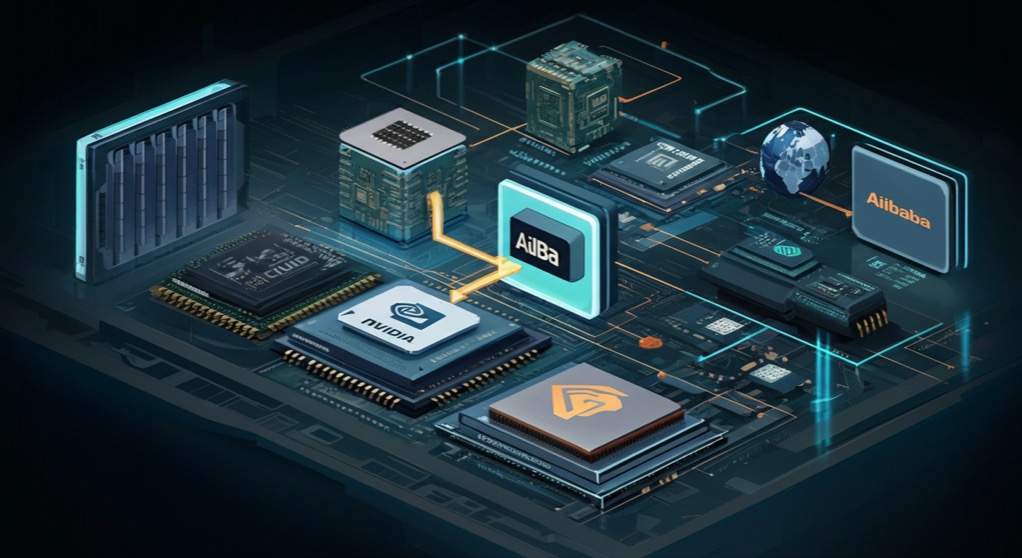
The South China Morning Post reports that Alibaba's cloud division is developing a comprehensive open-source AI stack designed to reduce dependency on Nvidia's proprietary CUDA platform. The project is not just another programming framework. It is a full software stack built to run across multiple GPU architectures, including domestic Chinese AI chips, AMD GPUs, and potentially RISC-V based accelerators. If it delivers, it could fundamentally reshape the economics of AI compute.
What Alibaba Is Actually Building
Alibaba's open-source AI stack aims to replace the layers of software that make Nvidia GPUs uniquely valuable. CUDA is not just a compiler or a library. It is an entire ecosystem: the CUDA Toolkit, cuDNN for deep neural networks, cuBLAS for linear algebra, TensorRT for inference optimization, and the CUDA programming model itself. Developers build on these tools, optimize for them, and depend on them for performance. That dependency is the moat.
Alibaba's alternative targets this stack at multiple levels. First, it provides a programming model that can compile to multiple GPU backends, similar to how Vulkan or DirectX can target different graphics hardware but optimized for AI workloads. Second, it includes libraries for common AI operations, from matrix multiplication to attention mechanisms, that map to whatever hardware is available rather than requiring Nvidia-specific instructions. Third, it is being designed as open-source from the start, which means the broader community can contribute backends for new hardware as it emerges.
The timing is strategic. US export controls have limited China's access to Nvidia's most advanced chips, including the H100, H200, and B200 series. Chinese companies can still buy lower-end Nvidia GPUs with reduced interconnect bandwidth, but the gap between what is available in China and what is available in the US is widening. Building a software stack that works well on domestic alternatives is not just a nice-to-have. It is a survival imperative for China's AI industry.
Why CUDA's Moat Has Survived Every Previous Challenge
This is not the first attempt to challenge CUDA. AMD has tried with ROCm, an open-source GPU computing platform that has been under development for years. Intel has OneAPI, designed to provide a unified programming model across CPUs, GPUs, and accelerators. Google has its own software stack for TPUs. None of these have meaningfully eroded Nvidia's dominance. The reason is network effects and developer habits.
Every AI paper, every open-source model release, every deployed inference pipeline is built on CUDA. PyTorch and TensorFlow, the two dominant deep learning frameworks, run CUDA by default. When a researcher downloads a model from Hugging Face, it expects CUDA. When a startup deploys a production inference pipeline, it uses NVIDIA Triton Inference Server and TensorRT. The switching costs are not just financial. They are cognitive, habitual, and structural.
What makes Alibaba's challenge different is the geopolitical dimension. Chinese companies cannot simply choose to use CUDA on the best hardware. They are being forced by export controls to build alternatives. That forced necessity creates a level of investment and urgency that AMD's ROCm and Intel's OneAPI never had. When a government decides that software self-sufficiency is a national priority, the resources available dwarf what any individual company would commit to a developer tools project.
The Broader Pattern: Open-Source as Geopolitical Strategy
Alibaba's CUDA alternative follows a well-established Chinese playbook. China has historically responded to US technology dominance by building open-source alternatives. When Google's Android was at risk of being cut off, Huawei built HarmonyOS. When US chip exports tightened, China accelerated domestic chip design through companies like Biren Technology and through initiatives like the push for RISC-V architecture.
The open-source approach serves multiple purposes. It accelerates adoption by removing licensing barriers. It allows Chinese companies to contribute improvements that benefit their own hardware while still getting contributions from the global community. And it provides political cover: an open-source project is harder for the US government to target with sanctions than a proprietary product controlled by a single Chinese company.
This is also where the broader ecosystem matters. Legendary GPU architect Raja Koduri recently launched a startup called Oxmiq Labs that is building RISC-V based hardware designed to run CUDA applications without modification on non-Nvidia hardware. The convergence of Alibaba building an open-source software stack and Koduri building hardware that targets CUDA compatibility suggests that the walls around Nvidia's ecosystem are being attacked from multiple directions simultaneously.
What This Means for Founders and Developers
For AI founders building outside of China, Alibaba's CUDA alternative is not immediately relevant. Nvidia GPUs remain the best hardware available, and CUDA remains the most mature ecosystem. But the long-term implications are significant. If the project succeeds, it means more hardware competition, which puts downward pressure on Nvidia's pricing. For startups spending hundreds of thousands or millions of dollars on GPU compute, even a 10 to 20 percent reduction in cost from increased competition would be transformative.
For founders building globally distributed teams or serving international customers, the bifurcation of AI infrastructure between US and Chinese ecosystems is becoming a real strategic consideration. Companies may need to choose which stack to optimize for, or maintain compatibility with both. This adds engineering overhead but also creates insurance against supply chain disruptions.
For Indian IT services firms and SaaS companies, the opportunity is significant. India has a massive AI developer workforce and deep client relationships. An open, multi-platform GPU programming model would give Indian firms more flexibility in how they build and deploy AI solutions. It would also reduce their dependence on a single US hardware supplier, which is a strategic advantage as geopolitical tensions fluctuate.
For developers, the immediate takeaway is to watch this space but not jump ship. CUDA skills remain the most valuable GPU programming credential in the market, and they will be for years. But learning about alternative programming models, experimenting with open-source AI compilers like MLIR or XLA, and understanding the multi-platform landscape will be increasingly valuable as the ecosystem diversifies. The era of one GPU architecture to rule them all is not ending tomorrow. But the foundations are being laid for a very different future.