When Anthropic opened its Bengaluru office in February 2026, it signaled what the numbers already confirmed: India was no longer just a growth market for Claude. It was the company's second-largest user base after the United States, accounting for 5.8 percent of global Claude usage. Now Anthropic has taken the next step, rolling out localized Indian rupee pricing for Claude subscriptions across its website and mobile apps. The move brings Claude in line with OpenAI's India pricing strategy and sets up a direct battle for the world's most price-conscious AI developer market.
For Indian developers and enterprises who have been paying in US dollars with currency conversion fees and international card charges, the shift is more than a convenience. It signals that Anthropic is committing to India as a core market with dedicated infrastructure, local leadership, and pricing built for the country's economics rather than an afterthought adjusted for exchange rates.
The Price Breakdown
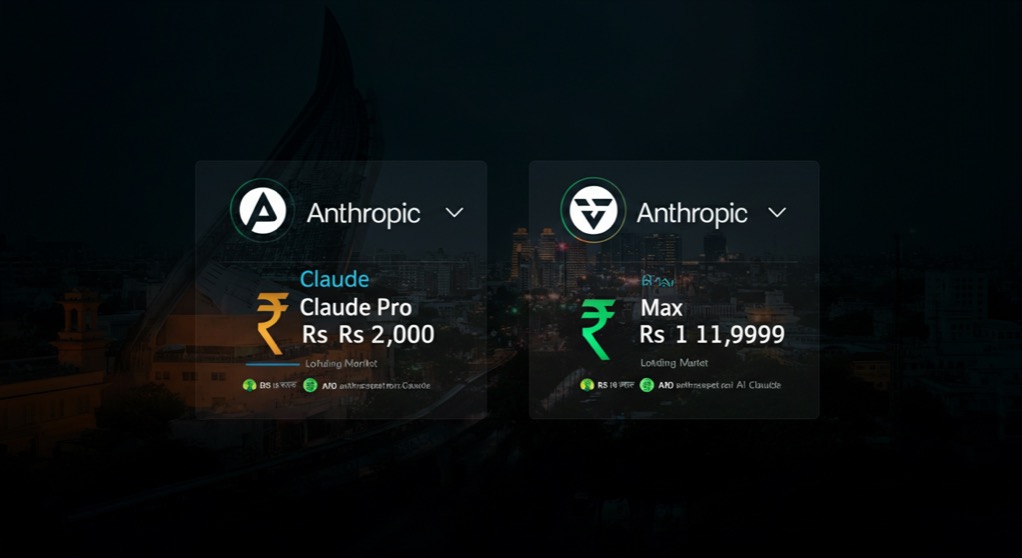
Anthropic is now listing Claude plans in Indian rupees with the following pricing. Claude Pro costs Rs 2,000 per month when billed annually, which works out to approximately $21. That is slightly higher than the $17 monthly US price, though the India figure includes local taxes. Claude Max, the premium tier designed for heavy users and power developers, starts at Rs 11,999 per month (approximately $125) compared with $100 in the US. Team plans are priced at Rs 2,399 per seat per month (approximately $25) versus $20 in the US. Prices on Claude's mobile apps vary slightly from the website rates.
One notable gap in Anthropic's India rollout is the absence of Unified Payments Interface support. UPI is the backbone of India's digital payments ecosystem, processing well over 10 billion transactions per month. Without it, users still need to pay by international credit card or through Apple and Google app store billing systems. This is a significant friction point compared with OpenAI, which rolled out ChatGPT rupee pricing in August 2025 with full UPI support from day one. For individual developers and small teams who rely on UPI for all their transactions, this limitation means Claude remains less accessible than its competitors for the long tail of the Indian market.
The pricing structure itself reveals Anthropic's strategy. Rather than undercutting US prices to compete on cost alone in a price-sensitive market, Anthropic has set India prices at a premium to US rates when taxes are factored in. This suggests the company believes Indian developers and enterprises will pay for perceived quality and reliability, especially as the market matures and companies seek production-grade AI tools rather than experimental ones.
Why India Matters for Anthropic's Growth
India's importance to Anthropic goes beyond raw user numbers. The country is home to one of the largest pools of software developers in the world, and those developers are increasingly building with AI tools as a core component of their workflow. For Anthropic, winning Indian developer mindshare today means locking in usage patterns that will compound for years as those developers move into decision-making roles at enterprises and startups.
The company has been building out its India presence methodically over the past year. It opened a Bengaluru office in February 2026 following an October 2025 announcement, and in January appointed Irina Ghose, former managing director of Microsoft India, to lead its India business. Ghose's appointment was a clear signal that Anthropic sees enterprise sales as the primary growth vector in India. The company has also struck partnerships with Indian IT services giants Infosys and Tata Consultancy Services in recent months, positioning Claude as the AI engine for enterprise deployments. These partnerships are critical because Indian IT services firms manage technology infrastructure for some of the world's largest companies, giving Anthropic a distribution channel that extends far beyond direct subscription sales.
That expansion faced a setback in June 2026 when Anthropic abruptly restricted access to its Fable 5 and Mythos 5 models for non-US entities. The move prompted some Indian developers and startup founders to publicly explore alternatives to American frontier models. The restriction on Fable 5 has since been lifted, but access to Mythos 5 remains limited, creating an undercurrent of uncertainty about how reliably Indian users can depend on Anthropic's most advanced capabilities. The localized pricing rollout can be seen partly as a goodwill gesture to rebuild confidence after that episode, though the lingering access restrictions complicate the narrative.
The Competitive Landscape in India
Anthropic enters the localized pricing game in a market that is already crowded with alternatives. OpenAI's ChatGPT has had Indian rupee pricing with UPI support since August 2025, giving it a significant payments convenience advantage that Anthropic has not yet matched. Google's Gemini is available in India through existing Google Cloud and Google One billing relationships, which many Indian users already have set up. And a growing ecosystem of local AI models from Indian startups and open-source projects offers cost-effective alternatives for developers willing to trade frontier performance for lower prices and data sovereignty.
What sets Anthropic apart in this landscape is Claude's reputation for reliability, safety, and structured reasoning. Indian enterprises handling compliance-sensitive workloads and Indian developers building production AI applications have gravitated toward Claude for its consistent output and long-context capabilities. The localized pricing removes the friction of dollar-denominated billing, which added currency conversion costs and made subscription management more complex for Indian users paying with domestic cards.
What This Means for Indian Founders and Developers
For Indian founders building AI-powered products, the localized pricing is a meaningful operational improvement. A team of five developers on Claude Max would previously have faced $500 per month in US dollar pricing plus unpredictable currency conversion fees from their banks. Under the new India pricing, the same team pays roughly Rs 59,995 per month, or about $625 including all taxes. While that is still a premium, the predictability of rupee billing and the elimination of conversion overhead makes Claude more viable as a line-item expense for startups operating on Indian budgets.
The absence of UPI support is the one practical gap that Anthropic needs to close. Without it, many individual developers and small teams who do not have international credit cards will find it harder to subscribe. OpenAI's decision to support UPI from day one of its India pricing rollout has proven to be a significant adoption enabler, and Anthropic will need to follow suit to capture the full breadth of the Indian market beyond enterprise customers.
For developers who have been using Claude through dollar-denominated accounts, the transition is straightforward: existing accounts can switch to the new India pricing tiers. The bigger strategic question is whether the pricing gap between Anthropic and local AI alternatives will narrow over time or widen as Indian models continue to improve their capabilities on standard benchmarks.
The real signal from this pricing move is clear: Anthropic sees India as a core market, not an afterthought. For Indian AI founders, that validation matters. It means global AI companies are willing to invest in local infrastructure, local leadership, and local pricing to win here. The competition between frontier AI providers for Indian users will only intensify, and that competition ultimately benefits every developer and business building with AI in India.