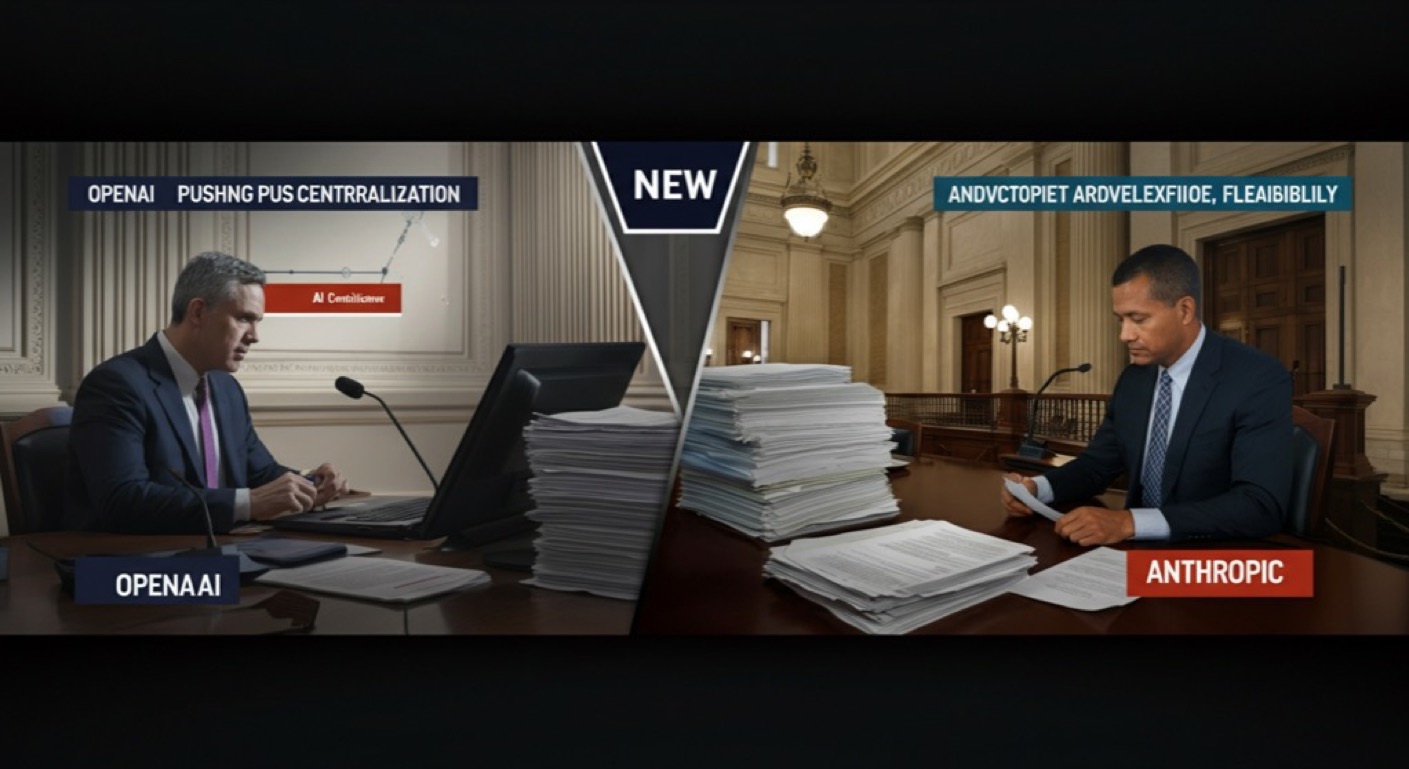
The most consequential AI policy debate of 2026 is not about what AI can do. It is about who gets to decide. And for the first time, two of the most influential AI companies in the world have staked out opposing positions on that question.
OpenAI has spent the last several months lobbying aggressively for a legal doctrine called reverse federalism, a regulatory approach where federal AI rules would preempt and override stronger state-level AI laws. Anthropic, meanwhile, has quietly developed a counter-proposal based on cooperative federalism, which would preserve state-level experimentation while setting federal baseline standards.
This is not a minor policy disagreement. The outcome of this debate will determine whether AI startups building for the US market face one federal compliance standard or 50 separate state-level frameworks. It will shape the competitive landscape for years.
Why This Debate Matters Now
The urgency of this question stems from a simple fact: states are not waiting for Congress. Over the past eighteen months, more than a dozen states have introduced or passed AI legislation targeting everything from algorithmic discrimination to deepfake political ads to AI system registration requirements.
Colorado passed SB 24-205, the first comprehensive state AI law requiring developers and deployers of high-risk AI systems to exercise reasonable care to avoid algorithmic discrimination, with enforcement starting in 2026. Connecticut proposed similar guardrails. California has advanced multiple AI safety bills. New York enacted a law requiring employers to notify candidates when AI is used in hiring decisions.
For an AI startup with limited legal resources, complying with a patchwork of state laws is expensive and operationally draining. A company building an AI hiring tool would need to verify compliance in Colorado, track emerging rules in California, monitor Connecticut's evolving framework, and stay ahead of bills in a dozen other states while trying to ship product. That is the opening OpenAI is exploiting with its reverse federalism push. The argument is simple: one national standard is cheaper, faster, and more predictable for American AI companies competing globally.
OpenAI's Reverse Federalism Play
OpenAI has framed its federal preemption push as a competitiveness issue. In meetings with administration officials and congressional staff, the company has argued that a fragmented state-by-state regulatory landscape would slow AI development, increase costs for startups, and hand an advantage to Chinese AI companies operating under a unified national framework.
The term reverse federalism describes a specific legal mechanism: federal law explicitly states that it occupies the field of AI regulation, preventing states from enacting their own rules. It is called reverse because it flips the traditional presumption that states regulate matters of health, safety, and commerce unless Congress explicitly preempts them.
OpenAI's public position memo, circulated in early 2026, argues that AI is inherently a national and global technology. Models are trained once and deployed everywhere, and therefore require national-level governance. A patchwork approach, the memo contends, would create regulatory arbitrage where AI companies gravitate toward the least restrictive state, undermining safety goals.
Critics of reverse federalism argue that it would lock in a lowest-common-denominator regulatory baseline. States like Colorado that have moved aggressively on AI accountability would see their efforts nullified. Consumer advocacy groups warn that preemption would eliminate laboratories of democracy where different regulatory approaches can be tested before being scaled nationally.
Anthropic's Cooperative Federalism Counter
Anthropic has taken a sharply different approach. In its own policy submissions and congressional testimony, the company has advocated for cooperative federalism, a model where the federal government sets baseline requirements for all AI systems while preserving the ability of states to experiment with additional protections.
Under Anthropic's framework, federal law would establish mandatory minimums: safety testing requirements for frontier models, disclosure obligations for AI-generated content, and transparency standards for high-risk AI systems. But states would retain the ability to add their own requirements in specific domains. California could impose stronger protections around AI in hiring and lending. Colorado could maintain its algorithmic discrimination framework.
Anthropic argues that this approach preserves regulatory innovation at the state level while preventing the chaos of 50 completely independent frameworks. It also avoids the constitutional and political battle that would accompany a full federal preemption push. The company has marshaled three core arguments for its position.
First, state-level experimentation produces valuable data about what works and what does not in AI regulation. Colorado's law will generate the first real-world data on how algorithmic auditing requirements function in practice. Second, cooperative federalism is more politically viable. It does not require invalidating laws that states have already passed and invested political capital in. Third, it creates a natural escalation mechanism: states that feel the federal baseline is too weak can push for stronger rules, creating upward pressure on standards over time.
What This Means for AI Founders
For AI startup founders, the stakes of this debate are intensely practical. The choice between reverse and cooperative federalism translates directly into compliance costs and operational complexity.
Under reverse federalism, a founder building an AI recruiting platform would need to understand one set of federal rules. That is simpler, faster, and cheaper. The compliance team can be lean. Legal review cycles are shorter. Product changes to meet regulatory requirements happen once, not 50 times. This is the path of least resistance for resource-constrained startups.
Under cooperative federalism, the same founder would need a compliance system capable of adapting to multiple state frameworks. Legal costs increase. Product decisions become more complex. But there is a countervailing benefit: states that compete on regulation may create more favorable environments for specific types of AI innovation. A startup building in an area where the federal baseline is poorly suited might find a welcoming state framework that allows it to operate legally.
The smartest move for founders right now is not to bet on which model wins. It is to build flexibility into their compliance systems from day one. Structure your AI systems so that state-level variations in disclosure requirements, auditing standards, and transparency obligations can be handled through configuration changes rather than architecture rewrites. Design your data governance around the most restrictive plausible standard rather than the least. And pay attention to this debate, because its outcome will define the regulatory environment you operate in for the next decade.
Even more important: do not assume this is a settled question. Both companies are actively lobbying. Both have allies in Congress and the administration. The outcome is genuinely uncertain, and it will be decided in the next twelve months. Founders who treat this as an abstract policy debate happening far away from their business are making a mistake. This is going to land directly in your compliance budget, one way or another.