
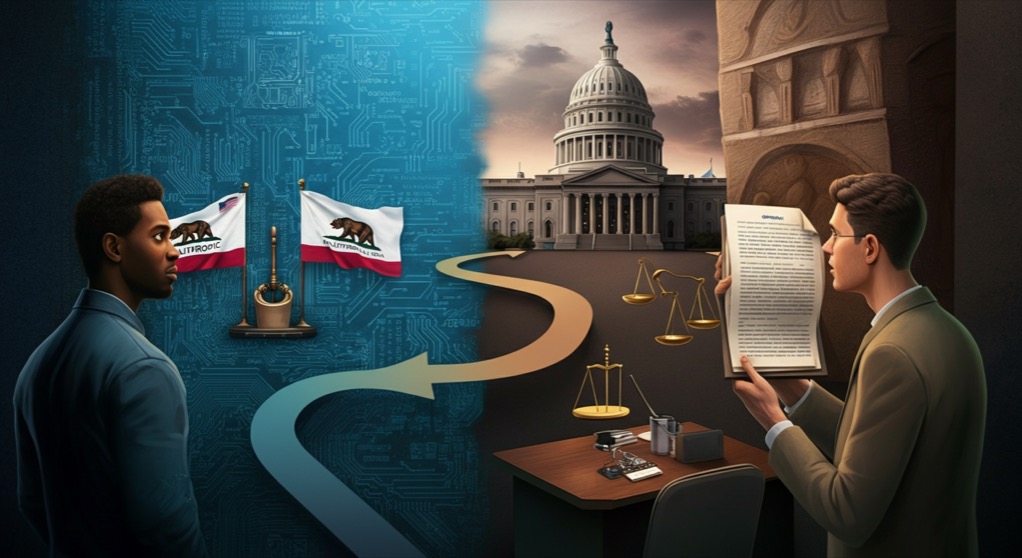
A rare public split has emerged between the two most prominent AI labs, and it carries enormous consequences for every founder building with AI. In mid-July, Anthropic publicly pushed back against OpenAI's strategy of lobbying for federal AI regulation that would preempt state-level laws. The debate, which Politico termed a fight over 'reverse federalism,' pits two competing visions of AI governance against each other: OpenAI wants uniform national rules to avoid a patchwork of conflicting state requirements, while Anthropic argues that state-level experimentation is essential and that preempting state laws without establishing federal standards first would create a dangerous regulatory vacuum.
Anthropic CEO Dario Amodei laid out the company's position in a July 15 New York Times op-ed and a formal statement to Congress. The core argument is that a blanket prohibition on state AI regulation, which OpenAI has been pushing for with a proposed 10-year moratorium on state-level AI laws, is too blunt an instrument. Amodei argues that state legislatures have been laboratories of democracy on AI, passing laws like California's SB 315 and Illinois' AI Safety Act that have established important guardrails. Preempting these without a robust federal framework in place would leave the United States without meaningful AI regulation of any kind at a critical moment.
The 'Reverse Federalism' Strategy Explained
The term 'reverse federalism' describes a political approach where a company that typically favors deregulation at the federal level suddenly asks Washington to preempt state laws. It is called 'reverse' because the usual pattern is progressives seeking federal standards to overcome conservative state resistance, or states acting as laboratories of democracy. Here, OpenAI is the one asking for national preemption, reversing the traditional roles. The company's argument is pragmatic: 50 different state AI laws would create a compliance nightmare that would crush startups and benefit only large incumbents with the legal resources to navigate a fragmented regulatory landscape.
OpenAI's framing has some merit for cash-constrained startups. A single national standard means one compliance framework, one legal review, one set of disclosure requirements. The California Consumer Privacy Act (CCPA) experience demonstrated that multi-state compliance is expensive and confusing, with companies needing to track differing definitions, exemptions, and enforcement mechanisms in each state. OpenAI argues that the same fragmentation happening across AI regulation would be even worse, because AI systems are inherently harder to compartmentalize by geography than data privacy regimes. An AI model deployed nationwide cannot easily apply different rules to users in California, Illinois, and New York.
But Anthropic's counterargument is equally compelling. Federal AI regulation does not currently exist, and the legislative process in Washington is slow. The Senate AI working group recommendations are expected in late 2026, but translating those into enacted legislation could take years. In the meantime, state laws like California's SB 315 have already taken effect, establishing requirements for safety testing, disclosure, and risk assessment. Preempting these laws without a federal replacement would leave a governance gap that could last years, during which AI systems would operate with no binding regulatory requirements at all.
What This Means for AI Founders
For founders building AI products and services, the outcome of this debate directly determines their regulatory compliance roadmap for the next three to five years. If OpenAI wins and federal preemption passes, founders face a single compliance regime. That regime could be weaker than what California or Illinois would impose on their own, because federal legislation typically requires compromise that dilutes the strongest state provisions. It would also be easier to comply with: one set of rules, one compliance team, one set of technical requirements. For early-stage startups with limited legal resources, this is the lower-cost outcome.
If Anthropic's position prevails and state-level regulation continues, founders face a compliance landscape that looks more like US privacy law than GDPR. California's SB 315, Illinois' AI Safety Act, New York's proposed AI bias law, and emerging legislation in Colorado and Washington would each impose different requirements. A startup selling an AI hiring tool would need to comply with Illinois' specific requirements for bias testing, California's risk assessment mandates, and New York's disclosure obligations. Compliance costs would be higher, and the regulatory surface area larger. But there is a silver lining: state-level experimentation tends to produce stronger and more nuanced regulation, and founders have more opportunities to shape regulation at the state level than at the federal level.
The Stakes for the Senate AI Working Group
The next major milestone is the Senate AI working group recommendations, expected in late 2026. This bipartisan group has been studying AI governance for over a year, and its recommendations will shape the legislative agenda for the next Congress. Both Anthropic and OpenAI are actively lobbying the working group, and the reverse federalism debate is now a central fault line in the discussions. The working group's recommendations on federal preemption will signal which direction Congress is likely to go.
For founders, the smart move is to prepare for both scenarios. Build compliance flexibility into your product architecture. Design your AI systems so that they can apply different rules to different jurisdictions if needed. Track state-level legislation actively, especially in California, Illinois, and New York, where the most significant AI laws are being debated. And engage with the policy process, because the window for shaping these regulations is still open. The Senate working group is accepting input, and state legislators are actively seeking industry perspective. Founders who engage now will have more influence than those who wait until the regulations are final.
What Founders Need to Do
The regulatory future is uncertain but companies can take concrete steps today. First, audit your AI systems against existing state requirements now, especially California's SB 315 and Illinois' AI Safety Act, because these are already in effect. Compliance retrofits are always more expensive than building for compliance from the start. Second, document your AI risk assessments and safety testing procedures, even if no law currently requires it. When regulation comes, whether federal or state, having this documentation ready will give you a head start. Third, join industry coalitions that engage with regulators. The Anthropic and OpenAI positions represent two poles, and the final outcome will likely be somewhere in between. Founders who make their voices heard will help shape that middle ground.