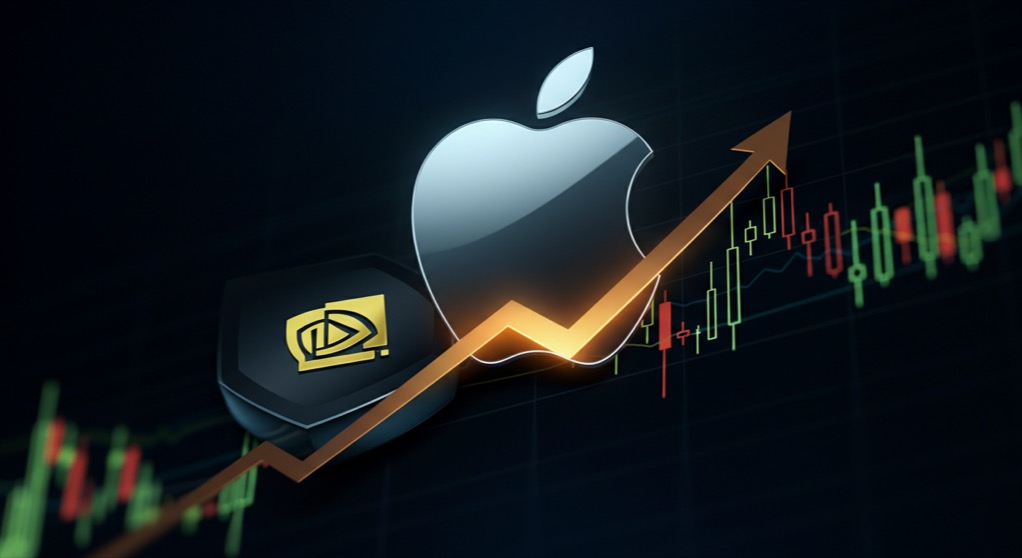
What does it take to topple a company that rode the AI chip boom from $360 billion to $5.5 trillion in under three years? For Apple, the answer was a combination of compounding services revenue, AI investment fatigue, and a single Chinese AI model launch that spooked the entire semiconductor sector. On July 17, 2026, Apple briefly surpassed Nvidia as the world's most valuable public company, with its market cap touching $4.88 trillion as Nvidia shares slid on mounting concerns about the sustainability of AI infrastructure spending.
The crown shift was confirmed by Reuters, Forbes, Bloomberg, and Yahoo Finance, with TradingView pegging Apple's exact market cap at $4.88 trillion at the moment of the overtake. While the gap has since fluctuated, the moment marks a symbolic end to Nvidia's uninterrupted reign as the AI era's undisputed king.
What Drove the Rotation Out of Nvidia
Nvidia's slide did not happen because the company lost its technological edge. Its Blackwell Ultra and Vera Rubin platforms remain the gold standard for AI training and inference, and its data center revenue continues to grow in absolute terms. The rotation is about sentiment and positioning, not fundamentals.
Three factors converged to create the selloff. First, China's Moonshot AI launched Kimi K3, a 2.8-trillion-parameter open-weight model that demonstrated competitive performance against GPT-5.6 and Claude Fable 5 on several benchmarks. The launch reignited fears that Chinese alternatives would compress pricing in the AI inference market, reducing the volume of high-margin Nvidia chips that hyperscalers need to deploy. Second, a growing chorus of analyst reports questioned whether the massive capital spending on AI data centers would generate commensurate returns. Companies like Microsoft, Google, and Amazon have committed hundreds of billions to AI infrastructure, but the revenue streams flowing back from AI products remain modest relative to the outlay. Third, the broader chip sector selloff that began in late June gathered momentum, dragging down AMD, Intel, and Nvidia alike.
Apple's Diversification Thesis Compounding
Apple's rise to the top is not driven by a single AI moonshot, but by the steady compounding of its services business. Apple's services revenue, which includes the App Store, Apple Music, iCloud, Apple TV+, and the rapidly growing advertising business, now accounts for over 25% of total revenue and carries gross margins above 70%. In markets like India, where iPhone adoption is accelerating rapidly, services revenue per user is growing at double-digit rates as users subscribe to Apple's ecosystem.
This diversification is precisely what makes Apple attractive in the current environment. As Nvidia's fate is tied almost entirely to the AI capex cycle, Apple's revenue spans consumer hardware, services, wearables, and an expanding finance arm with Apple Savings and Apple Pay Later. Investors are repricing companies with multiple revenue engines upward while penalizing single-bet thesis stocks. The iPhone 17 cycle, which launched in September 2025, has been one of the strongest upgrade cycles in years, driven by AI features built into the A19 chip. Even Apple's relatively quiet AI strategy, which has focused on on-device inference rather than datacenter-scale models, now looks prescient rather than conservative.
What the Crown Shift Means for AI Founders
For founders building in AI, this market rotation carries three concrete implications. First, the era of unlimited AI infrastructure funding is showing cracks. If the largest hyperscalers begin to scrutinize their AI ROI more carefully, the downstream effect will hit every startup that depends on cheap, abundant GPU compute. Founders should build efficiency into their cost models now, before the cycle turns further.
Second, the Kimi K3 effect cannot be ignored. A Chinese open-weight model spooking the world's most valuable semiconductor company is not an isolated event. It signals that the open-weight competition is real, and that pricing pressure on inference will continue to intensify. Startups that build their business models on exclusive access to frontier models face a structural headwind: the gap between closed and open models is narrowing, not widening.
Third, Apple's market cap milestone validates a strategy that many AI founders dismiss as too slow: building durable revenue streams around user ecosystems rather than chasing the hottest model release. Apple's $4.88 trillion cap is built on services revenue that compounds predictably, not on AI hype. For solo founders and small teams, the lesson is that customer retention and recurring revenue are better long-term bets than riding a single technological wave.
What Happens Next
The crown could shift again. Nvidia's July earnings call, expected in late August, will be the next major catalyst. If the company reports data center revenue above expectations and provides guidance that calms investor fears about Chinese competition and AI ROI, the stock could recover its losses quickly. Nvidia's GTC conference in September will also be closely watched for the MI400 competitive response and any updates on the Vera Rubin roadmap.
Apple, meanwhile, faces its own headwinds. The DOJ antitrust lawsuit continues to cast a shadow over the App Store business model, and iPhone replacement cycles in developed markets are lengthening. But for now, the message from the market is clear: AI is not the only game in town, and diversified business models are being rewarded. The $4.88 trillion moment is a reminder that the most valuable company in the world became so not by betting on a single technology, but by building a system of interlocking revenue streams that compound across hardware, software, and services.
For founders watching from the sidelines, the playbook is the same whether you are building a $10 million ARR SaaS product or a $100 billion company: diversify your revenue, build defensibility into your business model, and never let a single dependency define your valuation.