
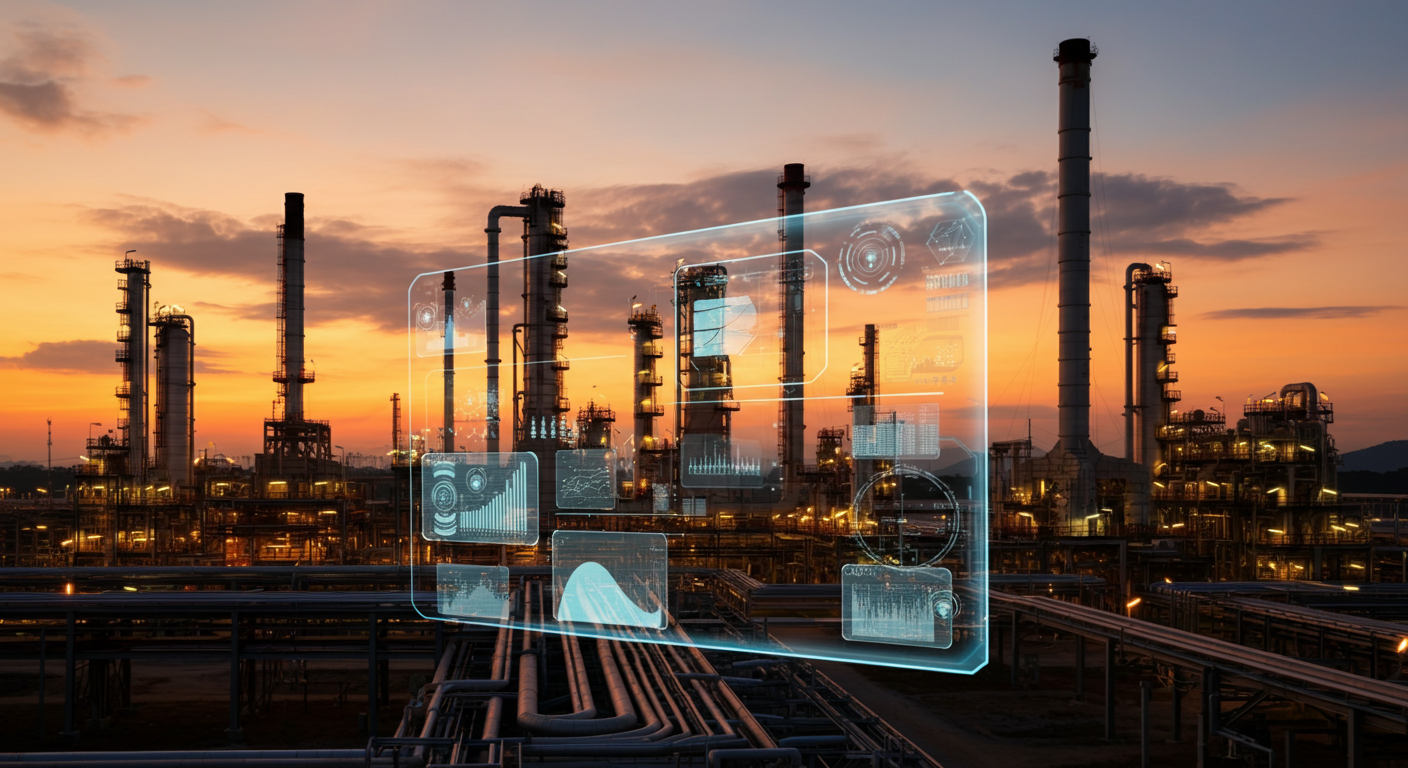
Oil and gas operators make critical decisions using less than 8 percent of the data their own sensors generate. That is the gap Applied Computing, a London-based startup founded in 2023, is trying to close with a $20 million Series A and a foundation model that does not predict the next word. It predicts the temperature, pressure, flow rate, and chemical state of an entire industrial plant.
The round was led by KBR, the engineering and construction giant that designs and operates many of the facilities Applied Computing hopes to optimize. Databricks Ventures also participated, a detail that matters more than the dollar amount because it reveals a broader strategic bet: Databricks sees industry-specific foundation models trained on proprietary operational data as the next wave of AI value creation, and it is positioning itself as the platform those models run on.
Applied Computing calls its model Orbital. It combines three distinct AI architectures: a time series model that learns from the thousands of sensors installed across oil, gas, and petrochemical facilities; a physics-based model that enforces the laws of thermodynamics, fluid dynamics, and chemistry; and a language model that reads engineering documentation, maintenance logs, and incident reports. The output is a unified prediction of the facility's current and near-future state, updated in real time as new sensor data streams in.
The Three-Model Architecture That Makes Orbital Different
Most industrial AI applications approach the problem one sensor at a time. A vibration model predicts when a pump will fail. A temperature model flags abnormal readings in a heat exchanger. These are useful, but they operate in isolation. Applied Computing's insight is that an oil and gas plant is a single interconnected system, and optimizing it requires a model that understands the whole thing at once.
Orbital's time series component ingests data from every sensor on the facility: temperature, pressure, velocity, viscosity, flow rate, chemical composition. That can be tens of thousands of data points per second. The physics-based model acts as a constraint layer, rejecting predictions that violate the laws of thermodynamics or fluid dynamics. If the time series model predicts a temperature spike that would require more energy than the system can physically deliver, the physics layer corrects it. The language model ties everything together by interpreting unstructured data incident reports, shift logs, engineering change orders that contain context the sensors cannot capture.
This multimodal architecture is not unique to Orbital. What is unique is that Applied Computing has packaged it as a foundation model purpose-built for one industry, rather than a general-purpose system that needs extensive customization at every deployment. The company claims this approach reduces the time to deployment from months to weeks, a claim worth watching as the product enters commercial use.
Why Databricks Ventures Invested in an Oil and Gas AI Startup
Databricks Ventures has been selective with its investments, backing companies that extend the reach of the Databricks data intelligence platform into new verticals. Applied Computing is a textbook fit: oil and gas operators generate enormous volumes of time series data, and most of it sits unused in historians and SCADA systems that were never designed for machine learning. Databricks wants to be the layer that ingests, stores, and serves that data to models like Orbital.
The investment also signals something larger. Databricks has watched the hyperscalers pour hundreds of billions into general-purpose AI infrastructure while a wave of vertical AI startups quietly builds models trained on proprietary data that the hyperscalers cannot replicate. An oil and gas foundation model requires access to years of sensor data from operating facilities, physics simulations, engineering blueprints, and safety records. No amount of internet-scale text scraping produces that dataset. Applied Computing's moat is not its architecture. It is the data required to train the model.
For founders building in other industrial verticals, this is the playbook. Identify an industry where less than 10 percent of available data is used for decision-making. Build a multi-modal foundation model that solves that specific problem. Partner with an industry incumbent for distribution and data access. KBR is not just an investor. It is a channel partner that can install Orbital across the facilities it designs and operates.
What This Means for Industrial AI Startups
The industrial sector represents one of the largest untapped opportunities in AI. Manufacturing, mining, logistics, energy, and agriculture all generate massive volumes of operational data that remain underutilized. The barriers have been clear: operational technology is fragmented and locked inside proprietary systems, industrial datasets are small by AI standards, and the cost of failure is high enough that operators are reluctant to trust black-box models.
What Applied Computing demonstrates is a path through those barriers. Instead of building a general model and trying to convince operators to trust it, the company built an industry-specific model with built-in physics constraints that operators recognize. The physics layer is not just a technical feature. It is a trust mechanism. When the model says a valve is about to fail, it can show the operator the thermodynamic calculation that led to that prediction.
The $20 million round is modest by AI funding standards, but the model it funds is ambitious. Applied Computing faces a long road: enterprise sales cycles in oil and gas run 12 to 18 months, and convincing operators to hand over control of critical processes to an AI model will take time and proof. But the direction is clear. Industrial AI is not about chatbots or code generation. It is about teaching machines to understand the physical world, and the companies that figure out how to do that safely and profitably will be among the most valuable businesses of the next decade.