
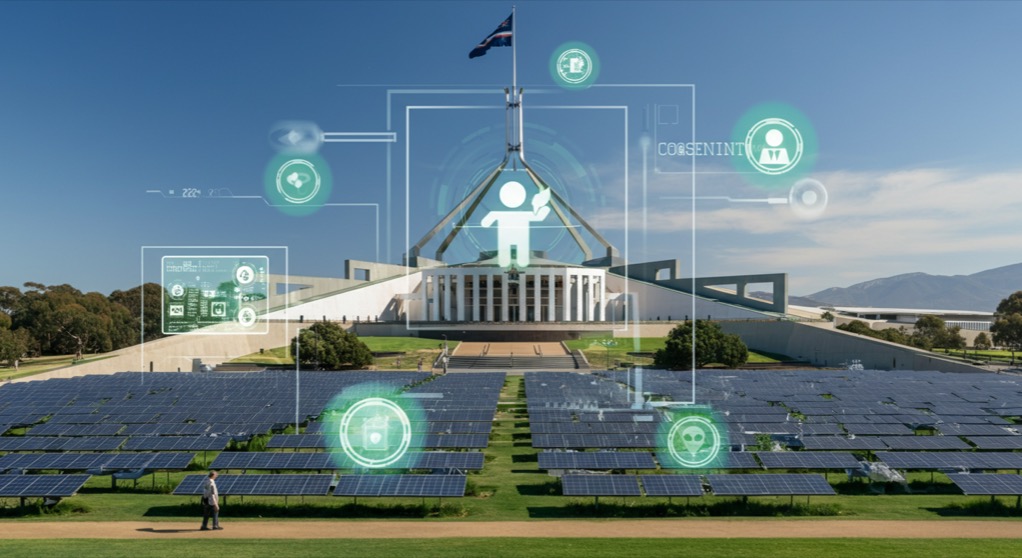
Australia just made two things simultaneously illegal: running an AI data center on fossil fuels without building equivalent renewable capacity, and training a model on Australian journalism without the creator's consent. No other country has attempted to regulate AI's physical footprint and its intellectual property footprint in a single bill. The framework, announced by Prime Minister Anthony Albanese's government on July 17, is the most comprehensive national AI regulatory package outside of the EU's AI Act. And it does something the EU did not: it directly ties AI compute to energy infrastructure.
What the Guardrails Actually Require
The policy has two independent but equally consequential components. First, any operator running AI data centers in Australia must match every megawatt of compute power consumption with an equivalent renewable energy capacity. This is not a voluntary pledge or a carbon credit scheme. It is a hard requirement: build the solar, wind, or battery storage, or do not operate at scale. Second, AI companies must obtain explicit consent before training on Australian creative works. This covers journalism, books, music, visual art, and broadcast content. The government has positioned this as a property rights issue rather than an innovation restriction, arguing that creators should share in the value their work generates when it becomes training data.
The timeline is aggressive. Data center operators have eighteen months to submit compliance plans and three years to reach full renewable matching. Creator protections took effect immediately. Penalties for noncompliance reach up to 5% of global annual revenue for the data center provisions, modeled on Australia's existing privacy fine structure. For the creator protection clause, individual creators can bring claims through a new AI Copyright Tribunal being established within the Australian Copyright Office.
Why the Dual-Pronged Approach Matters Globally
The genuinely novel aspect of Australia's policy is that it bundles environmental and IP regulation into a single framework. In the United States, data center energy use is regulated through state-level utility commissions and environmental review boards. AI training data is regulated through copyright lawsuits playing out in federal courts. They are treated as completely separate domains. Australia is saying they are connected: the same industry consuming massive amounts of energy is consuming massive amounts of creative labor, and both need guardrails.
This matters for founders outside of Australia because frameworks that work tend to be copied. The EU's AI Act took years to negotiate and is primarily concerned with risk classification and transparency. It does not mandate renewable matching or creator compensation. Australia's approach is faster, narrower, and more tangible. If it works and data centers still get built and models still get trained, other nations will study it closely. California, which already has aggressive renewable energy standards and is considering its own AI training data bills, is the most likely early adopter. India's booming data center industry and growing concerns about AI training on Indian creative works make it another candidate.
What This Means for AI Infrastructure Costs
The most immediate financial impact is on the cost of running AI infrastructure in Australia. Renewable energy matching adds a capital expenditure layer that does not exist in jurisdictions without the requirement. For a 100 MW data center, building equivalent solar or wind capacity costs between $80 million and $150 million depending on location and storage requirements. That is a 10% to 20% increase in total project cost for a typical hyperscale deployment. Some operators may choose to serve the Australian market from data centers in New Zealand, Singapore, or Southeast Asia instead. But that introduces latency and data sovereignty issues, particularly for industries like finance and healthcare that face their own local data storage requirements.
For Indian SaaS companies serving Australian customers, the cost impact is indirect but real. If your cloud provider passes through Australian energy compliance costs, your infrastructure bill goes up. If your provider opts to serve Australia from outside the country, your latency and data residency compliance become more complex. For Indian AI startups specifically, this is a signal worth watching. India's data center capacity is projected to grow from 950 MW in 2025 to over 4,000 MW by 2030. If India follows Australia's lead and imposes renewable matching requirements, the cost structure for Indian AI inference and training shifts significantly.
The creator protection clause has a different kind of financial impact. AI companies that train on Australian content face either a licensing cost (negotiating with publishers, music labels, and visual artists' collectives) or a scrubbing cost (removing Australian content from training datasets). Neither is trivial. For a company training a frontier model on a corpus the size of Common Crawl, identifying and removing Australian-specific content is a classification problem that requires its own engineering investment. And if this becomes the global norm rather than the Australian exception, training data assembly becomes a per-jurisdiction licensing exercise rather than a scrape-first-ask-questions-later process.
What Founders Need to Do
If you operate data center infrastructure or serve the Australian market, the timeline is clear: eighteen months to a compliance plan, three years to full implementation. Begin the audit of your current energy sourcing now rather than waiting for the deadline. If you are building an AI training pipeline that might include Australian content, you have two options: negotiate a licensing framework with the Australian Publishers Association and the music industry bodies, or implement a geographic content filter that excludes Australian-sourced training material. The second option is faster but limits model performance on Australian English and cultural context.
For founders not directly exposed to Australia, the lesson is preparatory. The dual-pronged framework is likely to appear in other jurisdictions within the next twelve to eighteen months. California's legislative session in 2027 is the most proximate venue. If you are an AI founder, build compliance flexibility into your infrastructure and data sourcing strategy now. The cost of adding renewable matching capability or content filtering after the regulation passes is higher than building it in from the start. Australia has drawn a line in the sand. The rest of the world is watching to see whether that line holds, and how much it costs to stay on the right side of it.