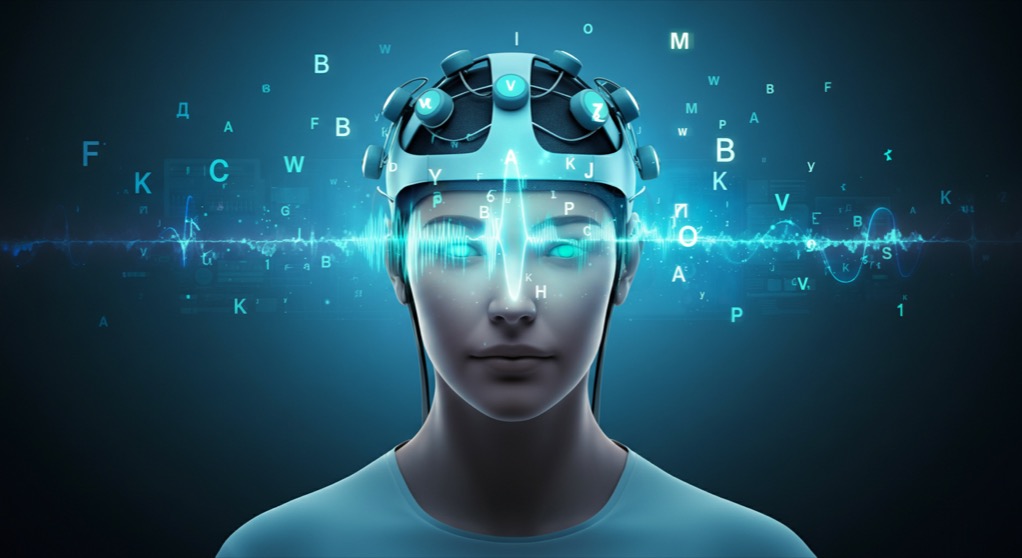
What if restoring communication for people with paralysis required no more than wearing a cap filled with sensors? Meta AI researchers just published a result in Nature Neuroscience that makes that question worth taking seriously. Brain2Qwerty v2, the latest iteration of Meta's non-invasive brain-computer interface, achieves 61% word accuracy across all participants and 78% for the best user decoding sentences directly from brain activity without any surgical implant. That is up from 8% in the v1 baseline. The team trained the system on 22,000 sentences from nine volunteers, each recorded for 10 hours while wearing a magnetoencephalography (MEG) device and typing normally. They are also releasing the full training code open-source, along with a data release from their partner at the Basque Center on Cognition, Brain, and Language (BCBL). For founders building in health tech, assistive technology, or human-AI interaction, this is the most important non-invasive BCI paper of 2026.
The Architecture: End-to-End Deep Learning From Raw Brain Signals
Previous non-invasive BCI systems relied on hand-crafted pipelines that detected specific neural events, like the readiness potential before a finger movement, and mapped them to discrete actions. Brain2Qwerty v2 discards that approach entirely. Instead, it feeds raw MEG signals directly into an end-to-end deep neural network that learns to decode the brain activity associated with typing each character. The architecture then fine-tunes a large language model on top of the neural decoder, allowing the system to leverage semantic context to fill in gaps when the brain signal is noisy. This matters because MEG signals are weak. A surgical implant like stereotactic EEG can place electrodes directly on the brain surface, picking up clean, high-resolution signals. A non-invasive MEG cap measures the magnetic fields produced by neural activity through the skull and scalp, which attenuates and distorts the signal significantly. The end-to-end approach with LLM fine-tuning is what makes the difference: the model learns to combine noisy neural patterns with linguistic priors about what words and sentences are likely.
What the Results Mean: From 8% to 61% Is a Step Change
The numbers tell the story of a technology crossing a threshold. Brain2Qwerty v1 achieved 8% word accuracy. That was barely above chance for any practical communication scenario. V2 hits 61% across all nine participants, with the best performer reaching 78% and more than half of all sentences decoded with one word error or less. For context, invasive BCI systems like the BrainGate clinical trials typically achieve 90%+ character accuracy, but they require patients to undergo brain surgery and have electrodes implanted for months or years. The non-invasive approach cannot match that today, but the trajectory is what matters. The paper also shows that decoding accuracy improves log-linearly with data volume. Every doubling of training data produces a predictable accuracy gain. That suggests the gap with surgical approaches could be narrowed through scaling alone, without requiring a fundamental algorithmic breakthrough.
Why Meta Is Open-Sourcing This
Meta's decision to release the full training code for both Brain2Qwerty v1 and v2 is strategic. The company has established a $5 million fund to stimulate open datasets in neuroscience and is building foundational models of the brain as a long-term platform play. By open-sourcing the BCI pipeline, Meta positions itself as the infrastructure layer for non-invasive neurotechnology research, similar to how PyTorch became the default framework for deep learning research. If the broader neuroscience community standardizes on Meta's codebase and data formats, the company gains a structural advantage in recruiting talent, shaping research directions, and ultimately commercializing neurotechnology products down the line. For founders, this means the barrier to entering BCI research just dropped significantly. A PhD student with access to a MEG lab can now start from a working pipeline that achieves state-of-the-art results, rather than building everything from scratch.
What This Means for Builders
Three implications stand out. First, non-invasive BCI is approaching practical utility for assistive communication. The 78% best-user accuracy means that for some patients, Brain2Qwerty v2 could already enable communication at a rate that changes quality of life, especially when combined with word prediction and error correction. Second, the log-linear scaling property creates a clear roadmap: collect more high-quality MEG data, and accuracy will continue to improve. This is an infrastructure play where early investment in data collection creates compounding advantages. Third, the intersection of BCI and foundation models is fertile ground. The paper shows that fine-tuning LLMs on neural data works surprisingly well. That opens the door to decoding not just typing but potentially imagined speech, visual imagery, or high-level intent directly from non-invasive recordings. The open-source release means the next breakthrough might come from a startup rather than a lab. Meta just lit a fuse in neurotechnology. The question for founders is what to build at the other end.