
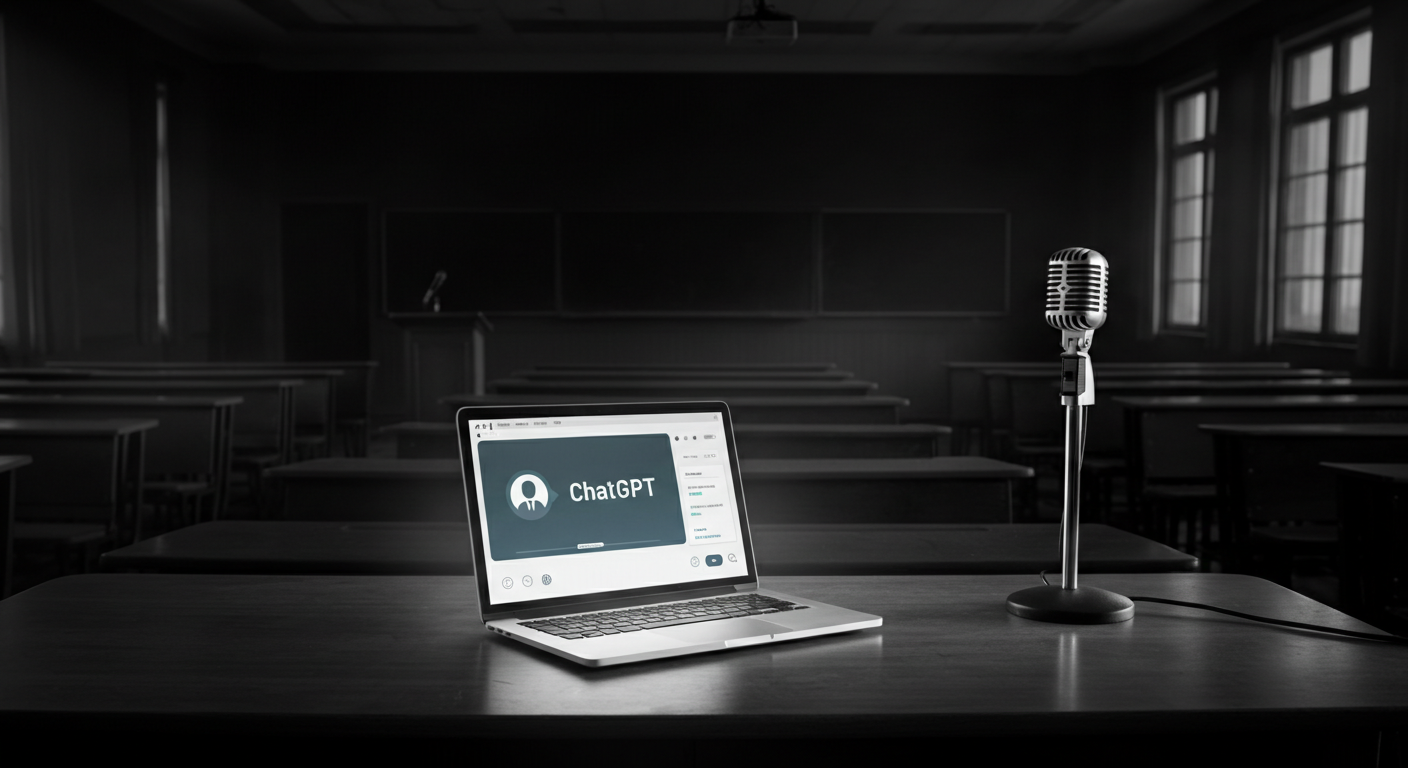
When a room of two hundred OpenAI engineers fell silent after a novelist told them they had "silenced an entire generation," something shifted in the conversation about artificial intelligence that no benchmark or model card had captured. Dave Eggers, the author behind The Circle and the founder of the indie publishing house McSweeney's, stood before the people building the most adopted writing tool in human history and argued that their creation had hollowed out the cognitive development of students. That silence, reported later by the Financial Times, is perhaps the most honest user feedback OpenAI has ever received.
The literary world has long watched Silicon Valley with suspicion, but Eggers' intervention was different. It was not a lawsuit or a polemic in a magazine. It was a direct address to the builders, and it exposed a fault line that product teams ignore at their peril. This is not merely about copyright or stolen prose. It is about what happens to the human mind when the struggle of writing is outsourced to an autocomplete engine.
The Performative Writing Crisis in Classrooms
Eggers' central claim is deceptively simple. Students using ChatGPT are not learning to write. They are learning to perform writing for a machine. He describes student output as "performative," meaning young people optimize their language for what they believe the model expects rather than wrestling with the messy, uncertain process of finding their own voice. This is a subtle but catastrophic shift. Writing has always been the laboratory where thinking gets formed. When a student stares at a blank page, the discomfort they feel is the friction of cognition. Remove that friction and you remove the rep.
Educators are reporting what Eggers calls a "catastrophic" effect on their professional lives. Teachers who once read essays to understand how a student's mind works now receive text that reveals nothing about the human behind it. The labor of grading has not disappeared, but its meaning has. Instead of assessing thought, instructors police provenance. The classroom, historically a space for intellectual risk, has become a surveillance standoff between detector and generator.
The broader cultural implication is that a generation may reach adulthood with fluent syntax and absent introspection. If you never have to choose your words, you never have to choose your thoughts. The literary establishment, from McSweeney's to university writing programs, is beginning to treat this as a civic emergency rather than a pedagogical nuisance.
Why the OpenAI Room Went Quiet
The detail that the audience of two hundred OpenAI staffers fell silent is the most telling part of the Financial Times report. These are not naive actors. They understand transformers and token probabilities. Yet a novelist with no engineering background managed to produce a reaction that roadmaps and evals could not. The silence suggests that even the builders harbor doubt about the societal residue of their work.
For years, the AI industry has defended itself with utilitarianism. Tools that summarize and draft save time, therefore they are good. Eggers punctured that logic by naming a cost that does not appear in a productivity metric. He implied that the company's flagship product, used by tens of millions, might be degrading the very capability (clear written thought) that makes its user base valuable. When the people shipping the model cannot respond to that, it reveals a gap between technical confidence and cultural comprehension.
This moment also reflects a wider pattern. The builders of social media were similarly silent when critics described attention extraction. The literary rebellion led by figures like Eggers is early signal data. It tells us that the next regulatory and market pressure will not come from IP holders alone, but from educators, parents, and writers who see cognitive atrophy as a measurable harm.
Writing As The Engine Of Thought
The phrase "writing is thinking" sounds like a bumper sticker, but cognitive science supports it. The act of composing sentences forces the brain to impose structure on diffuse feeling. When AI completes the sentence, the user skips the structuring. Over years of schooling, that skipped repetition is precisely the reps that build a mind capable of independent analysis.
Eggers, through McSweeney's, built a career on the opposite value. His publishing house celebrates awkward, specific, human voices. The Circle, his novel adapted with Emma Watson and Tom Hanks, warned about tech systems that flatten individuality for the sake of seamless interaction. His speech to OpenAI is the nonfiction echo of that fiction. The surveillance dystopia he imagined was not only about cameras. It was about a world where people stop generating inner life because the interface generates it for them.
If students cease to think through writing, the downstream effects touch democracy, innovation, and mental health. Citizens who cannot articulate a position are easier to manipulate. Founders who cannot reason on paper are weaker at product strategy. The cost is not sentimental. It is infrastructural.
The Limits Of The Literary Rebellion
It would be naive to assume Eggers' speech will change OpenAI's roadmap. The company operates inside competitive and capital pressures that a silent room cannot undo. Moreover, the rebellion from authors and publishers has sometimes been self interested, focused on royalty protection rather than pedagogy. The literary establishment's pushback risks being read as nostalgia if it offers no constructive path.
Yet the cultural backlash has real teeth because it aligns with parent anxiety and school district bans. When districts block ChatGPT on networks, they are not protecting copyright. They are protecting cognitive formation. The rebellion's power is in reframing AI not as a theft problem but as a developmental one. That frame is harder for vendors to dismiss because it speaks to outcomes everyone claims to want: capable, original humans.
The challenge for critics is to avoid pure negation. If the answer is simply "ban the tool," they will lose to inevitability. The more durable position is to demand AI that makes the struggle visible, that withholds the easy answer, that teaches rather than replaces. This is where the literary world and the product world can find uneasy common ground.
What this means for builders
For AI founders and product teams, the Eggers episode is a brief from the field. First, assume that raw generation tools will face growing resistance in education unless they are redesigned for pedagogy. There is white space for AI native tools that teach with AI, showing students where their reasoning weakened instead of handing them a finished paragraph. Second, measure your product's impact on user capability over time, not just engagement. A writing tool that makes users worse at writing is a liability waiting for a lawsuit or a ban.
Third, the silence in that OpenAI room is a reminder to build feedback loops with critics who are not in your Slack. Novelists, teachers, and philosophers see downstream effects that eval sets miss. Invite them in before the Financial Times does. Finally, recognize that the cultural story about your product is part of the product. If the narrative becomes "it silences generations," no context window will save your retention in schools.
The literary rebellion is not going away. It is maturing from outrage to design critique. Builders who listen now can ship the tools that survive the backlash. Those who wait for the room to empty will find the next speech is given under subpoena.