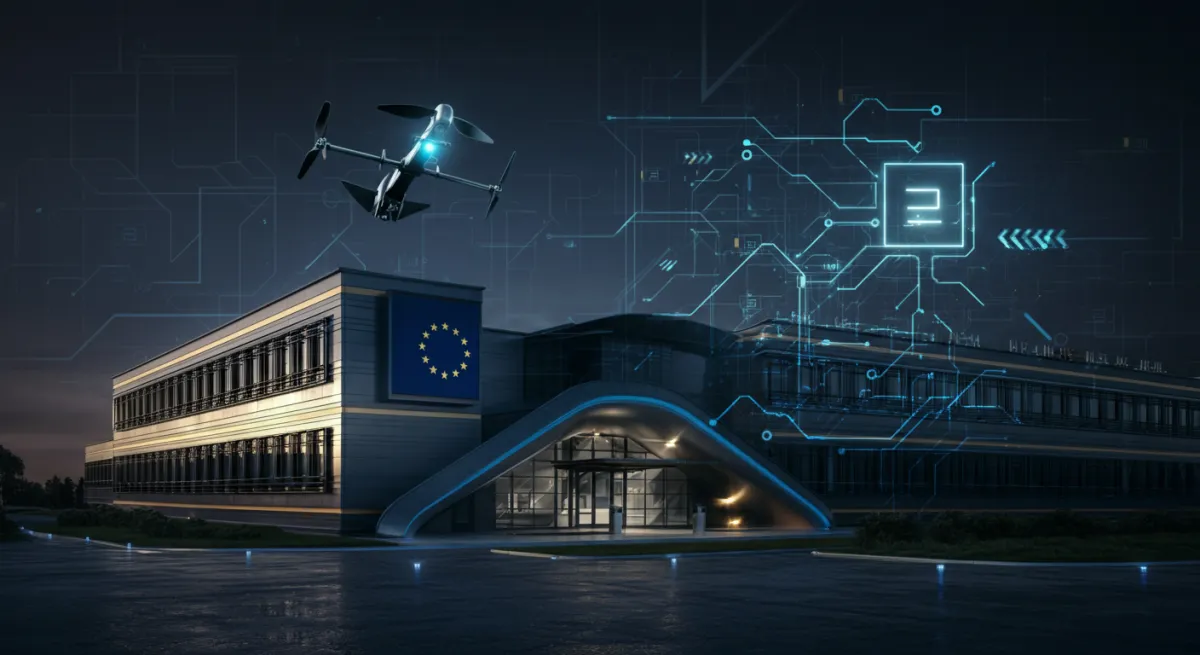
Helsing raised $1.8 billion in a single funding round at an $18 billion valuation. Those two numbers would be remarkable for any AI company in 2026. What makes them genuinely surprising is that they belong to a defense contractor based in Munich, not a consumer AI chatbot or an enterprise SaaS platform. Founded in 2021 by Torsten Reil, Gundbert Scherf, and Niklas Kohler, Helsing has grown from a small software team working on AI for military sensors to a full-spectrum defense technology company with 900 employees, its own drone production line, and a subsidiary in Grob Aircraft. This Series E vaults Helsing into the same fundraising tier as OpenAI and Anthropic, and it positions defense AI as one of the most capital-attractive sectors in technology today.
The $1.8 Billion Round and What It Buys
The Series E values Helsing at nearly triple its previous valuation of around $6 billion from its 2024 Series D. The company has now raised over $3 billion in total since inception, a staggering sum for a company that was barely known outside European defense circles three years ago. The round was led by a consortium of sovereign wealth funds and large institutional investors, with participation from existing backers including Daniel Ek, the Spotify founder who serves as Helsing's chairman. The capital is earmarked for three things: scaling production of Helsing's HX-2 strike drone and HF-1 aerial systems, expanding its underwater surveillance capabilities through the Fathom and SG-1 platforms, and hiring AI researchers to improve the core software that processes sensor data in real time for battlefield decision-making.
Helsing's product lineup has expanded significantly beyond its original software-only approach. The company now builds physical hardware including military drones and underwater surveillance systems. Its acquisition of Grob Aircraft, a German aerospace manufacturer, gave it production capacity that pure software companies lack. This hardware-plus-software strategy mirrors the approach of Anduril, the US defense AI company valued at over $28 billion, and it signals that Helsing is positioning itself as a prime contractor rather than a subcontractor that sells software modules to existing defense primes like Rheinmetall or Airbus.
Why Defense AI Is Attracting Record Capital
The Helsing round is not happening in isolation. Global defense spending has reached new highs in 2026, driven by ongoing conflicts in Ukraine and shifting geopolitical alignments in Europe and the Indo-Pacific. Governments that once treated AI as an experimental add-on to military hardware are now mandating AI capabilities as a core requirement in new defense contracts. Helsing's software, which analyzes sensor data from drones, radar, and satellite imagery to provide real-time battlefield intelligence, addresses a specific and urgent need: human operators are overwhelmed by the volume of data generated by modern surveillance systems, and AI is the only viable filter.
The shift from experimental to operational is the single most important factor driving valuations in defense AI. Helsing's HF-1 drone and HX-2 strike drone are not prototypes. They are being deployed and used in active theaters. Having real battlefield data to train its models gives Helsing a compounding advantage that would-be competitors cannot easily replicate. Every mission generates more data, which improves the models, which makes the hardware more effective, which wins more contracts. This flywheel is what investors are betting on when they assign an $18 billion valuation to a company that was founded five years ago.
What the Raise Means for Founders
For founders building in defense, security, or government technology, Helsing's raise sends three clear signals. First, the capital is available. There was a time when defense tech was considered too risky, too regulated, and too slow-moving for venture capital. That narrative has collapsed. Sovereign wealth funds, pension funds, and large institutional investors are writing nine-figure checks to defense AI companies because they see government procurement as the most predictable revenue model in technology. Governments do not disappear. Defense budgets do not shrink in a crisis.
Second, the hardware-software hybrid model is winning. Pure software defense companies that sell modules to primes face margin compression and long sales cycles. Companies that control their own hardware production, like Helsing with its Grob Aircraft acquisition and Anduril with its Arsenal production facility, capture more of the value chain and build moats that software-only competitors cannot cross. Founders should be thinking about how to integrate hardware into their defense AI strategy from the start, not as an afterthought.
Third, Europe is serious. For years, the narrative was that European defense tech could not compete with American companies because European government procurement was too fragmented and too slow. Helsing has disproven that. It has won contracts with multiple European governments, scaled to 900 employees, and raised capital at a valuation that puts it in the same conversation as the largest US defense tech companies. The lesson is that a focused strategy targeting European defense needs, combined with real hardware production capability, can work at the highest level.
What Happens Next
The $1.8 billion round gives Helsing a multi-year runway to scale production, hire aggressively, and pursue additional contracts across Europe and potentially in allied markets outside the continent. The company's biggest challenge is not financial but operational: scaling hardware production from hundreds to thousands of units while maintaining quality and meeting delivery timelines that governments demand. Anduril faced similar scaling challenges in the US and solved them through its Arsenal production facility. Helsing will need to build equivalent production capacity in Europe, where the defense supply chain is less developed.
Helsing's raise also raises the bar for every other defense AI startup. Valuations across the sector will be benchmarked against this round. Competitors seeking Series B or C funding will need to show production contracts, not just pilot programs. And investors who were on the fence about defense AI will now treat it as a validated category alongside enterprise AI and autonomous systems. For founders, the window is wide open, but the entry requirements just got higher.