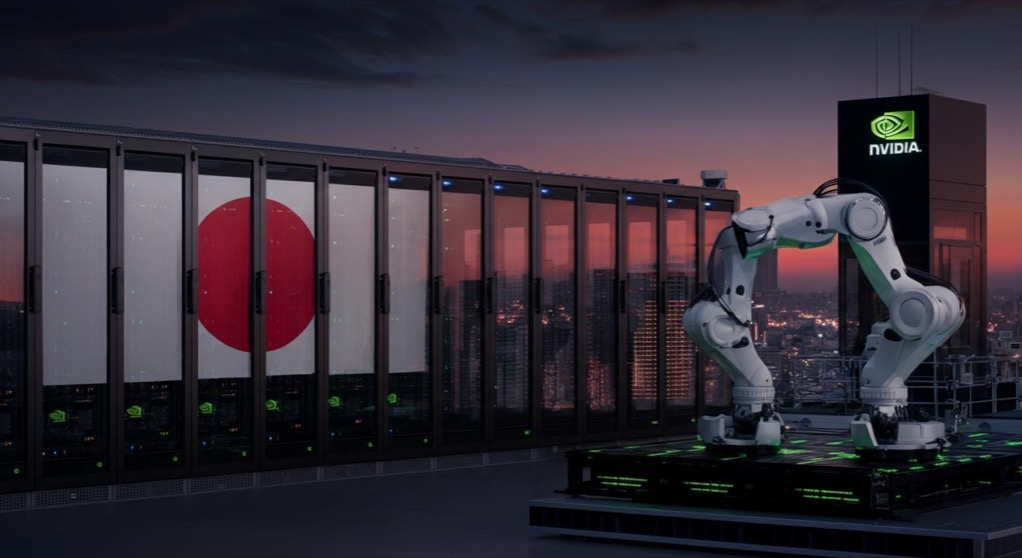
What happens when a government treats AI infrastructure the way it treats national railways? Japan just gave us the answer. On July 16, the Japanese government and Nvidia unveiled FRONTia, the world's first national AI infrastructure project, backed by approximately $2.4 billion from Japan's Ministry of Economy, Trade and Industry. The project will be built by Noetra Corp. and powered by 27,500 Nvidia Rubin GPUs paired with 13,750 Vera CPUs, drawing 140 megawatts of power. This is not a cloud region. This is a national AI factory, purpose-built to develop open multimodal foundation models for robotics, digital twins, and intelligent manufacturing.
Nvidia founder Jensen Huang, who traveled to Japan for the announcement, framed the moment in characteristically sweeping terms. The next frontier of AI is the physical world, and Japan, the country that invented modern manufacturing, is now building the AI factories for the next industrial revolution. The scale of the bet is hard to overstate: Japan is targeting more than 30% of the global AI robotics market by 2040, a prize Nvidia and its partners value at $133 billion. For founders building physical AI products, this is the single most important infrastructure story of 2026.
The FRONTia Project: A National AI Railroad
The FRONTia project represents a new category of AI investment: sovereign AI infrastructure modeled after national railroad grids. Unlike cloud regions operated by AWS, Azure, or Google Cloud, FRONTia is purpose-built for physical AI workloads. Its mandate is not general-purpose cloud compute but the development of open multimodal foundation models specifically for robotics, digital twins, and intelligent manufacturing. The project draws 140 megawatts, roughly equivalent to a small city, all dedicated to a single national AI factory. For comparison, ChatGPT reportedly uses around 1 gigawatt-hour per day across all of OpenAI's infrastructure. FRONTia concentrates roughly the same order of magnitude of compute into a single national asset. The $2.4 billion commitment from Japan's METI signals something important: sovereign AI is no longer a theoretical concept. It is a funded, built, and operational reality. Other nations are now faced with a choice: build your own or rely on someone else's. Japan chose the former.
Cosmos 3 Edge: Physical AI That Runs on Devices, Not in Data Centers
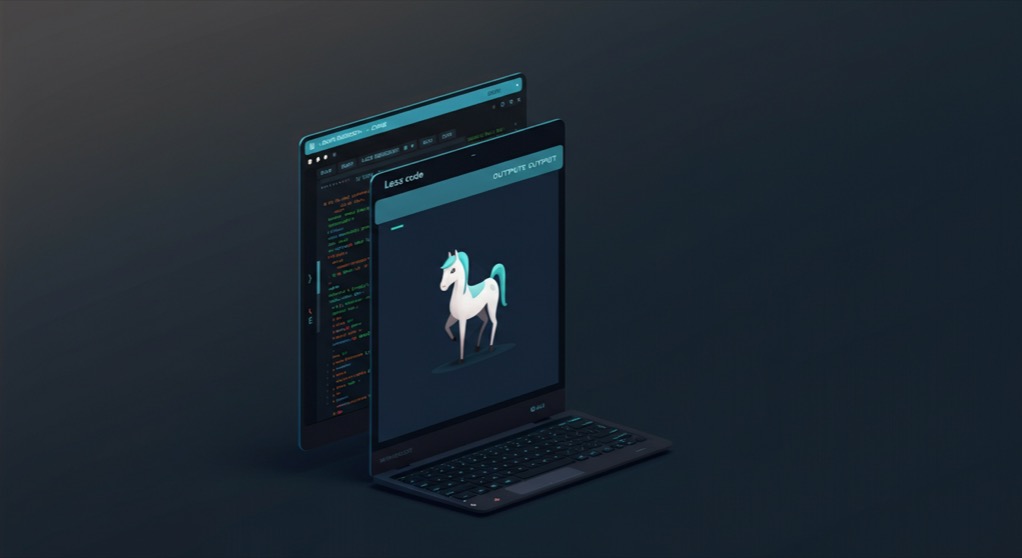
Alongside FRONTia, Nvidia launched Cosmos 3 Edge, a compact 4-billion parameter world model built on the Nemotron architecture. Cosmos 3 Edge is engineered to run vision reasoning and robot control directly on edge devices. It generates robot policies and can be adapted to specific robots, vehicles, and sensors in about a day. This is a meaningful architectural shift. Most physical AI models today run inference in the cloud or on high-end datacenter hardware, introducing latency and connectivity dependencies that limit real-world deployment. Cosmos 3 Edge runs on Nvidia's Jetson platform, including the newly announced T2000 and T3000 modules, as well as RTX GPUs and DGX systems. It offers on-device vision reasoning and generates robot policies without requiring a round trip to the cloud.
More than 20 Japanese companies have signed on to the Nvidia Cosmos Coalition, including FANUC, Yaskawa Electric, Kawasaki Heavy Industries, Fujitsu, Hitachi, NEC, SoftBank, Sony, Honda R&D, and Toyota-backed Preferred Networks. Fujitsu is already building a collaborative control platform that connects FANUC, Yaskawa, and Kawasaki robots. The breadth of participation signals that Japan's industrial base is treating AI not as an experimental technology but as an operational requirement. Nvidia also rolled out new Metropolis libraries that let developers build and operate Cosmos-based video intelligence systems at least six times faster, using coding agents for training and deployment.
What This Means for Founders Building Physical AI
The FRONTia project changes the competitive landscape for physical AI startups in three specific ways. First, it validates physical AI as a serious infrastructure category. Foundation models for robotics and digital twins are now receiving government-scale investment, which means the technology readiness level is no longer in question. Second, it creates a national reference architecture: open multimodal foundation models trained on sovereign infrastructure. Startups building on FRONTia's open models will have a cost and compliance advantage over those relying on general-purpose cloud AI, especially for Japanese or Asian market deployments. Third, it raises the question of which country is next. If Japan can mobilize $2.4 billion for national AI infrastructure, what happens when South Korea, Germany, India, or Saudi Arabia follow suit? India's national AI mission, at roughly $1.2 billion, looks small by comparison.
For founders building physical AI products, the Cosmos 3 Edge launch is equally significant. The ability to run world models on edge hardware rather than in the cloud fundamentally changes the economics of robot deployment. A factory that deploys 1,000 robots does not want to stream 1,000 video feeds to a cloud endpoint every second. On-device inference at a 4-billion parameter scale, adapted to specific hardware in a day, makes physical AI deployment practical where it was previously theoretical. The FRONTia project and Cosmos 3 Edge represent two sides of the same coin: centralized national compute for training foundation models, and distributed edge compute for running them where they are needed. Japan is building both, and the rest of the world will be watching closely.