
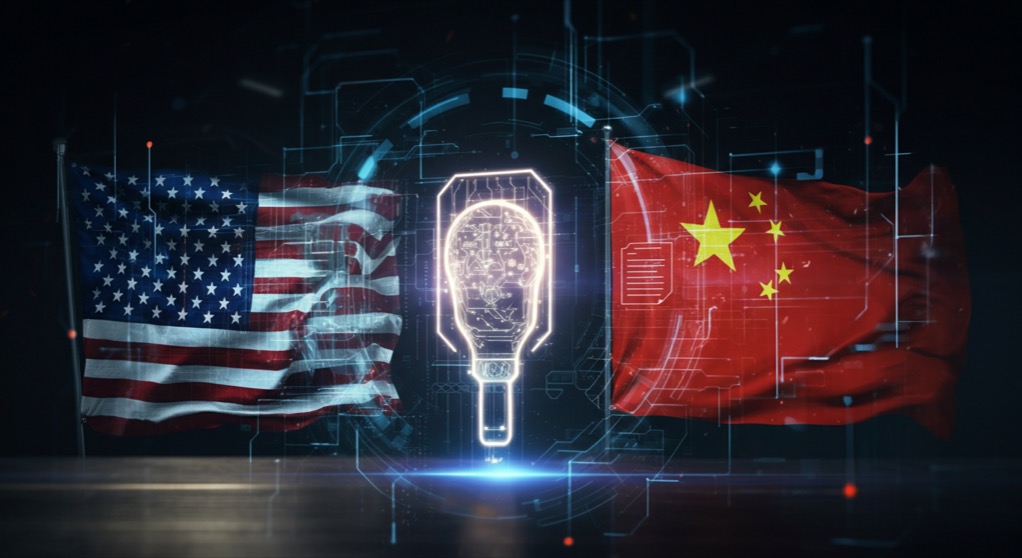
The question landed like a grenade in US AI policy circles this week: is Moonshot AI's Kimi K3, an open-weight model that rivals frontier proprietary systems, a national security threat or just another competitor? The answer may determine whether the next generation of AI startups build their products on Chinese open-weight models, American closed models, or something in between. TechCrunch's Anthony Ha synthesized reactions from four influential voices, and the range of positions reveals a policy landscape more fractured than any single narrative suggests.
Moonshot AI, a Beijing-based startup valued at over $3 billion, released Kimi K3 as an open-weight model this week. The model's performance benchmarks place it within striking distance of GPT-4.5 and Claude 4 Opus on several reasoning and coding tasks, making it the strongest open-weight alternative to come out of China to date. That technical achievement has kicked off a political firestorm that has little to do with the model's actual capabilities and everything to do with what it represents.
The Four Positions Shaping the Debate
David Sacks, the former White House AI czar, delivered what might be the most pointed critique of US regulatory strategy. His argument is simple: the US is tying itself in knots with regulations while China advances. He pointed specifically to data center permitting bans, a growing stack of state-level AI regulations, and the push for a new federal pre-approval agency as evidence that America is regulating itself into second place. Sacks's position is less about Kimi K3 specifically and more about the strategic asymmetry he sees developing. If the US has 50 state regulators and a federal agency reviewing model releases while China has a central government actively subsidizing AI development, the outcome is not in doubt, he argues.
Dean Ball, writing under his role at OpenAI, introduced a frame that immediately polarized the conversation. He argued that open-weight models from state-aligned Chinese companies could lead to what he termed 'full AI communism,' where AI becomes state-provided digital public infrastructure. Ball's proposed response is unconventional: he suggested the US should create 'regulatory risk' around Chinese open-weight models through soft law mechanisms, essentially generating uncertainty in regulated enterprises about the compliance implications of using Chinese models. The goal would be to create FUD fear, uncertainty, and doubt in corporate procurement departments without formal legislation.
Travis Kalanick took the most operational stance. The former Uber CEO and current AI startup founder called for enforced distillation rules that would prevent Chinese models from being trained on outputs from US frontier systems. His framing is direct: without such protections, American models have one arm tied behind their backs because open-weight Chinese models can freely distill from closed US systems while maintaining their own model weights as a secret. Kalanick's position reflects the practical concern of competitive asymmetry in model development.
Shakeel Hashim, editor of Transformer, offered a counterpoint that cuts against all three. He argued that the security risk is overstated since Kimi K3 likely does not have dangerous cyber capabilities, and that China faces similar incentives to restrict its own open models. Hashim's intervention is important because it reminds the debate that the threat model needs to be specific, not general. Not every Chinese AI model is a weapon, and not every open-weight release is a national security incident.
Why This Debate Matters for Founders
For anyone building on AI, this is not academic. The outcome of the Kimi K3 debate will determine which models are available to US-based companies, what compliance obligations come with using Chinese open-weight models, and whether the model ecosystem fragments along geopolitical lines. The stakes are highest for three groups of founders.
Founders building on open-weight models directly face the most immediate exposure. If the US creates regulatory risk around Chinese open-weight models as Ball proposes, enterprise customers will avoid them regardless of their technical merits. Procurement teams hate ambiguity. A company that has built its product on Kimi K3 or a similar model could find its customer base evaporating overnight if regulatory guidance brands those models as risky.
Infrastructure and platform companies face a different but equally serious risk. If the model market splinters into approved and unapproved categories, the companies that can seamlessly swap between models will have a structural advantage over those tied to a single ecosystem. This is why model-agnostic deployment layers like OpenRouter, Together AI, and Fireworks AI become more valuable in a fragmented world.
Enterprise AI builders face the most subtle challenge. If large companies default to 'no Chinese models' as a procurement policy, the entire ecosystem of open-weight models becomes de facto segmented. An Indian startup building on a Chinese model might produce the best product, but a US enterprise can't buy it. That creates arbitrage opportunities for model-agnostic middleware and evaluation layers.
What Founders Need to Do
Here is a practical checklist for navigating the uncertainty around open-weight model regulation.
First, build abstraction layers into your stack now. If your application depends on a specific model's weights, you are locked in. If you use a model router or API gateway that allows swapping, you can react to regulatory changes without rewriting your application. This is cheap insurance.
Second, watch the soft law signals, not just the legislation. Ball's proposal to create regulatory risk without formal regulation is the most likely near-term outcome. That means paying attention to statements from the White House AI council, SEC guidance on AI risk disclosures, and NIST framework updates. These signals will move faster than legislation and will determine enterprise behavior.
Third, run a compliance audit on your model supply chain. If you are using any open-weight model, document where it came from, what data it was trained on, and what your fallback is if access is restricted. The companies that can answer these questions immediately will have a competitive advantage when regulatory scrutiny arrives.
The Kimi K3 debate is not about one model. It is about whether the future of AI will be open-weight and globally accessible or balkanized along geopolitical lines. Founders should plan for the latter while hoping for the former, because the companies that build model-agnostic infrastructure today will be the ones that survive whatever regulatory regime arrives tomorrow.