
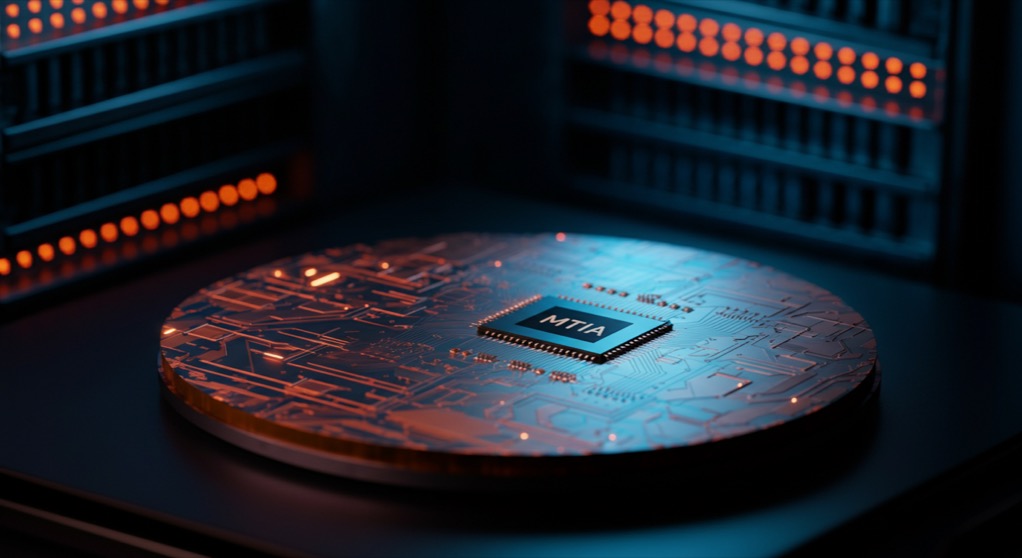
What does it take for a company spending tens of billions on Nvidia GPUs to start saying no? Meta just gave the clearest answer yet. The company unveiled four new generations of its custom MTIA chips (the 300, 400, 450, and 500) developed in partnership with Broadcom, targeting production in September 2026. The announcement is not a side project. It is a structural shift in how Meta plans to power its AI infrastructure, and it signals where the entire hyperscale AI market is heading.
The MTIA lineup splits into two distinct families. The MTIA 300 and 400 are built for generative AI inference: powering Meta AI chatbots, Llama model serving, and AI features across Facebook, Instagram, and WhatsApp. The MTIA 450 and 500 target the ranking and recommendation workloads that drive Meta's core business: content feeds, ad targeting, and Reels recommendations. This split is telling. Meta is not building one chip to rule them all. It is building purpose-built silicon for the two most compute-intensive categories in its infrastructure, acknowledging that inference and recommendation systems have fundamentally different performance profiles.
Why Meta Is Building Chips Instead of Buying Them
Meta's custom silicon strategy did not emerge overnight. The company has been investing in in-house chip design since at least 2022, when it first announced the MTIA program. But the scale of the current ramp is new. Meta projects it will double its AI compute capacity over the next two years, and buying Nvidia GPUs to cover that entire increase would create both a supply chain bottleneck and a cost structure that is difficult to sustain. Custom chips are not free to design (Broadcom's custom silicon services and tape-out costs run into the hundreds of millions), but at Meta's scale, the per-unit savings on inference and recommendation compute add up faster than most companies can calculate.
The Broadcom partnership is itself a strategic signal. Broadcom has been quietly building a custom AI chip business that now competes directly with Marvell and, increasingly, with the idea of buying merchant silicon from Nvidia or AMD. Broadcom's custom ASIC division worked with Google on its TPU generations and with Apple on various chips. Partnering with Meta positions Broadcom as the go-to custom silicon designer for hyperscale AI: a market that is growing faster than the merchant GPU market and that has far fewer players.
Meta is far from alone in this pivot. Google built its TPU line to handle both training and inference for its own models, cutting Nvidia out of the loop entirely for workloads like search ranking and YouTube recommendations. Amazon develops Trainium and Inferentia chips for AWS customers, quietly making its own infrastructure less dependent on Nvidia supply. Microsoft unveiled the Maia 100 AI accelerator in 2024 and has continued investing in custom silicon for Azure. The pattern is consistent across every hyperscaler: build your own chips for the workloads you understand best, and reserve Nvidia's H100s and B200s for frontier training where the ecosystem moat is deepest.
What the Chip Specs Tell Us About Meta's AI Roadmap
The decision to build separate chip families for GenAI inference and recommendation workloads reveals more about Meta's internal architecture than any public earnings call. GenAI inference (running models like Llama 4 for chat, image generation, and assistant features) demands high memory bandwidth, low latency per token, and the ability to handle variable-length sequences efficiently. Recommendation systems, by contrast, process millions of fixed-size inference requests per second against embedding tables that can be hundreds of gigabytes. The compute profiles are so different that optimizing a single chip for both would force unacceptable tradeoffs.
Meta's approach mirrors what Google has done with its TPU generations: separate silicon for training versus inference, and further specialization within inference for different workload classes. The MTIA 450 and 500 targeting ranking and recommendations is particularly significant because that is where Meta makes its money. Every ad auction, every feed ranking, every Reels recommendation runs through recommendation models. Optimizing the silicon for those workloads means Meta can either serve more recommendations at the same cost, or reduce cost while maintaining quality. Either outcome improves the bottom line directly.
The September 2026 production timeline also tells a story about Meta's confidence in its chip program. A company that was still experimenting with custom silicon would not commit to a volume production date this far out across four separate SKUs. Meta is signaling to its data center operations team, to Broadcom, and to its supply chain partners that the MTIA program is not a prototype. It is the future of Meta's compute infrastructure.
What This Means for Founders Building on AI Infrastructure
For founders who build AI products, the hyperscaler custom chip trend has three concrete implications. First, inference costs for the most popular foundation models (Llama, Claude, GPT) will continue to decline as the big platforms optimize their silicon for serving those models. If you are building an application that runs inference at scale, your cost structure will improve over the next 18 months regardless of which platform you choose. Second, the concentration of custom chip design among a small number of players (Broadcom, Marvell, and a handful of in-house teams at Google, Amazon, Microsoft, and Meta) means that access to frontier chip supply will increasingly depend on which ecosystem you commit to. If you optimize your inference pipeline for Meta's Llama models on MTIA hardware, you are making a bet on that specific stack. Third, the split between GenAI inference and recommendation silicon suggests that founders building recommendation-intensive products (content feeds, ad platforms, personalization engines) will see the most dramatic cost improvements because the hardware is being purpose-built for those workloads.
Meta's MTIA announcement is ultimately a story about the industrialization of AI infrastructure. The era of every company buying the same Nvidia GPU and calling it a day is ending. The hyperscalers are building their own silicon, and that means the cost curves, performance profiles, and ecosystem lock-ins for AI compute are fragmenting. For founders, the decision of which platform to build on has never been more consequential, and it is no longer just about software.