
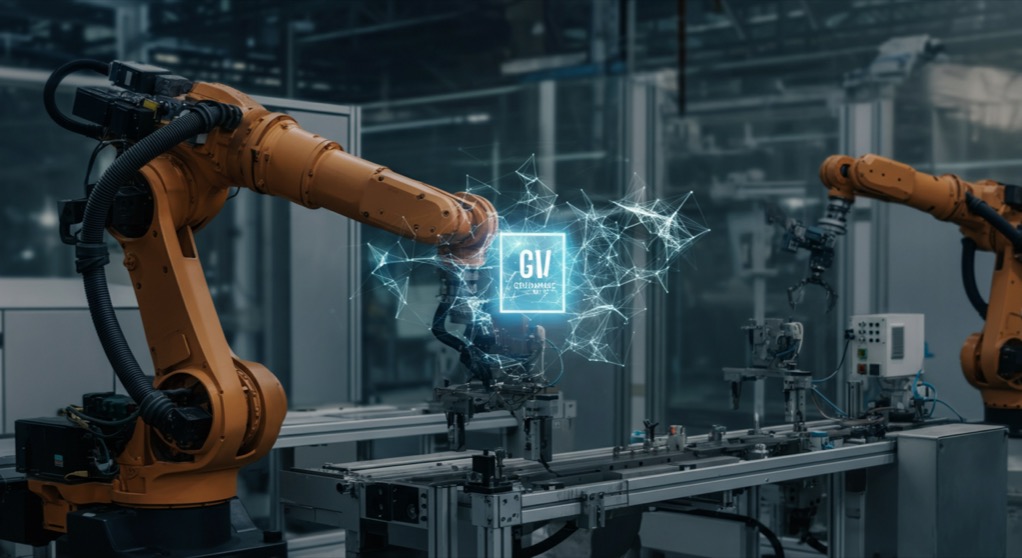
What happens when Formula 1 engineers, a WhatsApp product leader, and an Alan Turing Institute researcher walk into the same Munich startup? You get microagi, and the answer is a $55 million seed round - one of the largest ever for a European robotics company. The founding team's unusual composition is not a coincidence. It reflects a thesis that physical AI, which combines machine intelligence with hardware that can actually manipulate the physical world, represents the next major wave after generative AI. And that getting AI models from research papers onto factory floors is a problem that requires expertise from all three domains.
The company is building what it calls an industrial robotics deployment platform, a software layer that dramatically simplifies the process of taking AI-powered robotic systems from prototype to production in manufacturing, logistics, and warehousing environments. The core insight is that the AI industry has solved the model problem but not the deployment problem. Robots can perceive the world, plan actions, and even learn from demonstration, but getting them to work reliably on a real factory floor with dusty sensors, inconsistent lighting, and unpredictable human coworkers remains prohibitively complex and expensive.
The Last-Mile Problem in Physical AI
The generative AI boom has been primarily a software story. Models generate text, images, and code, and deployment means spinning up an API endpoint. Physical AI faces a fundamentally different challenge. A robot that can assemble a circuit board in a lab under controlled conditions may fail spectacularly when faced with the temperature variations, vibration, and debris of an actual factory floor. Each deployment requires environment-specific calibration, safety validation, and integration with existing manufacturing execution systems.
Microagi's platform aims to abstract away this complexity. The company has developed a software stack that handles sensor calibration, environment mapping, task specification, safety verification, and integration with industrial control systems. The goal is to allow manufacturers to deploy AI-powered robots without needing a team of robotics PhDs on site. Instead, a factory engineer can specify a task in high-level terms, and the platform handles the low-level details of perception, planning, and control.
This approach mirrors what cloud platforms did for software deployment. Before AWS, deploying a web application meant buying servers, racking them, configuring networks, and managing uptime. AWS abstracted that complexity away and opened software deployment to a much broader set of builders. Microagi is attempting the same abstraction for industrial robotics, and the $55 million seed round suggests investors believe the analogy holds.
Why the Founding Team Matters
The founding team is itself a signal of how the industry is evolving. The two former Formula 1 engineers bring deep expertise in real-time control systems, sensor fusion, and operation under extreme conditions. The WhatsApp entrepreneur brings product thinking, scaling expertise, and an understanding of how to build consumer-grade user experiences for industrial tools. The Alan Turing Institute researcher brings credibility in AI safety, verification, and the theoretical foundations of autonomous systems.
This combination is increasingly becoming the template for deep-tech startups. Domain expertise in the application area, scaling experience from consumer technology, and research credibility from academic or institutional settings. Pure research teams struggle with product-market fit. Pure product teams struggle with technical depth. Teams that span all three domains, as microagi's does, are disproportionately likely to succeed in bringing complex technology to market.
What Physical AI Means for Founders
The $55 million seed round is a canary in the coal mine for founders. The venture capital market is signaling that physical AI is the next frontier. After the LLM boom and the generative AI wave, the investment community is rotating toward AI that can interact with the physical world. Manufacturing, logistics, warehousing, construction, and agriculture are all industries where AI-powered automation could unlock massive value, but where the deployment challenges have historically been prohibitive.
For Indian founders in particular, the industrial robotics deployment opportunity is significant. India's manufacturing sector is undergoing a digital transformation, with the government's production-linked incentive schemes driving investment in automation. Logistics and warehousing are growing rapidly with the e-commerce boom. But the availability of robotics engineering talent remains constrained. A platform that simplifies deployment, as microagi is building for European markets, could be even more valuable in markets where the talent bottleneck is tighter.
The lesson from microagi's founding team is also worth internalizing. The most ambitious problems in AI no longer yield to pure software solutions. They require understanding of hardware, control systems, safety certification, and industrial workflows. Founders who can combine software AI expertise with domain knowledge in physical industries will be best positioned to capture the next wave of value creation in the AI economy.