
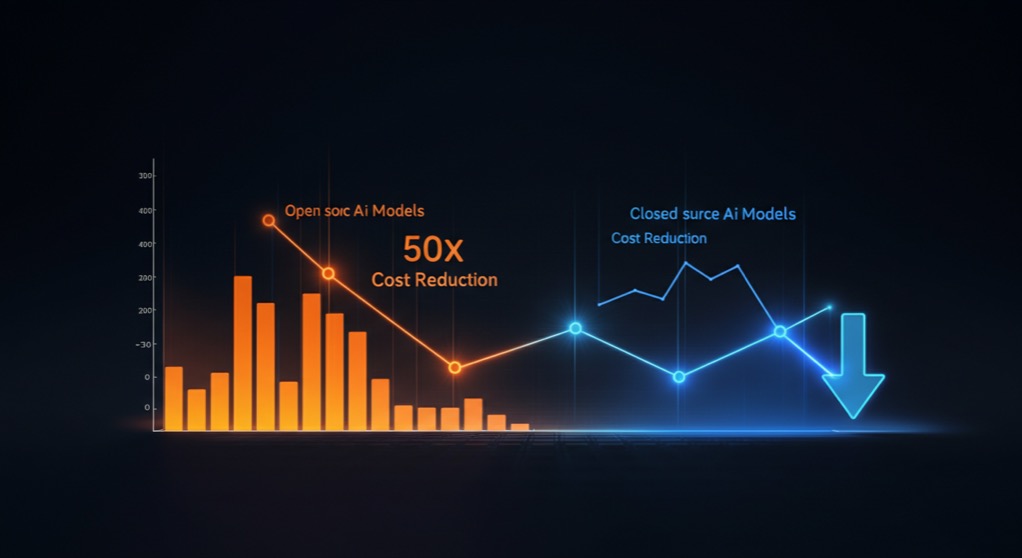
Stripe cut its AI running costs by 73 percent by moving 50 million daily AI requests off closed vendor APIs onto open source models running on its own hardware. Uber blew through its entire 2026 AI coding budget in four months, with individual engineers racking up bills between $500 and $2,000 apiece. And Microsoft cancelled most of its Claude Code licenses at the end of June after pay-per-use billing consumed its division's annual AI allocation in a matter of months. These three examples, published in Mozilla's first State of Open Source AI report, tell the story of an industry at an inflection point: open source models have nearly matched the closed leaders on capability, the cost of running them has fallen roughly 50 times in three years, and the fundamental question facing every AI builder has shifted from whether open models are good enough to who controls the software stack above them.
The Capability Gap Has Nearly Vanished
The Chatbot Arena, a public leaderboard that scores AI models based on blind user ratings in side-by-side tests, shows leading closed models just 3.3 points ahead of leading open-weight models as of March 2026. At the start of 2024, that gap was more than eight points. By early 2025, the two categories were roughly tied. Mozilla's report, built on a global survey of more than 950 developers, argues that the broad trend is unmistakable: the capability lead the closed labs held for years is evaporating.
To be precise, closed models from OpenAI, Anthropic, and Google still lead on the hardest reasoning problems, long-document analysis, and multi-step agentic workflows where an AI has to call external tools and act on the user's behalf. Anthropic's Claude Fable 5 release in June pushed the closed labs back out in front on those dimensions. But on code generation, instruction following, and general knowledge questions, open-weight models now perform at parity. Mozilla's CTO Raffi Krikorian put it directly in the report's announcement: the conversation is no longer about expanding access to models. It is about who has the power to shape, audit, and improve them.
The 50x Collapse in Inference Costs
The economic shift is even more dramatic than the capability story. Inference costs, which is what an organization pays every time a model generates an answer, fell roughly 50 times over the last three years. Running a model at GPT-4 level performance went from about $20 per million tokens in 2023 to around 40 cents today. Mozilla's analysis points out that this drop is more than three times faster than the historical cost curve for personal computing over the same window, and more than two and a half times faster than the decline in bandwidth prices during the dotcom era.
The traffic data confirms the migration. On OpenRouter, a platform that lets developers switch between different AI models through a single API, open-weight models now handle roughly one-third of all traffic, up from around 2 percent in late 2024. The platform now processes 25 trillion tokens per week, five times what it did six months ago, and the single largest source of that traffic is an open model. On Hugging Face, the main repository where developers publish and download AI models, there are now 2.5 million models available and 13 million users pulling from them, including one-third of the Fortune 500.
Mozilla Foundation president Mark Surman summarized the moment on LinkedIn: the question of whether open is good enough is settled. What is not settled is who gets to shape what comes next. That is the difference between owning your AI and renting it.
The Real Battle Has Moved to the Harness Layer
Mozilla's most provocative finding is that the competition has shifted one layer up from the model itself. The report calls this the harness: the software stack of tool integration, identity management, multi-step orchestration, and evaluation that sits above the model. Companies like Anthropic and OpenAI are building proprietary moats at this layer, pulling it in-house and tuning it exclusively to their own models. If the model is becoming a commodity, the harness is where the real lock-in happens.
This insight matters enormously for founders. The conventional wisdom has been that choosing an open source model protects you from vendor lock-in. Mozilla's analysis suggests that is only half true. You can swap the model, but if your entire application logic, agent workflows, and tool integrations are built on a proprietary orchestration layer, the switching cost is still substantial. The open source ecosystem now needs its own harness layer: open tools for agent orchestration, evaluation, and deployment that work across any model. Companies like Mistral, which has reached $400 million ARR (up 20x in 12 months) and is reportedly raising 3 billion euros at a 20 billion euro valuation, are proving that there is real money in the open source AI stack. But the bulk of that money is flowing to infrastructure and deployment tooling, not just model weights.
What This Means for Founders
The practical implication for anyone building with AI today is that the strategy of running everything through a single closed vendor API is increasingly hard to defend. Stripe's example of moving 50 million daily requests to self-hosted open models is not a boast about engineering prowess; it is a financial necessity that any company hitting scale will eventually face. The pay-per-use pricing model that closed vendors rely on breaks at enterprise scale, and the companies that recognize this early will have a structural cost advantage over competitors still on variable API billing.
For solo founders and small teams, the takeaway is more nuanced. Running your own models on your own hardware saves money at scale, but it adds operational complexity. The middle path is emerging: platforms like OpenRouter and Together AI that give you access to open models through an API without tying you to a single vendor's pricing. The key is to build your application layer in a model-agnostic way, so that when the next cost collapse or capability leap happens, you can ride it rather than being locked into last year's architecture.
Mozilla's report makes one thing clear: the era of treating AI as a premium luxury service is ending. The infrastructure is commoditizing faster than almost anyone predicted, and the winners will be the builders who design for that reality rather than against it.