
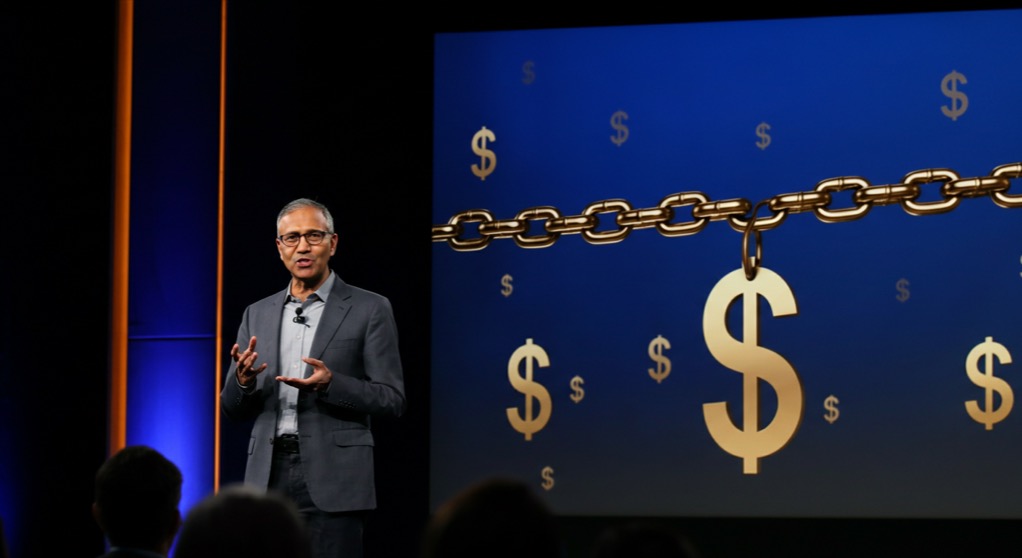
What is the actual cost of the AI model you are building on? If your answer is limited to the API price per million tokens, you are missing the bigger number by a wide margin. Microsoft CEO Satya Nadella recently made a provocative argument that companies building products on proprietary AI models like OpenAI's GPT or Anthropic's Claude are paying for intelligence twice: once in API fees, and again in the hidden tax of vendor lock-in. The warning arrived during a period when Microsoft is investing billions into both open-weight model infrastructure and proprietary partnerships, making the self-serving element obvious. But the underlying logic is harder to dismiss, especially for founders whose entire product depends on a single API key.
The Trojan Horse Argument Nadella Is Making
Nadella framed proprietary AI labs as Trojan horses. The argument works like this: a startup adopts an API from a frontier model provider. Integration goes smoothly. The product logic gets built around specific model behaviors, prompt structures, and output formats. The team optimizes for that model's cost structure and latency profile. Months pass. The product gains traction. And then the model provider changes its pricing, deprecates a version, updates its safety filters, or shifts its business model. The startup now faces an enormous switching cost not just in API migration but in retesting, retraining, and rebuilding workflows that were never designed to be portable.
This is not a theoretical concern. OpenAI has changed its pricing multiple times. Anthropic has adjusted its safety policies. Google has deprecated entire model families. Each change creates downstream disruption for companies that built dependency into their architecture. Nadella's point is that the actual cost of a proprietary AI model is not the per-token fee. It is the accumulated technical debt that makes you unable to leave, multiplied by the risk that your provider will eventually act in its own interest rather than yours.
Why Open-Weight Models Change the Risk Equation
Microsoft's strategy has been to offer both proprietary model access through Azure OpenAI Service and open-weight models through its own infrastructure investments, including Phi and partnerships with Mistral and Meta's Llama. Nadella positioned this dual approach as the safer path for enterprises. The logic is straightforward: an open-weight model that you can host on your own infrastructure or through a competitive marketplace eliminates single-vendor dependency entirely. You control the deployment. You control the version. You control when and how to upgrade.
Open-weight models come with their own tradeoffs. They generally lag behind frontier proprietary models in benchmark performance, especially on complex reasoning tasks. They require infrastructure expertise to deploy effectively. And the cost of self-hosting at scale can approach or exceed API pricing when GPU utilization is factored in. But the strategic advantage is real. A company that builds its AI layer on open-weight models with an abstraction layer that supports API fallbacks has optionality. A company that builds directly on a single proprietary API has a ticking clock.
For founders building AI-native products, the calculus shifts based on stage. Early-stage startups racing to find product-market fit should optimize for speed and capability, which often means using the best proprietary model available. But there is a point roughly around the Series A stage where model portability becomes a board-level concern. If your product's core value depends on a specific model that you cannot replace, you have a concentration risk that no amount of revenue growth will fully offset.
What the Nadella Warning Means for Your Vendor Strategy
The practical response to Nadella's warning is not to abandon proprietary models entirely. It is to build an architecture that treats your model provider as a replaceable component rather than a platform. The engineering pattern that matters most is the model abstraction layer: a thin interface between your product logic and the AI models it calls, designed so that swapping providers requires configuration changes rather than rewrites. This is not a new idea. Companies have been doing this with cloud providers, payment processors, and data stores for years. AI models are the latest critical dependency that needs the same treatment.
Beyond architecture, the operational playbook includes maintaining a fallback relationship with an alternative provider that you test and monitor regularly. If your primary model goes down, raises prices, or changes its behavior, you need to know that your fallback works in production. This is the same discipline that governs disaster recovery planning, but applied to AI dependencies that are evolving much faster than traditional infrastructure.
Nadella's warning also carries implications for how you negotiate with AI vendors. Multi-year pricing commitments, usage caps, and guaranteed service levels become more important as your dependency deepens. If you are spending significant monthly amounts on a single AI API, you have leverage to negotiate terms that protect you against sudden price changes. The startups that fail to use that leverage are effectively paying a premium for convenience while absorbing the full risk of future price volatility.
The deeper takeaway is that the AI industry is still in its infrastructure phase, where the platforms themselves are competing aggressively for lock-in. OpenAI wants you on its API. Anthropic wants you on Claude. Google wants you on Vertex. Microsoft wants you on Azure. Each of these companies is rational and will eventually price in a way that maximizes shareholder value rather than your startup's margins. The only durable defense is architectural optionality combined with the discipline to actually exercise it before you need to.