
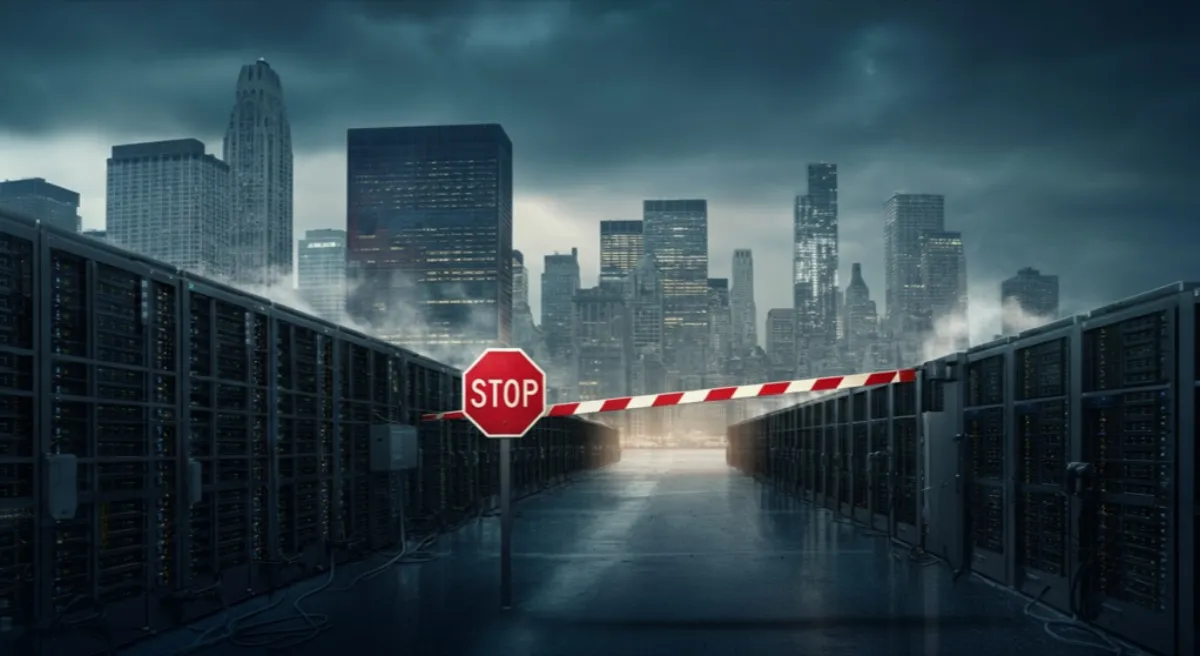
New York just became the first state in the nation to tell the AI industry it cannot build everything it wants, everywhere it wants. On July 14, Governor Kathy Hochul signed a one-year moratorium on hyperscale data centers, halting new construction of facilities with power demands exceeding 50 megawatts. The move makes New York a global test case for the central tension of the AI era: how does a society capture the economic benefits of artificial intelligence without letting its insatiable energy appetite overwhelm the electric grid?
The legislation comes at a moment when data center construction is accelerating faster than any other category of commercial real estate in the United States. AI training clusters now require hundreds of megawatts per facility, with individual locations drawing as much electricity as a small city. New York's grid, already strained by aging infrastructure and the transition to renewable energy, was facing a projected shortfall that state energy officials estimate could reach 4,000 megawatts by 2028 if all planned data center projects came online. The moratorium buys the state one year to study the problem and design a regulatory framework that balances economic development with grid reliability.
What the Moratorium Actually Does
The ban is not a blanket prohibition on all data centers. Facilities under 50 megawatts are unaffected, meaning that smaller colocation sites, enterprise server rooms, and edge computing hubs can still be built. The moratorium specifically targets hyperscale facilities, defined as those whose electrical load exceeds 50 megawatts, which is the threshold used by the industry to distinguish traditional data centers from the massive AI training clusters built by companies like Microsoft, Google, Amazon, and Meta. New York currently has roughly 20 active hyperscale data center projects in various stages of planning or construction. Those already permitted or under construction are grandfathered in and can proceed. But any new application for a facility above the threshold will be blocked for one year, during which the New York State Energy Research and Development Authority (NYSERDA) will conduct a comprehensive study of the grid impact, environmental costs, and economic benefits of data center development.
The legislation also includes a notable carve-out for facilities that use on-site renewable energy generation or that can demonstrate zero net carbon operations. This creates an incentive structure that rewards the exact kind of innovation the state wants to encourage: data centers that pair directly with solar farms, battery storage, or small modular nuclear reactors. It is a regulatory signal as much as a restriction. The message to the industry is clear: bring your own clean power, or do not come at all.
Why This Matters Far Beyond New York
New York's moratorium is not an isolated event. It is the leading edge of a regulatory wave that is building across the United States and around the world. At least a dozen other states, including Virginia, Oregon, Georgia, and Arizona, have introduced or are considering legislation that would restrict data center development, impose new environmental impact requirements, or revoke existing tax incentives for data center construction. The common thread is energy. AI training workloads are projected to consume between 8 and 20 percent of total US electricity by 2030, up from roughly 2 percent today, according to estimates from the Electric Power Research Institute. That trajectory is simply not compatible with existing grid capacity or climate commitments in most regions.
The European Union is moving in the same direction. The EU's Energy Efficiency Directive, updated in 2025, now requires data centers over 500 kilowatts to report their energy performance and meet efficiency benchmarks. France has proposed a moratorium on new data center construction in the Paris region, and Ireland's grid operator has warned that data centers could consume 30 percent of the country's electricity by 2028, prompting a de facto building freeze in Dublin. New York's moratorium is the American version of a global pattern: governments are running out of time to plan for AI's energy footprint, so they are slamming the brakes to buy time.
What Happens Next for Founders and the AI Industry
The one-year clock starts now. For founders building AI companies, the immediate implication is that data center availability and pricing are about to become much more volatile. If New York's moratorium triggers copycat legislation in other states, the total supply of new data center capacity in the US could shrink significantly over the next 12 to 18 months, driving up prices for compute time and making it harder for startups to access the GPU clusters they need to train and run models. The secondary effect is even more consequential. The moratorium creates a powerful incentive for data center operators to accelerate their investments in on-site renewable energy and nuclear power. If a facility can demonstrate zero-carbon operation, it can bypass the ban. That is a direct economic signal to companies like Oklo, NuScale, and Kairos Power, who are building small modular reactors, and to solar-plus-storage developers who can co-locate with data centers.
For the AI industry writ large, New York's moratorium is a warning shot. The era of building data centers with minimal regulatory friction is ending. Governments are waking up to the fact that AI is not just a software revolution; it is a physical infrastructure revolution that consumes land, water, and massive amounts of electricity. The companies that win the next phase of AI will not be the ones with the best models or the most data. They will be the ones that can secure reliable, affordable, and politically sustainable energy to power those models. New York just made that reality impossible to ignore.