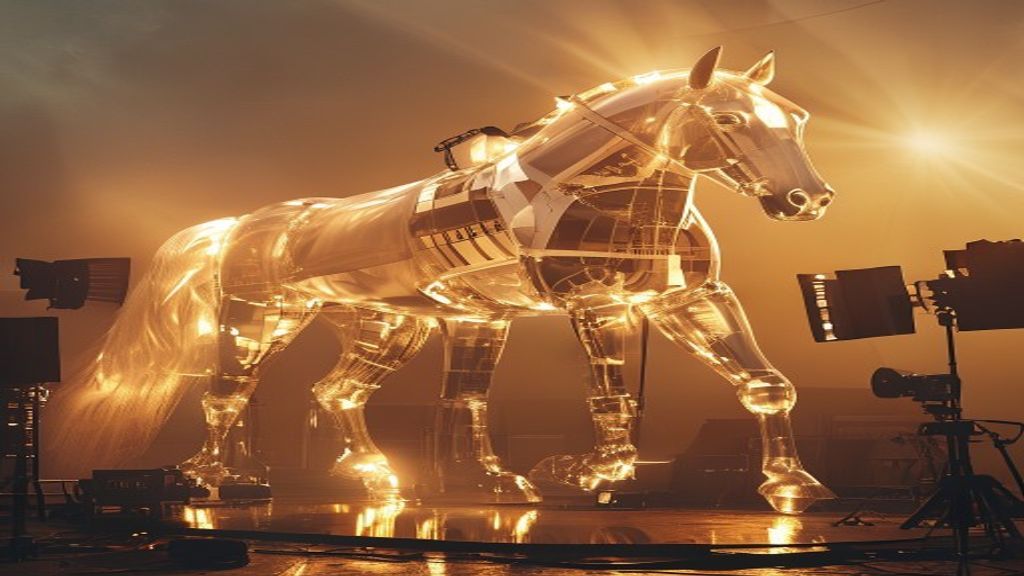
Christopher Nolan's "The Odyssey" is the first feature film ever shot entirely on IMAX film stock, and in a promotional interview this weekend the director turned the wooden horse at the center of his movie into a warning about artificial intelligence. Asked by French interviewer Hugo Travers whether AI might be the kind of gift you welcome into daily life before it becomes something darker, Nolan laughed and said the comparison was almost too obvious. "I think AI is a Trojan horse that everybody knows the Greeks are inside," he said. The remark landed because Nolan is not a random commentator. He is president of the Directors Guild of America and one of the few filmmakers with enough cultural weight to shape how a mass audience thinks about a fast-moving technology.
Why the Metaphor Fits Differently Than You'd Expect
The original Trojan horse worked because the Greeks hid inside it. The danger was concealed, and the Trojans dragged it through their gates willingly but blindly. Nolan's version inverts that. He called modern AI "a transparent horse, it's made of glass." Everyone can see the risks, he argued, yet adoption continues anyway. That distinction matters more than the soundbite suggests. Most AI anxiety is framed as a problem of deception, of systems quietly doing things we never authorized. Nolan is pointing at something colder: the threat is not that we are being tricked, but that we are consenting with our eyes open because the short-term convenience is too attractive to refuse.
This is the rare public figure who can say "AI slop" without it sounding like moral panic. He noted that young people, including his own children's age group, immediately label low-quality generative output as AI slop and box it away. That is a real consumer signal, not a celebrity opinion. When the generation that will define the next two decades of media consumption has already developed an instinct to dismiss machine-generated content on sight, the branding liability for any product that leans too hard on "AI-powered" as a selling point becomes severe.
The Hollywood Union Angle Most Coverage Skipped
Nolan is not speaking only as an artist. As DGA president, he helped secure generative-AI protections in the guild's most recent contract, and the 2023 writers' and actors' strikes made AI a central labor battleground. What gets lost in the "Trojan horse" framing is that the safeguards won so far are contractual, not legal. A union clause protects a guild member on a covered production. It does nothing for the freelance editor, the marketing copywriter, or the small studio that never signs a guild agreement. The gap between what Hollywood's most powerful unions extracted and what actually protects working creatives is wide, and Nolan's metaphor is more accurate as a description of that gap than as a prediction of doom.
There is also a strategic read for the companies building generative tools. The creative industry is the canary here. If the most visible, best-funded corner of media labor manages to ring-fence AI through collective bargaining, that playbook becomes the template other industries study. If it fails, the pressure shifts to legislation, which in the United States has moved at a crawl. Either way, the creative sector is where the first large-scale human-versus-machine labor settlement is being negotiated in public.
What This Means for Builders and Founders
The takeaway for anyone shipping AI products is uncomfortable but actionable. Nolan's "transparent horse" line is a trust verdict. The market is not short on capable models. It is short on reasons to believe a given AI feature will respect the user instead of extracting from them. Founders who treat transparency as a regulatory chore rather than a product differentiator are building straight into the skepticism Nolan described. The products that survive the AI slop filter will be the ones that make their human oversight, data handling, and failure modes visible by design, not the ones that bury them.
There is a second lesson in Nolan's own contradiction. He resists smartphones, shoots on film, and calls himself a "techno-skeptic" rather than a technophobe, yet he embraces new technology constantly when it serves the work. His objection was never to tools. It was to replacing systems that still work with systems sold at their expense. Startups that pitch AI as a wholesale replacement for journalism, design, or cinema are walking into the rejection he documented. Startups that pitch AI as a way to extend what a human can already do well are aligned with the skepticism, not against it.
The box office will decide whether "The Odyssey" cements Nolan's cultural authority for another decade, but the interview already did something useful for the industry. It gave the diffuse anxiety about generative AI a clean, repeatable metaphor, and it did so from inside the camp of the people most threatened by the technology. That is why a short exchange in a promotional interview is worth more than most policy white papers. The story is no longer "will AI hurt creative labor." It is "the people making the biggest creative bets in the world already assume it will, and they are planning accordingly."
The Real Signal for the AI Industry
Nolan's comments will be filed under celebrity cautionary tales by some outlets, but the signal is broader. A technology "advancing so rapidly" while being "so completely rejected by the public" has no modern precedent, in his words. For an industry that markets itself on inevitability, that rejection is the real story. The companies that win the next phase will be the ones that treat public skepticism as data, not as a public-relations problem to manage. The horse is made of glass. Everyone can see inside. The question is whether the people handing it out are willing to be seen too.