
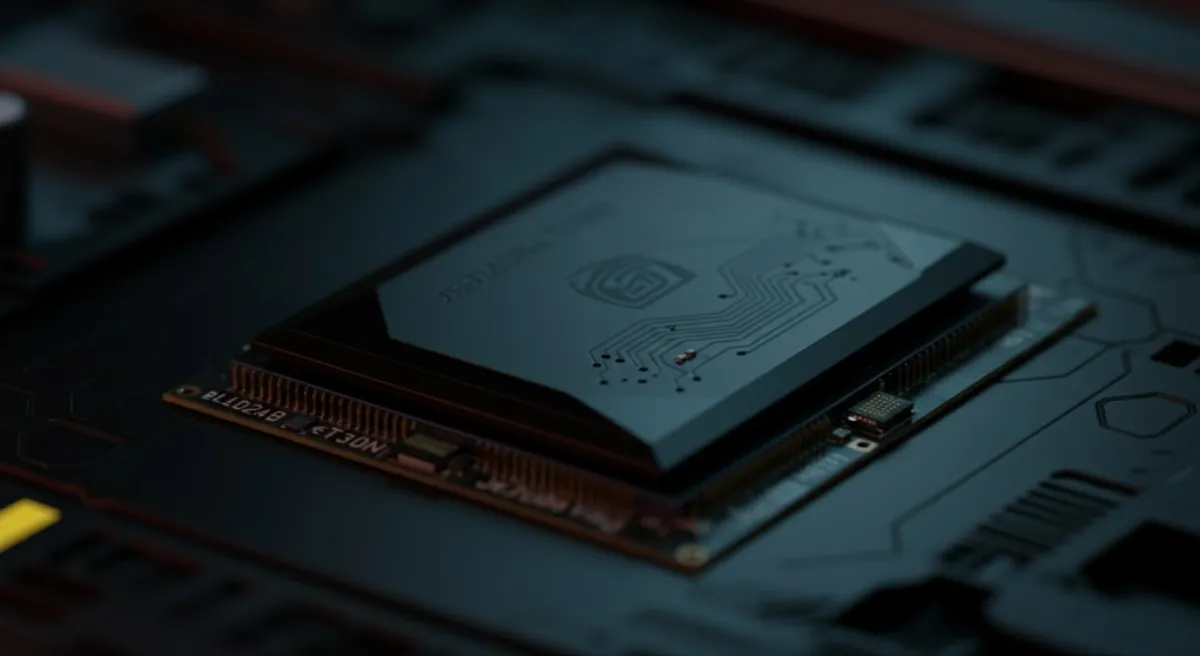
NVIDIA claims the new Jetson Thor T3000 delivers up to 8x the AI performance of its predecessor, the Jetson AGX Orin, while fitting into a module small enough to embed inside a humanoid robot's torso. That performance jump marks a pivotal shift for the entire edge computing space: edge AI is no longer about running lightweight inference on security camera feeds. It is now about deploying full-scale foundation models directly onto machines that navigate the physical world in real time.
What the Jetson Thor Lineup Brings to the Edge
The T3000 and T2000 modules are built on NVIDIA's Blackwell architecture, the same GPU design powering the company's data center flagship B200. That is notable because Blackwell was originally conceived for massive AI training clusters running at hundreds of kilowatts. Shrinking that down to a 75-watt module that operates on battery power inside a warehouse robot is an engineering feat that took multiple design iterations across NVIDIA's hardware teams. The T2000, the lower-power sibling, targets cost-sensitive deployments where every watt and every dollar matters, while the T3000 aims at the high end of edge inference for applications like autonomous mobile robots and medical carts.
Both modules support the full NVIDIA AI software stack. That means developers who trained models on DGX systems or in the cloud using NeMo can deploy them on the edge without reworking pipelines, converting formats, or sacrificing precision. NVIDIA also announced new software capabilities alongside the hardware, including memory optimization tools that allow larger models to fit within the edge power envelope and what it calls agent skills. These are prebuilt AI capabilities that let the module handle perception, navigation, and manipulation out of the box. For founders building on these systems, the implication is a dramatically reduced time to market. Instead of stitching together custom computer vision, path planning, and natural language processing modules, they can lean on NVIDIA's bundled stack and differentiate at the application layer where the real customer value lives.
Why Mainstream Robotics Needs Its Own Supercomputer
Until now, most industrial robots have operated on programmable logic controllers or single-board computers running deterministic control loops. Those systems are reliable and proven, but they cannot run a large language model or a vision transformer in real time. The new wave of robotics, especially humanoids and autonomous mobile robots, requires exactly that capability. A robot that needs to understand natural language commands, recognize objects it has never seen before, and plan a path through a cluttered factory floor needs a computer closer in capability to a data center GPU than to a microcontroller.
The Jetson Thor family is designed to fill that specific gap. With Blackwell's transformer engine and FP4 precision support, the modules can run large multimodal models locally rather than sending data to the cloud for every inference decision. That matters for latency-critical tasks like grasping an object mid-fall or navigating through a crowd of workers, where a 100 millisecond round trip to the cloud is the difference between a successful action and a collision. It also matters for data privacy. Sensitive factory floor data, proprietary manufacturing processes, and video feeds of internal operations never need to leave the building. For enterprise buyers, that alone can justify the hardware upgrade cycle.
What This Means for Founders Building Physical AI Products
For solo founders and small teams building physical AI products, the Jetson Thor announcement lowers two major barriers that have kept edge AI projects in the prototype phase for years. The first barrier is hardware cost. The T2000 is positioned as an entry point for high-volume robotics deployments. If NVIDIA hits its pricing targets, the per-unit cost of enough AI compute for real-time perception and planning could drop below what it cost the previous generation just to run a single camera feed.
The second barrier is software complexity. NVIDIA's Jetson platform already has a mature SDK ecosystem with thousands of developers, but the addition of agent skills and memory optimization means a solo developer can build a working prototype without a team of firmware engineers and perception specialists. That is a meaningful shift for founders working on warehouse automation, agricultural robotics, medical devices, and last-mile delivery systems where the software talent pool is thin and expensive.
There is also a strategic dimension. NVIDIA is betting that robotics will be the next major AI platform shift after cloud computing and autonomous vehicles. By seeding the ecosystem with affordable, powerful edge modules now, the company is creating a generation of developers whose products are tied to its hardware and software stack. Founders who build on Jetson Thor today are positioning themselves inside a platform play that comes with a long tail of hardware roadmaps, software updates, and ecosystem support that smaller chip vendors simply cannot match.
Physical AI Is Approaching Its Inflection Point
Jetson Thor does not exist in isolation. It connects directly into NVIDIA's broader robotics ecosystem: the Cosmos world model platform for simulation training, the Nemotron family of language models optimized for reasoning tasks, and the Omniverse platform for digital twinning and synthetic data generation. Together these pieces form a full pipeline from simulation to real hardware deployment, a stack that NVIDIA has been quietly assembling for years but is only now ready to market as a unified offering.
The timing aligns with an accelerating market. Multiple humanoid robotics startups have moved from concept demonstrations to pilot production in 2026, and the global robotics market is projected to grow at over 20 percent annually through the end of the decade. NVIDIA's decision to bring Blackwell to the edge now, rather than waiting for the next architecture cycle, suggests the company sees a market that is ready to scale today. For founders building in robotics, warehouse automation, medical devices, or agricultural technology, the strategic question is no longer whether edge AI is viable. It is which hardware platform to bet the company on. With Jetson Thor, NVIDIA has made its case stronger than it has ever been.