
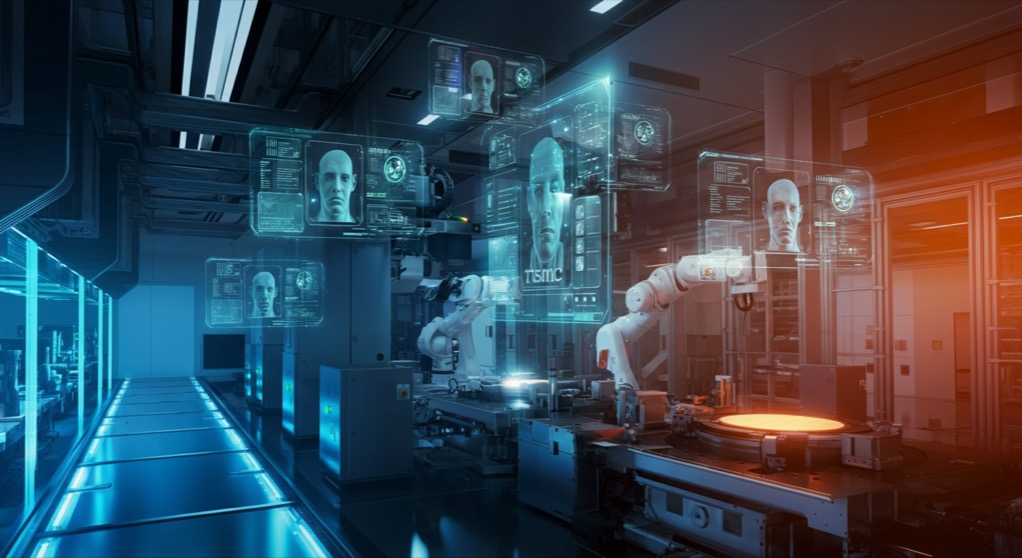
TSMC, the company that manufactures the silicon powering nearly every AI data center on earth, is now using AI to manufacture that silicon. At GTC Taipei, NVIDIA announced that the world's leading semiconductor foundry is deploying NVIDIA accelerated computing across its entire chip fabrication workflow, from the physics simulations that design each transistor to the optical inspection systems that catch nanometer-scale defects. The headline number that should stop you cold: cuLitho, NVIDIA's computational lithography library, is delivering 20 to 50 percent cost improvement on the most expensive step in the entire chipmaking process. That is not an optimization. That is a structural shift in the economics of manufacturing at the physical limit of what silicon can do.
The Four Pillars of AI-Powered Chip Manufacturing
The partnership spans four distinct technology layers, each addressing a different bottleneck in the chip fabrication pipeline. First is computational lithography with cuLitho. Lithography the process of etching transistor patterns onto silicon wafers already consumes tens of billions of computing hours per chip design. TSMC is using cuLitho on NVIDIA accelerated hardware to reduce that cost by 20 to 50 percent while improving pattern fidelity. At the scale TSMC operates, a 20 percent reduction in lithography cost translates into hundreds of millions of dollars in annual savings. Second is electronic structure simulation with cuEST. TSMC engineers are using this library to run chemistry simulations 50 times faster than conventional methods, enabling researchers to model new materials and transistor architectures that would otherwise be computationally prohibitive. Third is machine learning for advanced process control using cuML. Semiconductor fabrication involves thousands of process steps, each with dozens of variables. TSMC is deploying ML models trained on fab sensor data to detect drift in real time and adjust parameters before yield is affected. Fourth is vision AI for nanometer-scale defect inspection. NVIDIA's Metropolis platform, combined with the TAO Toolkit, powers automated optical inspection systems that can identify defects at resolutions far beyond what human operators or traditional computer vision could manage. Together, these four pillars represent the full stack of AI applied to the full stack of chip manufacturing.
The FabTwin: Why Digital Twins Change the Game for Physical Manufacturing
Among the most strategically significant announcements buried in the release is TSMC's exploration of NVIDIA Omniverse to build a FabTwin, a fully simulated virtual replica of a semiconductor fabrication facility. A FabTwin would allow process engineers to simulate the placement of manufacturing tools, the flow of wafers between stations, and the impact of production line changes without ever touching a physical fab. In an industry where a single fab costs $10 billion to $20 billion to build and any production line reconfiguration can take weeks of downtime, the ability to simulate changes in a digital environment before implementing them in the physical world is transformative. This is not theoretical. Industrial giants like BMW and Siemens have already deployed Omniverse digital twins for factory layout and logistics optimization. Applying the same approach to semiconductor fabs, where precision tolerances are measured in atoms rather than millimeters, pushes the concept into an entirely new regime. For any founder building in industrial AI, the message is clear: if digital twins are good enough for TSMC's nanometer-scale fabs, they are good enough for your manufacturing use case.
What This Means for Founders Beyond Semiconductors
The NVIDIA-TSMC announcement is far from a narrow story about two companies extending a decades-old partnership. It is a validation signal for the entire AI-for-physical-industries thesis. Three categories of opportunity emerge for founders watching this closely. The first is simulation software for manufacturing. If the world's most advanced manufacturer is investing in AI-powered simulation, industrial simulation startups addressing everything from chemical processing to automotive assembly lines have a reference customer model. The second category is AI-powered process control. TSMC's use of cuML for real-time process parameter adjustment is directly applicable to any high-precision manufacturing domain, from pharmaceutical production to semiconductor packaging to battery cell manufacturing. The third category is vision AI for quality assurance. TSMC is deploying NVIDIA Metropolis and TAO for defect inspection at nanometer resolution. The same stack, adapted for specific verticals, can inspect everything from electronics components to food products to aerospace parts. For each of these categories, TSMC's adoption removes the objection that enterprise customers commonly raise about whether AI is ready for production manufacturing.
The Feedback Loop Closes: AI That Makes the Silicon That Runs AI
There is a recursive logic to this announcement that deserves explicit attention. NVIDIA GPUs power the training and inference of frontier AI models. Those models run on chips manufactured by TSMC. Now, that same TSMC fabrication process is itself being optimized by AI running on NVIDIA hardware. The loop is closed: AI accelerates the design of chips, AI now accelerates the manufacturing of those chips, and those chips in turn run the AI software ecosystem that the entire technology industry depends on. This feedback loop has profound implications for the pace of capability improvement. When the tool that improves manufacturing is itself running on the hardware being manufactured, the improvement curve compounds in ways that linear optimization cannot match. For the founders in The Break Daily's audience, the strategic implication is straightforward. The era of thinking about AI as something that happens purely in software is over. The physical world manufacturing, logistics, materials science is now an AI application domain. The companies that recognize this and build accordingly will be the ones that define the next decade of industrial technology.