
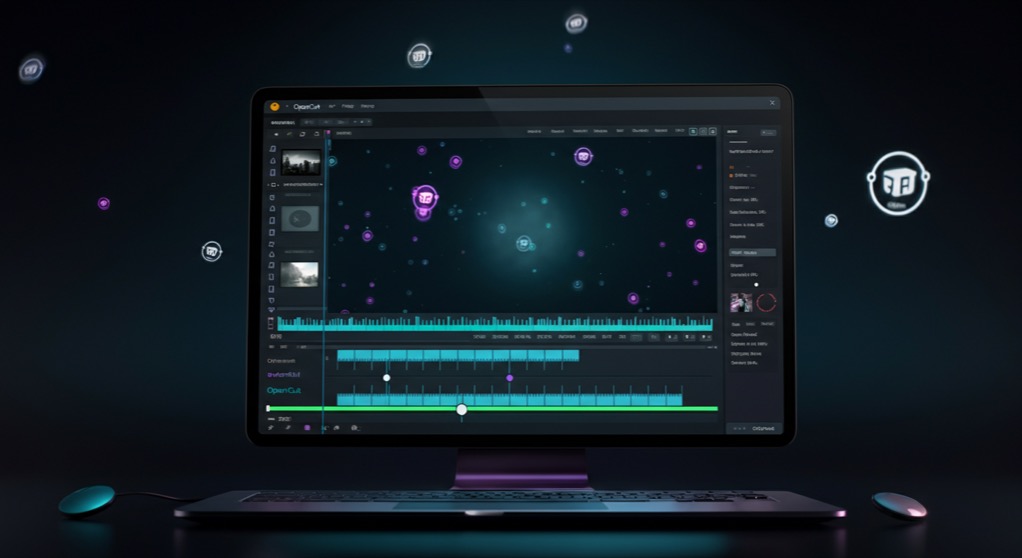
What happens when the default video editor for a generation of creators starts paywalling basic features? You get 75,349 GitHub stars in under 14 months. OpenCut, an open-source video editor that positions itself as a free alternative to ByteDance's CapCut, has exploded onto the trending charts, hitting the number one spot on GitHub as creators actively seek an exit from the TikTok parent company's ecosystem. The project, founded in June 2025, has amassed over 7,500 forks and 366 watchers, with new contributors joining daily as the community rallies around a single thesis: video editing should not require surrendering your data or your wallet to a social media conglomerate.
CapCut became the de facto video editor for short-form content creators by being free, fast, and deeply integrated with TikTok's sharing ecosystem. But ByteDance's strategy has shifted. Basic features that were once free - higher resolution exports, advanced transitions, cloud storage beyond a minimal tier - have moved behind a subscription paywall. Simultaneously, privacy concerns around CapCut's data collection practices have grown louder, particularly among creators who do not want their raw footage, editing patterns, and creative workflows transmitted to ByteDance's servers. OpenCut offers a fundamentally different value proposition: everything runs locally, nothing is uploaded, and the code is open for anyone to inspect.
What OpenCut Does and Why It Matters
OpenCut is a full-featured video editor supporting timeline-based editing, multi-track audio, effects, transitions, keyframe animation, masks, volume envelope controls, canvas backgrounds, stickers, and a graph editor for fine-tuning animation curves. It ships as both a web application and a desktop native app, with a Rust-powered compositor core that handles GPU-accelerated rendering and effects processing. The project is MIT-licensed, meaning anyone can fork it, modify it, or embed it in their own products without legal friction.
What makes OpenCut strategically important is not its feature set but the statement its growth makes about the creator economy. CapCut has been downloaded over 1 billion times. It is the default. A challenger reaching 75,000 GitHub stars signals that the creator community’s tolerance for walled-garden ecosystems has a limit. For AI founders building creator tools, this is a directional signal: the next generation of creative software will be open, local-first, and resistant to platform lock-in. Any startup building AI video features - auto-captioning, scene detection, AI upscaling, text-to-video - should consider OpenCut as a potential integration target rather than building yet another closed ecosystem.
Why It Is Trending: The ByteDance Backlash
The timing of OpenCut's surge is not coincidental. ByteDance has been tightening its grip on the creator workflow through CapCut's subscription model, pushing more features behind the paywall with each update. For creators who use CapCut daily as their primary editing tool, the subscription cost adds up, but more importantly, it creates a dependency: the projects, templates, and presets all live inside ByteDance's cloud, making it costly to switch. OpenCut breaks this lock-in by being fully local. No account required. No cloud dependency. No data collection. The tradeoff is straightforward: you lose the one-click TikTok sharing integration, but you gain full ownership of your creative workflow.
There is a broader pattern here. CapCut is not the only creative tool facing an open-source challenger. Blender disrupted the 3D modeling market against Maya and 3ds Max. GIMP and Krita chipped away at Adobe's image editing monopoly. OBS Studio became the standard for live streaming. OpenCut is repeating this pattern in the mobile-first short-form video space, and the speed of its adoption - 75,000 stars in a year, trending number one on GitHub - suggests the market is ready for a credible open-source alternative far faster than earlier creative tool disruptions.
What Is Coming: The Ground-Up Rewrite
The current OpenCut codebase is being rewritten from scratch, and the roadmap reveals an ambitious vision that extends well beyond being a CapCut clone. The rewrite uses a Rust core that compiles to native desktop, web (via WASM), and mobile from a single codebase. The new architecture includes an Editor API for programmatic control, a plugin-first system for third-party extensions, an MCP server for AI agent integration, headless mode for automation and batch rendering, and a scripting tab directly inside the editor. This is notable because it positions OpenCut not just as an end-user product but as a platform for building video editing workflows, including AI-powered ones.
The MCP server is particularly relevant for AI founders. It means AI agents will be able to directly control OpenCut, import footage, apply effects, and render exports through a standardized protocol. Imagine telling an AI agent to create a 30-second highlight reel from a 2-hour recording with trending music and captions and having it execute inside OpenCut programmatically. That is the vision the rewrite enables.
For now, the stable version is available at opencut.app and the source code is on GitHub under an MIT license. Installation is straightforward for developers: clone the repo, install Bun, copy the environment file, start the local database with Docker Compose, and run the development server. A pre-built desktop version is available for macOS, Windows, and Linux with a one-click installer from the website.
Comparison to Alternatives
CapCut remains the most accessible option for TikTok-native creators who need seamless sharing integration and do not mind the data tradeoff. DaVinci Resolve offers vastly more professional-grade capabilities but has a steep learning curve and requires powerful hardware. Shotcut is another open-source option but lacks the polish and modern UX that OpenCut targets. OpenCut sits in the sweet spot: it is as easy to use as CapCut, as open as Shotcut, and runs on less powerful hardware than DaVinci Resolve. The major current limitation is that the rewrite is still in progress, meaning some advanced features available in CapCut such as text-to-speech, auto-captions, and AI background removal are not yet present in OpenCut. However, the plugin architecture in the rewrite makes it straightforward for the community to add these capabilities.
Who This Is For
OpenCut is for creators who want a professional video editor without the subscription fees, data collection, or platform dependency. It is for developers who want to build AI-powered video tools on top of an open foundation. It is for solo founders and small teams who cannot afford Adobe or CapCut subscriptions but need reliable editing capabilities. And it is for anyone who believes that creative tools should be owned by their users, not by the platforms that host their content. With 75,000 stars and trending at number one on GitHub, the market has already cast its vote.