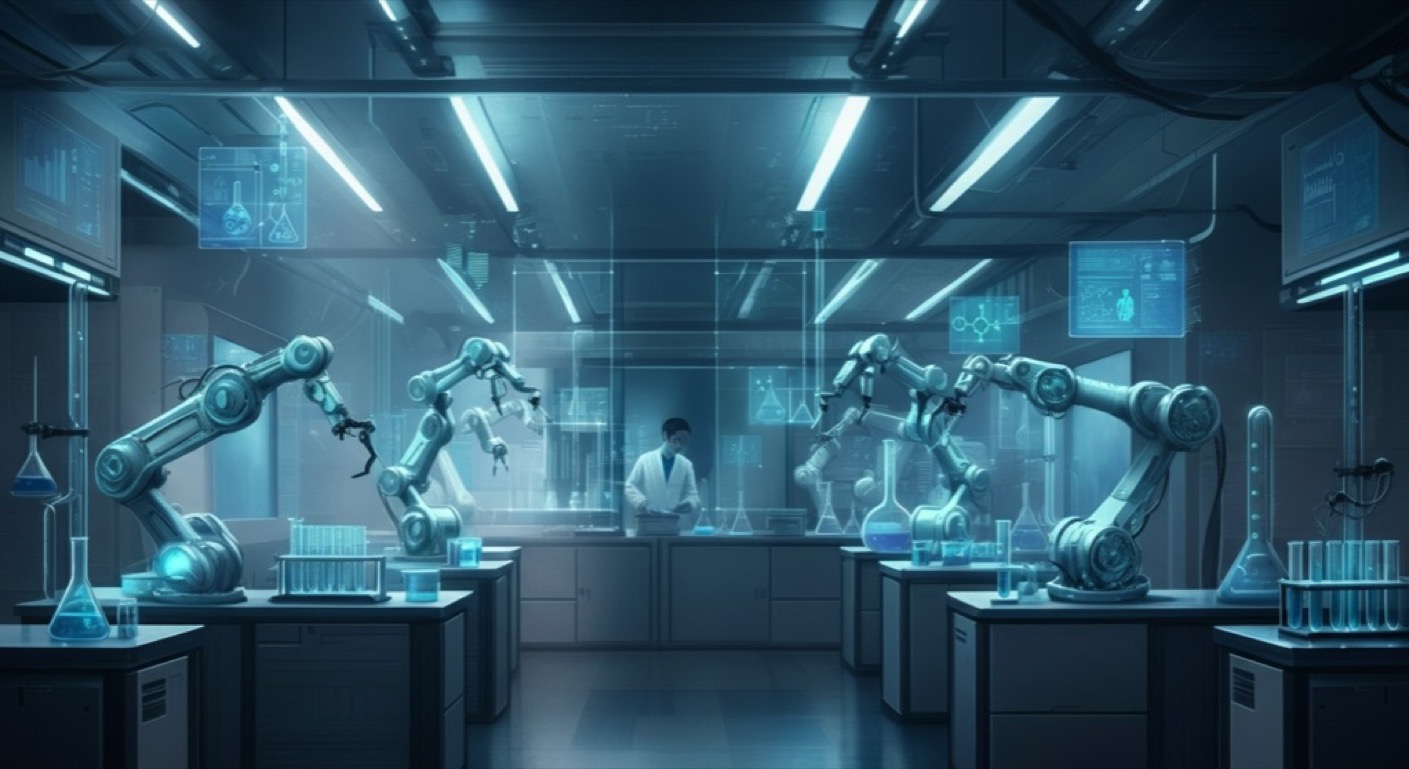
What happens when AI stops being a tool scientists use and becomes a scientist itself? That question is the central thread of a provocative new essay on arXiv (2607.15164) titled "The Industrialization of Research," which argues that artificial intelligence is not simply accelerating scientific discovery but fundamentally restructuring the entire research enterprise. The shift, the author contends, mirrors the Industrial Revolution in manufacturing: from a craft model where knowledge, method, and judgment live inside the researcher, to a pipeline model where every step is decomposed, automated, and supervised.
The US Department of Energy's Genesis Mission serves as the essay's primary case study for what this looks like in practice. Genesis represents the most ambitious current instantiation of AI-driven science, but the questions it raises extend far beyond any single program. The essay identifies seven critical concerns that anyone building or funding AI research tools needs to understand.
The Seven Existential Risks of AI-Driven Science
The first and perhaps most unsettling risk is the erosion of intergenerational transmission of scientific competence. When AI systems handle hypothesis generation, experimental design, data analysis, and even paper writing, the apprentice model of scientific training breaks down. Junior researchers no longer develop the tacit knowledge that comes from struggling through each step manually. The essay warns that this creates a dangerous dependency: we lose the human capacity to vet, challenge, or even understand the outputs of our own automated research pipelines.
Second, the opacity of AI-generated theories poses a fundamental epistemological challenge. If a model proposes a new physical law or biological mechanism, and that theory is too complex for any human to fully grasp, can we meaningfully claim to "know" it? The essay frames this as a direct challenge to the scientific method's core premise: that knowledge must be communicable and verifiable by human reason.
Third, peer evaluation faces collapse under a flood of machine-generated output. If AI systems can produce thousands of papers per day, the traditional peer review system cannot keep pace. The signal-to-noise ratio degrades, quality control becomes impossible, and bad science slips through at scale. This is not a future problem. It is already emerging in fields where automated research assistants generate candidate papers that human reviewers cannot adequately assess.
Fourth, the essay questions whether AI systems have any proven capacity for paradigm-shifting discovery. Most AI-assisted science to date has produced incremental advances within established frameworks. There is no evidence yet that AI can replicate the kind of conceptual leap that defines a Kuhn-style scientific revolution. The author warns that the industrialization of research may optimize for volume of output while systematically filtering out the anomalous results that lead to genuine breakthroughs.
Structural Risks in the Pipeline Model
The fifth concern addresses the capture of the scientific agenda by political and industrial actors. When research is organized as an automated pipeline, the question of who controls the pipeline inputs becomes critical. Funding priorities, data access policies, and model training objectives all become levers for shaping what gets researched and what gets ignored. The essay warns that this creates a system where the "important" questions are determined not by scientific curiosity but by institutional incentives.
Sixth, the compounding of systematic errors in closed-loop pipelines presents a unique failure mode. In traditional research, errors are eventually caught through reproduction attempts, peer review, and the self-correcting nature of the scientific community. But in a fully automated pipeline, where every step depends on the outputs of previous steps, biases can compound undetected. An early assumption baked into the training data propagates through hypothesis generation, experimental design, and interpretation, producing confident but deeply wrong conclusions.
Seventh and finally, the essay identifies the structural bifurcation of the global research community into incommensurable tiers. Organizations with access to the most powerful AI research infrastructure will produce science at a pace and scale that others cannot match. This creates a two-tier system: a high-speed industrial tier producing most of the published output, and a slower craft tier whose work may be dismissed as irrelevant. The essay warns that this stratification could permanently fracture the global scientific community, with the lower tier losing not just output volume but also the institutional capacity to evaluate the upper tier's work.
What This Means for Builders
For founders building AI research tools, scientific automation platforms, or lab infrastructure products, this essay serves as both a roadmap and a warning. The seven risks translate directly into product opportunities. Build tools that preserve human vetting capacity alongside automation. Design systems that audit their own outputs for bias propagation. Create peer review infrastructure that can handle machine-generated scale while maintaining quality. The winners in this space will not be the companies that automate science most aggressively, but those that automate it most responsibly.
The essay is careful to note that these concerns do not constitute an argument against AI-driven science, whose demonstrated potential is real and significant. Rather, they define the conditions under which that potential can be responsibly pursued. For anyone building in this space, those conditions should inform your product roadmap today. The industrialization of research is coming regardless. The question is whether we build the guardrails before or after the accidents.