
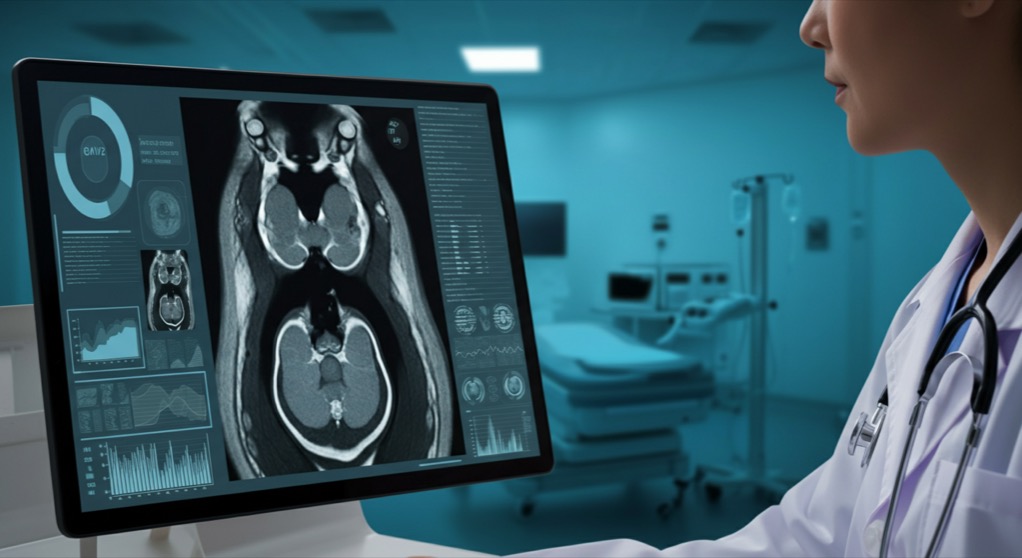
What if the single most important data point about AI regulation in healthcare is hiding in plain sight? After 30 years of FDA AI device approvals, one specialty accounts for roughly 78% of all cleared AI-enabled medical devices. Radiology has dominated the regulatory landscape since the very first AI device was approved by the FDA for computer-aided detection in mammography back in the 1990s. And that pattern has only intensified with the explosion of machine learning in medicine over the past five years.
A comprehensive analysis of FDA clearance data reveals a clear, predictable pattern that every founder building AI for healthcare needs to understand. The FDA's comfort zone starts with imaging because radiology offers something most other medical domains cannot: objective ground truth. When a radiologist diagnoses a tumor, the finding can be confirmed through biopsy, surgical pathology, or follow-up imaging. The outputs are measurable, the errors are definable, and the regulatory pathway is established. This makes radiology the lowest-risk entry point for AI regulation in medicine.
The Radiology-First Regulatory Pathway
The data shows that FDA's approach to AI regulation followed a deliberate sequence. The first wave, spanning the late 1990s through the early 2010s, focused on computer-aided detection and diagnosis in mammography, chest X-rays, and CT scans. These were narrow, single-task algorithms trained on well-curated datasets with binary outcomes: is the finding present or not? The FDA cleared these devices under the 510(k) pathway, finding them substantially equivalent to predicate devices, creating a precedent that subsequent AI devices could follow.
The second wave, from roughly 2015 to 2020, coincided with the deep learning revolution. Convolutional neural networks enabled AI to analyze images with accuracy that matched or exceeded human radiologists for specific tasks. The FDA saw a surge in submissions for AI algorithms covering fracture detection on X-rays, lung nodule identification on CT, hemorrhage detection on brain scans, and breast cancer screening on mammograms. Each approval reinforced the regulatory infrastructure for imaging AI, creating a snowball effect that made radiology the default path for AI medical device clearance.
By the time the FDA published its first discussion paper on AI/ML-based Software as a Medical Device (SaMD) in 2019, radiology already represented an estimated 70-80% of all AI device clearances. The agency's proposed regulatory framework for AI modifications and premarket review was built on lessons learned predominantly from radiology devices. This created an implicit bias in the regulatory system: if your AI application fits into a radiology workflow, the path to clearance is well-lit. If it does not, you are navigating largely uncharted territory.
Beyond Radiology: The Slow Expansion into New Domains
The FDA's AI clearance data shows the agency is methodically expanding its regulatory scope. Cardiology has emerged as the second-largest category, with AI devices approved for echocardiogram analysis, electrocardiogram interpretation, and coronary CT angiography. These applications share key characteristics with radiology AI: they analyze structured imaging data with well-defined clinical endpoints and objective ground truth available through cardiac catheterization or surgical findings.
Pathology represents the third wave, with digital pathology AI systems receiving FDA clearance for cancer detection and grading on whole-slide images. The regulatory pathway here mirrors the radiology playbook, with the FDA leveraging the same 510(k) framework and the same fundamental approach: narrow task, well-defined inputs, objective ground truth available through histopathological confirmation. The key difference is that digital pathology required additional infrastructure standardization, including whole-slide image formats and color normalization protocols, before the regulatory pathway could mature.
Clinical decision support systems and patient-facing LLMs represent the frontier that the FDA is actively grappling with today. Unlike imaging AI, CDS systems process unstructured clinical data, make probabilistic recommendations, and involve subjective judgment. There is no objective ground truth for many clinical decisions, making validation inherently more complex. The FDA's current challenge is determining whether its radiology-derived regulatory framework can be adapted for these higher-risk, more subjective AI applications or whether entirely new pathways are needed.
What This Means for AI Founders in Healthcare
For founders building AI products in healthcare, the 30-year regulatory data points to a clear strategic implication: radiology remains the path of least resistance. If your AI application can be framed as a radiology tool even if the underlying technology has broader applications, the regulatory timeline is significantly shorter and the evidence requirements are better understood. The established 510(k) pathway with predicate devices means you can often achieve clearance in months rather than years, at a fraction of the cost of a de novo submission or PMA.
But the data also reveals a second, more interesting opportunity. The FDA is systematically expanding its regulatory aperture, moving from radiology to cardiology to pathology to clinical decision support. Each expansion creates a sequential window of opportunity. Founders who build for the next domain on FDA's roadmap can position themselves as pioneers in a newly opening regulatory space, establishing predicates that later entrants must reference. The key is timing your submission to coincide with the FDA's readiness to expand, which typically follows a published guidance document, a public workshop, or a first-of-kind clearance in a new category.
A third strategic insight comes from the international dimension. India's Central Drugs Standard Control Organization is closely following the FDA's trajectory for AI regulation. The CDSCO has studied the FDA's radiology-first framework and is building its own AI regulatory approach on similar principles. For Indian founders building AI healthcare products, understanding the FDA's 30-year pattern effectively means you can predict India's regulatory pathway for the next 5-10 years. The playbook is already written; you just need to read the tea leaves from the American experience.
The Frontier Challenge: Patient-Facing LLMs and Real-Time CDS
The glaring gap in the FDA's AI approval data is the near-total absence of cleared devices for the most transformative AI applications in healthcare: patient-facing large language models, real-time clinical decision support, and autonomous diagnostic systems. These applications represent the frontier where the FDA is actively struggling to build a regulatory framework that balances innovation with safety.
The fundamental problem is that the radiology-derived regulatory model breaks down for these applications. Radiology AI asks a narrow question: is there a finding in this image? A patient-facing LLM asks an open-ended question across an unbounded space of possible clinical scenarios. The ground truth is subjective, the risk profile varies by use case, and the concept of a predicate device is difficult to apply when each LLM has its own training data, architecture, and behavior profile. The FDA is exploring options including predetermined change control plans, ongoing real-world performance monitoring, and voluntary certification programs, but no clear framework has emerged yet.
For founders building at this frontier, the regulatory uncertainty presents both a risk and an opportunity. The risk is that you cannot achieve formal FDA clearance for a truly novel AI application today because the regulatory apparatus has not caught up. The opportunity is that you can help shape the framework by engaging with the FDA through the agency's pilot programs, discussion papers, and public comment periods. The companies that contribute to designing the regulatory framework often find themselves with a significant competitive advantage when the framework is finalized.
The 30-year data on FDA AI device approvals tells a clear story. The agency built its regulatory muscle on radiology because imaging offered the safest, most measurable starting point for a technology that could have profound implications for patient safety. That foundation now supports an expanding regulatory edifice that is systematically reaching into cardiology, pathology, and eventually clinical decision support and patient-facing AI. For founders, the message is clear: understand the regulatory trajectory, position yourself in the path of expansion, and engage with the framework while it is still being built.