
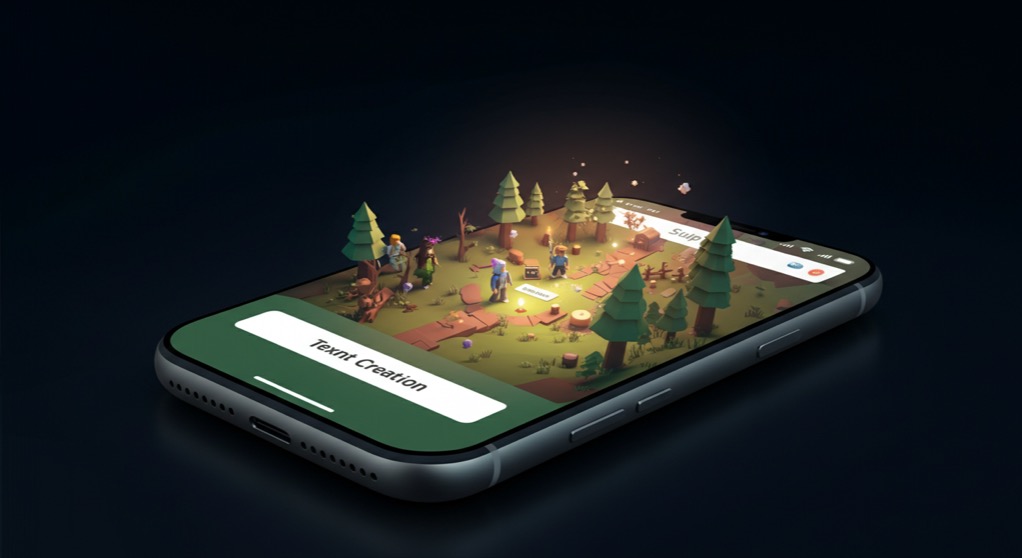
Roblox has 80 million daily active users, a number that most social platforms would envy. But Roblox is not a social platform in the traditional sense. It is a creation platform where those 80 million users do not just play games. They also build them. And starting July 28, they will be able to build them without writing a single line of code. That is the promise of Build, Roblox's new AI-powered feature that generates complete games from a single text prompt on mobile.
The announcement landed on July 16, 2026, alongside a developer blog post detailing how Build works under the hood. The feature is being positioned as the most significant expansion of Roblox's creator tools since the platform launched its original game creation system. And it arrives at a moment when the gaming industry is deeply divided over whether generative AI is a creative revolution or an existential threat.
What the Build Feature Actually Does
Build lets a user type a prompt like 'Let's make a cozy adventure game set in a dense forest' and receives a complete, playable game on their mobile device. The AI generates gameplay mechanics, the environment, characters, visual style, sound design, and more. According to Roblox, the system is powered by a broad set of AI models that include both open-source and proprietary Roblox models working in concert.
The output is not a final product. It is an initial version that users can then modify, customize, and share. Roblox is explicitly not positioning Build as a replacement for its existing creation tools, which include the widely used Roblox Studio. Instead, Build is designed as an on-ramp. A user who generates a game with Build can later open it in Roblox Studio to make deeper edits, add custom logic with Luau scripting, and fine-tune the experience.
The feature enters public alpha on July 28. It will be available first to users in New Zealand aged nine and older who have verified their age. Users aged 16 and up can publish their creations to a global audience. Roblox plans to offer both a free basic version and paid premium tiers with additional capabilities, though specific pricing has not been announced.
Beyond Build itself, Roblox is developing AI agents that will assist creators with playtesting and analytics. These agents will simulate players interacting with a game and surface potential issues before the game goes live. Roblox is also working on a scene-generation model that can create editable 3D environments from text prompts, which would allow creators to generate and then modify specific scenery rather than accepting whatever the AI produces wholesale.
The Quality Signal Problem That Every AI Platform Faces
When any platform lowers the barrier to creation this dramatically, a predictable problem emerges: volume overwhelms quality. If anyone can generate a game in 30 seconds, the platform will be flooded with low-effort content. Gaming veterans have raised exactly this concern, warning that AI-generated games could bury human-built creations under an avalanche of derivative content that all looks and feels the same.
Roblox's answer to this is retention-based discovery. The same system that ranks all other games on the platform will apply to AI-generated games. If a game is not played, it will not be surfaced. Roblox's discovery algorithms are designed to highlight games that keep players coming back over days and weeks, not games that get a single session and are abandoned. The company has stated this explicitly: 'The quality of games on the homepage isn't changing. If no one plays it, no one can find it.'
This is an elegant solution because it aligns incentives. It does not require Roblox to manually curate or review every AI-generated game. It does not require a team of moderators to decide what counts as quality. It simply lets user behavior do the filtering. A game that retains players gets promoted. A game that does not sinks into obscurity automatically. For any founder building an AI-powered content platform, this retention-based filtering approach is worth studying closely. It solves the signal problem without creating a moderation bottleneck.
The Industry Backlash and the Numbers Behind It
Roblox is launching Build into a conflicted industry. The 2026 Game Developers Conference State of the Game Industry survey found that 52% of game development professionals believe generative AI is having a negative impact on gaming. That is a majority. It is not a fringe opinion. It reflects real concerns about job displacement, creative homogenization, and the devaluation of craft in game development.
Companies like Google, Microsoft, and Tencent have built similar AI game generation tools, but none operate at Roblox's scale. Roblox's user base skews young, and its creator community includes millions of children who have learned to build games through its existing tools. For that community, Build represents both an opportunity (faster creation, lower barrier to entry) and a threat (the sense that their skills may become less valuable if anyone can generate games with a prompt).
Roblox's response has been careful. The company emphasizes that Build is not replacing Roblox Studio or Luau scripting. It is adding another entry point. The most successful creators will still need to polish, customize, and iterate on their AI-generated foundations. The platform is betting that AI lowers the initial friction of creation but does not eliminate the need for craftsmanship on top.
The timing of this launch also reflects a broader strategic shift. Roblox recently disclosed plans to discontinue Roblox Connect, its avatar-based video calling feature launched in 2023. The company is consolidating around its core value proposition: creation. Build is the most visible signal yet that Roblox believes its future is tied to making creation accessible to everyone, not just the minority of users who can write Luau scripts.
Key Lessons for Founders
There are three takeaways from Roblox's Build launch that apply directly to founders building AI-powered platforms, regardless of industry.
First, AI is a new on-ramp, not a replacement for existing tools. Roblox is not removing Roblox Studio. It is adding Build alongside it. The most successful AI-powered platforms will be those that expand their addressable creator base without alienating their existing power users. If you are building an AI product in any creative domain, ask yourself: does this tool help new users start, or does it try to replace the tools that experts already love?
Second, retention-based discovery is the only scalable quality filter for AI-generated content. Roblox could have tried human curation. It could have built a review queue. It could have required AI-generated games to pass a quality gate before being published. Instead, it let user behavior do the work. The signal problem is not going away. Volume will always outpace moderation capacity. The platforms that solve this will be the ones that build discovery systems that reward quality automatically.
Third, manage creator community sentiment as carefully as you manage technical capability. Fifty-two percent of game developers see generative AI negatively. That number should terrify any founder building AI tools for creative professionals. The technology may work. The market may exist. But if the creators you need to adopt your tool see you as a threat rather than an enabler, you will face an uphill battle that no feature set can solve. Roblox is handling this by emphasizing augmentation over replacement. Founders in every domain from music production to video editing to design tools should take note. The message matters as much as the model.