
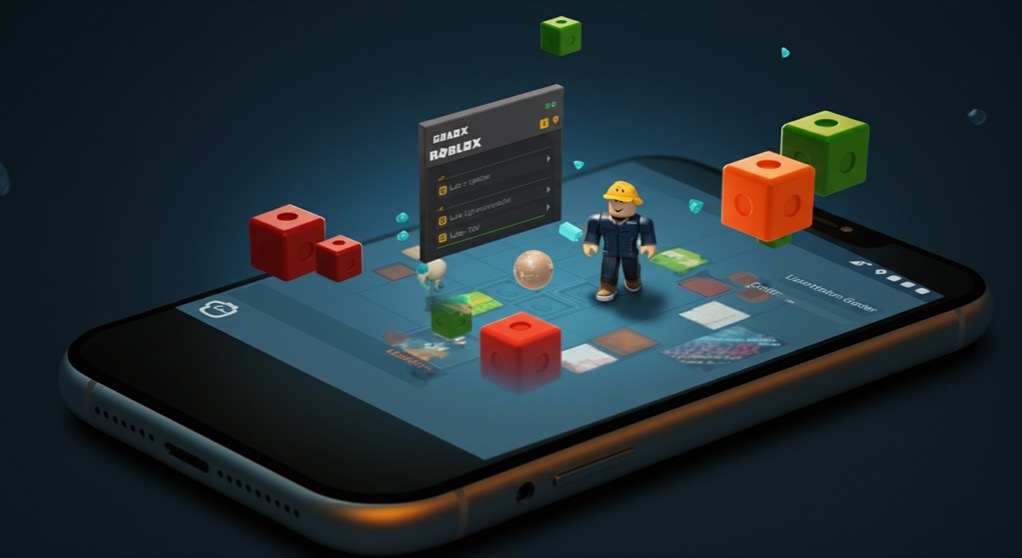
Seventy million daily active users just got a generative AI game creation tool in their pocket. Roblox rolled out "Assistant" to its iOS and Android apps on July 16, 2026, letting anyone describe a game feature in natural language and have the platform generate the corresponding Lua code and 3D assets in real time. This is the largest deployment of generative AI for end-user coding by active users, and it fundamentally changes what it means to be a game creator on mobile.
What Roblox Assistant Actually Does
The Assistant lives inside the Roblox mobile app's creation mode. A user taps the Assistant button and types a prompt: "Make a forest with a hidden treasure cave" or "Create a quest system with three levels and a boss at the end." The AI generates Lua scripts, terrain geometry, and game logic on the fly, updating the experience in real time. Roblox built the system on a proprietary foundation model trained on millions of user-created experiences from the platform's own catalog, giving it an unusually deep understanding of what Roblox game creation looks like in practice.
Before Assistant, mobile game creation on Roblox was limited to placing prebuilt parts and adjusting simple properties. Full coding required a desktop computer, the Roblox Studio IDE, and knowledge of Lua syntax. The Assistant collapses that workflow into a conversation. A user can iterate by refining their prompt: "Make the cave darker" or "Add a score counter that tracks coins." Each refinement regenerates the relevant code and assets without requiring the user to understand the underlying implementation.
This is not a wrapper around a general-purpose LLM. Roblox trained the model on platform-specific data, meaning it understands Roblox's physics engine, its monetization APIs, its lighting system, and its avatar customization framework. The Assistant generates code that actually works within Roblox's constraints, which is the hard part that general coding assistants cannot solve for a proprietary platform.
Why This Matters Beyond Gaming
Roblox's Assistant is the first time a mainstream consumer platform with tens of millions of young users has made natural-language-to-code the default creation interface. For the millions of kids and teens on Roblox, "writing software" will mean describing what they want to build, not typing syntax. This normalizes a mode of interaction that most adults still think of as futuristic or niche. The generation that grows up with Assistant will expect every tool to work this way.
For founders building dev tools, the implications are immediate. The next cohort of developers entering the workforce between 2030 and 2035 will have spent their formative years building games by describing intent. They will find traditional IDEs archaic. They will expect AI to handle syntax, scaffolding, and boilerplate as a baseline feature, not a premium add-on. Tools that treat AI as a copilot rather than the primary interface will feel retro by comparison.
Roblox's model also demonstrates a specific strategic playbook: train on your own user-generated content, deploy the AI inside your existing creation tools, and monetize through your marketplace. Any UGC platform with a large content corpus games, design, video, music can replicate this. The platform becomes smarter the more its users create, creating a data flywheel that competitors without comparable content libraries cannot easily match.
The Competitive Landscape Shifts
Unity and Unreal Engine now face pressure to deliver mobile-first AI creation tools of their own. Both platforms have desktop AI assistants, but neither has deployed a mobile-native creation experience at Roblox's scale. Roblox's advantage is structural: its entire business model depends on user-generated content, so it can invest aggressively in creation tools without worrying about cannibalizing professional tool sales. Unity and Unreal serve professional developers whose workflows are fundamentally different from a teenager building an obstacle course on a phone.
For the broader AI coding market, Roblox's Assistant validates a thesis that has been debated since GitHub Copilot launched: that the end state of AI-assisted development is not a better autocomplete but a completely different interaction paradigm. Copilot and Cursor are still anchored to the file-and-function mental model. Roblox's Assistant discards it entirely. The user describes what they want; the platform makes it happen. That distinction becomes more important as context windows grow and models get cheaper, because the bottleneck shifts from what the AI can generate to what the user can imagine.
What This Means for Builders
For founders building AI-powered creation tools, Roblox's launch offers three concrete lessons. First, platform-specific training data is a durable moat. A general model cannot match the output quality of a model trained on the platform's own content and constraints. If you are building an AI tool for a specific domain, invest in domain-specific training sets from day one. Second, the mobile-native AI creation interface is underbuilt. Roblox is the only major platform to ship this at scale. There are opportunities in video editing, music production, 3D modeling, and document creation on mobile that no one has captured yet. Third, the flywheel matters more than the model. Every creation on Roblox feeds back into the training data. Founders should design their products so that user output improves the AI, creating a compounding advantage over time.
Watch for the first "AI-native" Roblox games built entirely by non-coders to hit the top charts. When they do, the conversation about AI replacing developers will shift from theory to observable reality.