
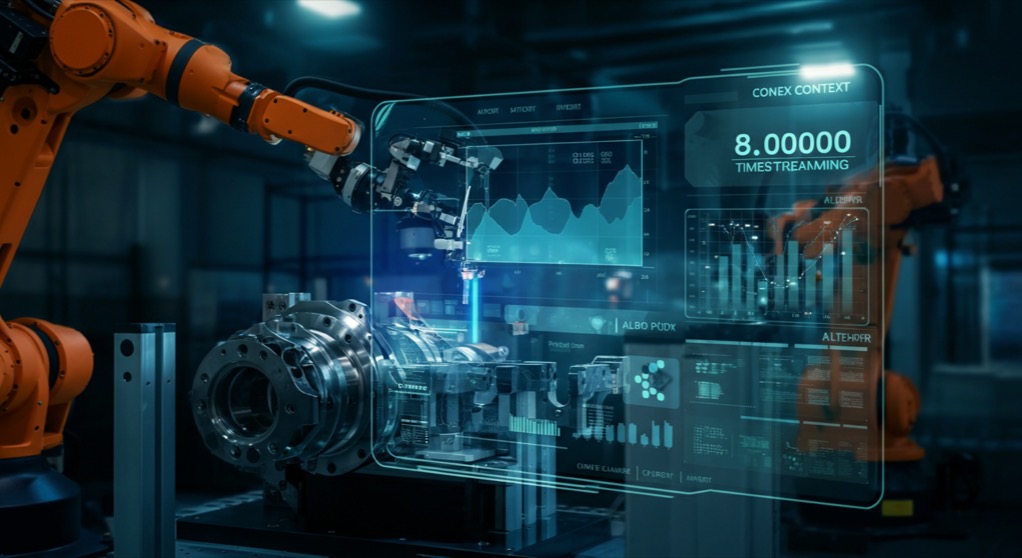
Consider a robot tasked with assembling a piece of furniture that requires ten distinct steps spread across five minutes. Until last week, no AI policy in existence could handle that task from start to finish. Today, a new paper from a team including Stanford professor Li Fei-Fei and NVIDIA senior research scientist Linxi "Jim" Fan has shattered that ceiling. RoboTTT (Test-Time-Training Robot Policies) scales visuomotor context to 8,000 timesteps, three orders of magnitude beyond what previous state-of-the-art robot policies could manage, and does it without increasing inference latency. On real-robot manipulation tasks, RoboTTT improves overall performance by 87% over single-step context baselines. But the headline number is this: RoboTTT trained with 8K-timestep context outperforms the same model trained with just 1K timesteps by 62%, suggesting that context length may be the next great scaling axis for robot foundation models.
The paper, published on arXiv on July 16, 2026, represents a collaboration between NVIDIA, Stanford University, and the University of Washington led by Yunfan Jiang, Yevgen Chebotar, and ten other authors. Its implications extend far beyond academic robotics labs. If RoboTTT's approach generalizes, it could unblock long-horizon robot tasks that have been considered impossible: surgical procedures spanning hours, assembly lines requiring dozens of sequential operations, and household chore robots that follow multi-hour, multi-room instructions. For anyone building in robotics, embodied AI, or autonomous systems, this is the kind of paper that fundamentally shifts what is possible.
The Context Problem in Robot Foundation Models
Current robot foundation models such as Vision-Language-Action (VLA) policies operate with strikingly limited context. Most process a single frame or, at best, a short history of frames, typically 2 to 8 timesteps. This short-context limitation creates a fundamental blind spot: the robot cannot remember what it did three seconds ago, let alone three minutes ago. It has no persistent understanding of task progress, no way to recover from a temporary failure, and no mechanism to adapt its behavior based on how a task has unfolded so far.
The naive solution of simply extending the context window is computationally prohibitive. Standard transformer-based architectures grow inference latency quadratically with context length. Doubling the context from 1K to 2K timesteps does not double the compute requirement, it quadruples it. This scaling wall has effectively capped robot context at the single-digit range for real-time, closed-loop operation where decisions must be made at 10-30 Hz.
RoboTTT's central innovation is recognizing that the problem is not one of architecture but of mechanism. Instead of storing history in a longer context buffer, the model compresses history into its own weight space using gradient descent at inference time. This is test-time training (TTT): the model continuously updates its own parameters as it operates, effectively writing its memory into the weights themselves. The result is a recurrent state made of fast weights that grows with model capacity, not with time, eliminating the quadratic scaling penalty entirely.
How RoboTTT Achieves 8,000-Step Context Without Latency Growth
The technical recipe involves two key components. First, the model integrates Test-Time Training into existing robot foundation model architectures. At each step, the model performs a lightweight gradient update on its own weights, compressing recent observations and actions into a compact internal representation. At inference time, this means the model carries a continuously updated model of the task context, compressed into the parameters themselves rather than into a growing attention buffer.
Second, the training recipe combines sequence action forcing with truncated backpropagation through time (TBPTT). This allows the model to be trained on long sequences of up to 8,000 timesteps without the memory explosion that naive backpropagation would cause. The combination yields a model that learns to compress effectively during training and then applies that compression capability at test time.
The results on real robot hardware are dramatic. On a set of challenging real-robot manipulation tasks, RoboTTT achieves an 87% improvement in overall performance over a single-step context baseline. More impressively, it is the first model to fully complete a five-minute, ten-stage assembly task, a task that every single baseline failed at entirely. The scaling trend is remarkably clean: 8K context outperforms 4K by 35%, which outperforms 2K by 28%, which outperforms 1K by 62% overall versus the 1K baseline. The paper reports steady, monotonic gains as pretraining context length scales, the first time this has been observed in closed-loop robot performance.
New Capabilities Unlocked by Long-Context Robot Policies
Beyond raw performance numbers, the paper demonstrates qualitatively new robot capabilities that simply did not exist before. The most striking is one-shot in-context imitation from human video demonstrations. A human can show the robot a task once via video, and RoboTTT can reproduce the behavior, not by matching frames but by understanding the task structure from the demonstration compressed into its context. This is fundamentally different from behavior cloning, which requires dozens or hundreds of demonstrations.
The model also exhibits on-the-fly policy improvement. As it operates, RoboTTT continuously updates its own policy based on new observations, effectively getting better at the task while doing it. This is reminiscent of how humans improve at a task through repetition, even within a single attempt. The robot can adapt to perturbations, tool slippage, object displacement, and lighting changes without failing or requiring a reset.
Multi-stage, long-horizon tasks are where RoboTTT truly separates itself. The ten-stage assembly benchmark involves picking, placing, aligning, fastening, and verifying, with each stage dependent on the success of the previous one. Previous models would fail at stage three or four and never recover. RoboTTT not only completes all ten stages but maintains consistent performance throughout the five-minute duration.
What This Means for Builders
For founders and engineers building in robotics and embodied AI, RoboTTT introduces a new fundamental capability: long-horizon autonomy without quadratic compute scaling. The immediate implication is that robot applications previously considered infeasible, such as assembly lines, surgical robotics, and warehouse logistics with 50+ step workflows, become addressable with current hardware.
The paper also provides a practical recipe. The test-time training approach requires no new hardware, just a model architecture that supports online gradient updates during inference. Teams building on VLA-style robot foundation models can integrate TTT as a drop-in modification to their existing architectures. The TBPTT training recipe is well-understood in the sequence modeling community and straightforward to implement.
For the broader AI community, RoboTTT suggests that context scaling may be a universal axis of improvement across modalities. If compressing history into weights via test-time training works for visuomotor policies, it is worth asking whether the same approach could extend to language models, video generation models, or any sequential decision-making system where long-context understanding matters. The paper's core insight, that memory does not have to live in the context window, represents a design principle that may influence model architecture decisions for years to come.
Full paper available on arXiv at arxiv.org/abs/2607.15275. Project page with demonstration videos at research.nvidia.com/labs/gear/robottt/. Watch the five-minute assembly task. It is the kind of video that changes what you believe is possible in robotics.