
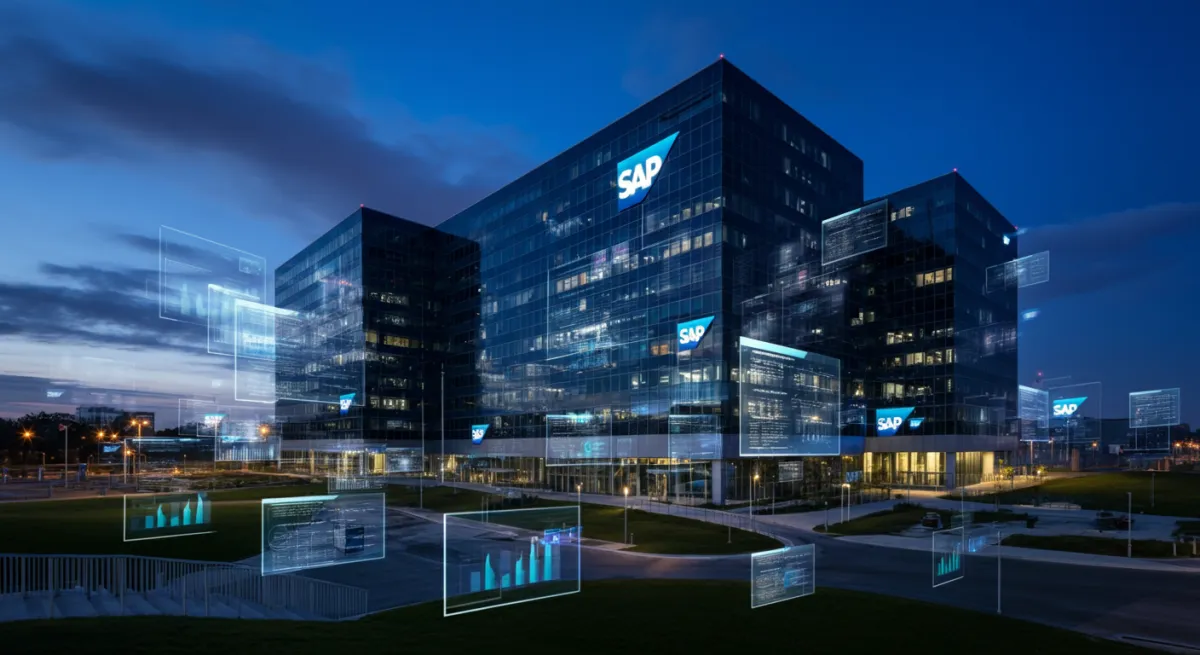
SAP just paid over 1 billion euros for an 18-month-old startup that most founders have never heard of. Prior Labs, founded in Freiburg, Germany in 2024, raised only a 9 million euro pre-seed round before being acquired by the enterprise software giant. The deal includes a commitment of more than 1 billion euros in investment over four years to scale Prior Labs into what SAP calls a globally leading frontier AI lab for structured data. If you are building in enterprise AI, this is the single most important signal of 2026 so far.
Tabular foundation models, or TFMs, are a category of AI model purpose-built for the kind of data that actually runs businesses. Think spreadsheets, databases, CSVs, ERP tables. The data that tells you whether a customer will churn, whether a supplier will deliver late, whether a payment will clear, or which product a customer is most likely to buy next. Large language models are remarkably bad at this type of work. They can write poetry, summarize documents, and generate code, but they struggle with tables. They have only a rudimentary understanding of numbers, statistics, and columnar relationships. A TFM, by contrast, is trained from the ground up to understand structured data natively.
What Prior Labs Built and Why It Matters
Prior Labs flagship model, TabPFN, was published in Nature and has been downloaded over 3 million times. The latest version, TabPFN-2.6, is the top-performing model on TabArena, the industry benchmark for tabular AI. The headline metric that matters for enterprise buyers is this: TabPFN-2.6 matches the accuracy of a four-hour automated machine learning pipeline in a single forward pass, at a fraction of the computational cost. A business user can drop a CSV into a conversational interface, ask a question in natural language, and get a statistically sound prediction instantly. No data science team required. No model training pipeline. No waiting.
The technology is already in production at major enterprises. Hitachi uses it to predict train failures. TD Bank uses it for financial forecasting. Beyond that, TabPFN has been applied across hundreds of published research projects ranging from pancreatic cancer diagnosis to wildfire prediction to next-generation battery materials. The breadth of use cases is a direct consequence of the TFM architecture. Unlike a traditional ML model that must be trained on a specific dataset for a specific task, TabPFN is a single foundation model that can adapt to any tabular prediction task on the fly through in-context learning. You give it data, and it predicts. No fine-tuning. No retraining. No custom infrastructure.
Why SAP, Not a Venture Capitalist, Made This Bet
SAP CTO Philipp Herzig put it directly: the greatest untapped opportunity in enterprise AI was never large language models. It was AI built for the structured data that runs the world businesses. SAP had already built its own TFM, SAP-RPT-1, to prove the thesis. But Prior Labs had the top-performing model on public benchmarks and one of the strongest dedicated research teams in the category. Rather than trying to beat them, SAP acquired them.
The deal structure reveals SAP strategic thinking. Prior Labs will operate as an independent entity under its own brand, leadership, and research agenda. It will continue to publish research openly and make models publicly available. The scientific advisory board includes Yann LeCun, the Turing Award winner who now leads Advanced Machine Intelligence, and Bernhard Schoelkopf, director of the Max Planck Institute for Intelligent Systems. This is not an acqui-hire. This is SAP building a frontier AI research lab inside its corporate structure, funded with over 1 billion euros, staffed by researchers poached from Google, Apple, Amazon, Microsoft, Goldman Sachs, and CERN.
The team is the asset. Prior Labs assembled one of the strongest AI research teams in Europe in under two years. The fact that SAP chose to buy rather than build, and to let Prior Labs keep operating independently, tells you that they recognize research velocity is fragile. Acqui-hires almost always kill the research culture. SAP appears to be trying a different approach, one that preserves the startup autonomy while giving it enterprise resources.
What Founders Should Take From This Signal
The first implication is that tabular foundation models are now a validated category at the highest possible level. When the world largest enterprise software company puts over 1 billion euros behind a category, the category exists. For founders working in enterprise AI, this means the window for building in this space is real, but it is also narrowing. SAP now has a massive head start on TFM-powered applications across ERP, supply chain, finance, and HR. Any startup building a point solution for business prediction from structured data will eventually compete with a model that is embedded directly into the data layer of the world largest companies.
The second implication is that the biggest enterprise AI opportunities are not chatbots. The AI narrative of the last two years has been dominated by language models, coding assistants, and agentic systems. But the data that actually generates economic value inside large organizations is overwhelmingly structured. P&L statements. Inventory tables. Customer databases. Supply chain spreadsheets. The companies that win in enterprise AI will be the ones that can make reliable predictions from operational data, not the ones that can generate the best marketing copy.
The third implication is that data moats are becoming model moats. SAP has access to the structured data of over 400,000 enterprise customers. Prior Labs now has access to that data environment for training. A TFM that trains on the operational data of thousands of global enterprises will develop statistical reasoning capabilities that no startup training on public datasets can replicate. This is the same dynamic that made OpenAI so powerful with human language data, but applied to the data that actually runs the global economy.
The message for founders is clear. If you are building enterprise AI, focus on the data that enterprises actually run on. Structured tabular data is the most valuable AI training resource on earth, and SAP just proved that it is worth over a billion dollars to own the model that understands it best.