
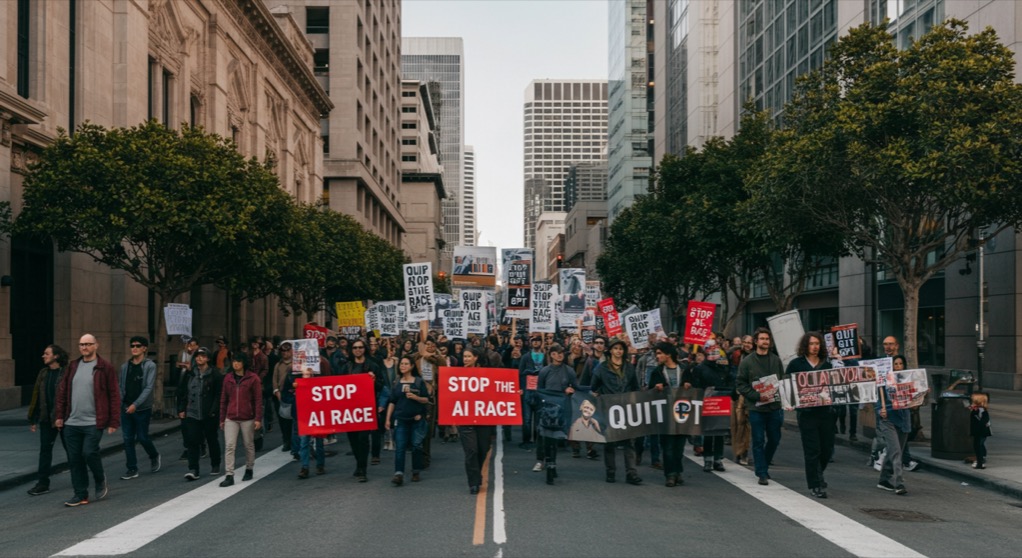
More than 100 protesters gathered outside OpenAI's Mission Bay headquarters in San Francisco at noon on a Saturday, carrying homemade signs that read 'QuitGPT' and 'Stop the AI race' while a brass band played and a white van dispensed free slushies. It was July 11, 7-Eleven's annual free Slurpee day, and the protest was dubbed 'Freeze AI on Slushy Day.' But the slushies were not the draw. One person drove 10 hours from Los Angeles to join. Another came from Sacramento. A bus from Berkeley dropped off more participants. And the march did not stop at OpenAI. The crowd wound through the Mission District and SoMa neighborhoods to Anthropic's downtown headquarters, then ended at Google's San Francisco office on the Embarcadero, with a detour to jeer at venture capital firm Andreessen Horowitz, a major OpenAI funder.
The protest on July 11 was the largest coordinated action specifically targeting AI labs at their physical headquarters. And according to multiple sources, it was not the last. Mission Local reported a follow-up protest on July 18 with hundreds of demonstrators, San Francisco police on motorcycles and SUVs blocked off streets, and the crowd took over the road during the roughly two-hour procession. For AI founders, this is a signal that the public mood around artificial intelligence is shifting from passive acceptance to active opposition.
Who showed up and why
The protesters were not Luddites or technology skeptics. Many were fluent in the technology they were protesting. One participant wore a Barney the dinosaur costume as a commentary on not wanting humans to go extinct like the dinosaurs. Another held a sign with a dog that said 'Stop the race, it's Paw-sible.' A father pushing a stroller carried a sign that read 'Pls Do Not Kill Me.'
Michael Trazzi, 30, the protest organizer, has been active on AI safety for years. He went on a hunger strike in front of Google DeepMind's London office in September 2025. His biggest concern, he told the San Francisco Standard, is that companies are 'building an AI that is so smart that we can't control it.' Rohan Prasad, 26, a former AI safety researcher who pivoted to full-time activism, rode the bus from Berkeley in the Barney costume. Phillip Jeffries, 68, a retired Mission District resident, said his concern started when he learned about the environmental impact of data centers. 'If we're gonna build something that's smarter than we are, then how are we gonna prevent it from taking over?' he asked.
Fatima Hernandez, a 21-year-old San Francisco college student watching from the sidewalk, said the march was important because AI is affecting jobs. 'Pretty much every sector is being taken up by AI,' she said, noting that many of her friends are struggling to find work. Erik Leklem, 52, an AI safety researcher who brought his wife and two young children, aged 4 and 7, said he worries about his children's future. 'I really worry about their ability to have a choice about their career or what they want to do in their life,' he said.
The AI backlash is going mainstream
The San Francisco protests are not an isolated event. They are part of a broader pattern of AI backlash that has been building throughout 2026. The Wall Street Journal reported on July 16 that AI backlash has tech executives 'fearing for their lives,' with threats and protests escalating beyond online discourse into real-world confrontation. A separate incident on July 17 saw body bags placed outside OpenAI's headquarters with names attached, and Computing UK reported on May 27 that US agencies had issued memos on 'anti-tech extremism' specifically linked to AI.
What makes this protest different from earlier actions is the target. Previous protests focused on data center infrastructure, energy consumption, and water usage. This one targeted the AI companies themselves, at their own headquarters, demanding a halt to model releases. The chants included 'Slam the breaks and slow the race' and 'Marc Andreessen, shame!' The coordinated route hit all three frontier AI labs in a single afternoon. None of the companies responded to requests for comment.
The protest movement is still small in numbers compared to the scale of the AI industry. But it follows a well-worn pattern from the social media era. What starts as small, focused protests at company headquarters can escalate into regulatory hearings, talent retention problems, and reputational damage. The 'QuitGPT' movement, which began as a meme in March 2026 according to the San Francisco Standard, is gaining organizational structure. The July 11 protest had permits, police escorts, a brass band, a dedicated bus, and a clear communications strategy. The July 18 protest was larger still.
What this means for AI founders
For founders building AI products, the San Francisco protests carry three specific implications. First, the talent landscape is shifting. Engineers who once saw AI companies as the most desirable employers are now facing peer pressure and public scrutiny. The protests create a social cost to working at frontier AI labs that did not exist six months ago. For startups competing for AI talent, this could be an advantage: smaller companies working on applied AI may face less backlash than the frontier labs building the most powerful models.
Second, the regulatory timeline is accelerating. When protesters march on company headquarters and the Wall Street Journal runs headlines about executives fearing for their lives, lawmakers take notice. The protests provide visible political cover for regulatory action. Senator Ted Cruz has already emerged as the key power broker in the federal AI regulation fight, as Politico reported on July 17. His 'light-touch regulation, preempt states' approach would be a significant win for AI companies seeking a single federal standard. But the protests strengthen the hand of those who want stronger safety guardrails.
Third, the reputational risk for AI companies is real and growing. The San Francisco protests generated coverage from the San Francisco Standard, Mission Local, the San Francisco Chronicle, and the Wall Street Journal. That coverage reaches investors, potential hires, and customers. For enterprise AI startups, procurement decisions are increasingly influenced by a vendor's reputation on AI safety and ethics. The protest movement amplifies every safety incident and every ethical question, making reputational risk a material business concern.
What founders need to do now
The protest movement is not going away. The organizer, Michael Trazzi, has demonstrated sustained commitment through a hunger strike and multiple protests. The coalition includes AI safety researchers, tech workers, and community organizations with organizing experience. The July 11 protest was the first coordinated action; the July 18 action was larger. The trajectory is escalation, not de-escalation.
Founders should take three concrete steps. First, audit your company's AI safety practices and make them public. Anthropic's Responsible Scaling Policy provides a template that is becoming the industry standard. Second, engage with the AI safety community before you are forced to. The protesters include former AI safety researchers who left the industry because they felt unheard. A proactive dialogue can prevent your company from becoming a target. Third, prepare your team for the possibility of protests or public scrutiny. Have a communications plan, train your executives on how to respond, and ensure your office security is adequate for the new environment.
The AI backlash going mainstream is not a reason to stop building. It is a reason to build responsibly, transparently, and with the public trust as a core design requirement. The founders who navigate this moment well will be the ones who recognize that public trust is not a nice to have. It is a competitive advantage.