
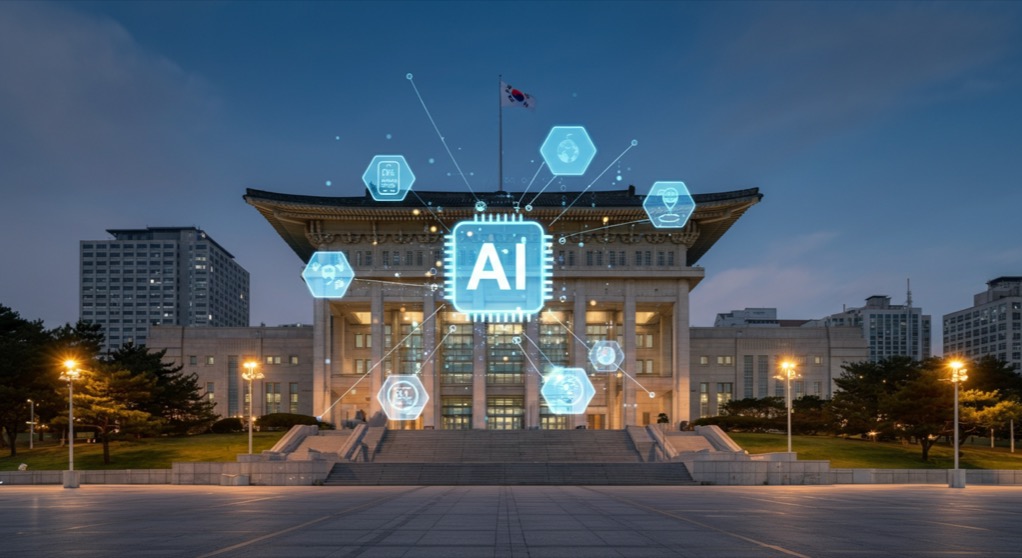
What happens when a G20 nation decides that AI access is a public utility, like water or electricity, and gives every single citizen free, unlimited access to it? South Korea is about to find out. On July 19, 2026, President Lee Jae-myung announced the "AI for All" initiative, making South Korea the first G20 country to guarantee every citizen free, unlimited access to a domestic AI chatbot service. The project deploys 512 GPUs across national infrastructure, mandates that more than 80% of AI model usage must come from domestic Korean models, and has already drawn commitments from Naver, Kakao, ESTsoft, and major telecom providers to participate as service providers. The service is scheduled to launch in December 2026, with the Ministry of Science and ICT overseeing the procurement process. President Lee has ordered that the free service continue beyond 2028, effectively establishing a permanent national AI utility.
The scale is unprecedented. No other government has attempted to deliver universal, free AI access to its entire population as a public service. South Korea is treating AI the way previous generations treated broadband internet or public education: as infrastructure that every citizen is entitled to use. For the global AI industry, this represents both a massive new market and a structural shift in how AI services are delivered at the national level.
How the "AI for All" Model Works
The initiative is built on a procurement model, not a direct government build. The Ministry of Science and ICT is issuing tenders for AI service providers who will deliver chatbot and AI assistant capabilities to South Korean citizens through existing platforms. Naver, which operates the dominant search portal in Korea, is expected to offer its HyperCLOVA models through the program. Kakao, the operator of KakaoTalk, the messaging platform used by over 90% of South Koreans, will similarly integrate its AI capabilities. ESTsoft, the software company behind the leading Korean language models Alpan and Pororo, rounds out the initial cohort of domestic AI providers.
The 80% domestic model mandate is the most consequential policy detail. It means that for every five AI interactions a Korean citizen has through the program, at least four must be served by domestic Korean models. Foreign frontier models from OpenAI, Anthropic, Google, and Meta are effectively capped at 20% of total usage. This is not a technical limitation but a procurement policy designed to build sovereign AI capacity. The 512 GPUs being deployed are intended to support domestic model inference at national scale, ensuring that Korean AI companies have the compute infrastructure to serve the entire population.
The service is scheduled to go live in December 2026, giving the Ministry and participating providers roughly five months to build, test, and deploy the infrastructure. Given the scale of the undertaking, this timeline is aggressive. South Korea is effectively building a national AI platform from scratch, with the expectation that it will serve over 50 million users from day one.
The Sovereign AI Playbook: What South Korea Is Really Building
The "AI for All" initiative is the clearest signal yet that sovereign AI is becoming a real market force, not just a policy aspiration. South Korea is positioning itself as the first nation to treat AI as a public utility, and in doing so, it is creating a model that other countries will likely follow. Japan, India, and several European nations have already signaled interest in national AI infrastructure programs. South Korea is moving first, and its choices will shape the template.
The domestic model mandate is the heart of the strategy. By guaranteeing usage volume for Korean AI models, the government is effectively providing a demand-side subsidy to domestic AI companies. Naver, Kakao, and ESTsoft will have access to tens of millions of daily active users through the program, generating the usage data and revenue needed to improve their models. This is how countries without frontier AI companies can build them: not through direct investment alone, but through guaranteed national demand that creates a sustainable business model.
The approach mirrors how South Korea built its semiconductor industry. In the 1980s and 1990s, the government provided guaranteed demand for domestic memory chips through procurement policies and public infrastructure projects, giving Samsung and SK Hynix the scale they needed to compete globally. The "AI for All" initiative applies the same playbook to AI. The question is whether AI models, unlike memory chips, are sufficiently differentiated that domestic models can match frontier quality. The park where existing Korean AI models stand relative to GPT-5, Claude Sonnet 5, and Gemini 2.5 will determine whether citizens perceive the free service as a benefit or a limitation.
What the Domestic Model Mandate Means for Global AI Companies
The 80% domestic model mandate is effectively a structural cap on foreign AI companies in one of the world's most technologically advanced markets. South Korea has over 50 million citizens and one of the highest smartphone penetration rates globally. The "AI for All" program will serve as the primary AI interface for most of them. For OpenAI, Anthropic, Google, and Meta, being limited to 20% of interactions through this channel represents a significant market access barrier.
This is not an outright ban. Foreign models are not prohibited. But the policy creates a strong incentive for Korean companies to prioritize their own models and for citizens to default to domestic AI services. Over time, the usage data advantage alone could help Korean models close the quality gap with frontier foreign models. If Naver's HyperCLOVA or Kakao's AI models serve 40 million daily users through the program, they will accumulate more real-world interaction data than any Western model has in Korea.
For founders building AI products, the implication is clear: sovereign AI markets are emerging, and they come with structural advantages for domestic players. If you are building an AI product for the Korean market, partnering with a domestic model provider may be essential. If you are building a global AI product, the fragmentation of the AI model market into national and regional blocs is accelerating. The unified global AI market that many assumed would emerge is giving way to a more fragmented landscape where domestic models serve domestic users.
The Feasibility Questions That Will Define the Program
For all its ambition, the "AI for All" program faces serious feasibility questions. The first is compute. 512 GPUs is a meaningful deployment but not obviously sufficient to serve 50 million users with low latency. By comparison, ChatGPT at peak serves tens of millions of users per day using tens of thousands of GPUs. Even accounting for lower model complexity and caching efficiency, 512 GPUs represents a fraction of what most frontier AI services deploy. The government may need to scale GPU procurement significantly before the December 2026 launch.
The second question is model quality. Korean language AI models have improved dramatically over the past two years, but they still trail frontier Western models on complex reasoning, coding, and multilingual capabilities. For a Korean-language-first service, this gap may be acceptable for basic queries. But for the program to be genuinely useful, domestic models need to handle complex tasks reliably. If users find the free service noticeably worse than ChatGPT or Claude, they may simply use foreign models on their own, undermining the program's goals.
The third question is cost. Free, unlimited AI access for 50 million users is expensive. The 512 GPUs, the model training and serving infrastructure, the provider compensation, and the ongoing operational costs add up to billions of dollars annually. President Lee has ordered the service to continue beyond 2028, but maintaining a permanently free national AI service requires sustained government funding. In a country where fiscal debates over social programs are fierce, the long-term funding commitment for AI as a public utility is uncharted territory.
The Korea Times has already raised feasibility questions in its coverage, pointing out that the scale of the ambition may outpace the infrastructure readiness. The Ministry of Science and ICT has not yet published detailed cost estimates or infrastructure plans, leaving analysts to speculate about whether the December timeline is realistic.
What This Means for Founders and Builders
For founders building AI products, the "AI for All" initiative carries several direct implications. First, the Korean AI market is now structurally different from every other market. If you are building a B2B or B2C AI product for Korean users, partnering with Naver, Kakao, or ESTsoft is no longer optional. The domestic model mandate means that any AI service touched by the government program must use domestic models. Even for purely private AI services, the default consumer behavior will shift toward domestic providers.
Second, the sovereign AI model is spreading. If South Korea's program succeeds, expect Japan, India, the UAE, and other nations to announce similar initiatives within 12 to 18 months. The domestic model mandate blueprint is now public, and other governments will adapt it to their markets. For founders building AI products that depend on a single global AI model provider, the fragmentation risk is real. Building model-agnostic architectures that can switch between domestic and foreign models is becoming a strategic necessity.
Third, the program is a massive real-world test of whether domestic AI models can match frontier quality at national scale. Korean AI companies have five months to prove that their models are good enough for 50 million users. If they succeed, it validates the sovereign AI approach globally. If they struggle, it sets back the domestic model agenda by years. Either outcome is valuable intelligence for founders evaluating which AI model ecosystem to bet on.
For the broader AI industry, South Korea has fired the starting gun on the national AI utility race. The question is no longer whether governments will build national AI infrastructure. It is who will do it next, and whether the quality gap between domestic and frontier models can close fast enough to make universal free AI access a genuine public good rather than a second-tier alternative.