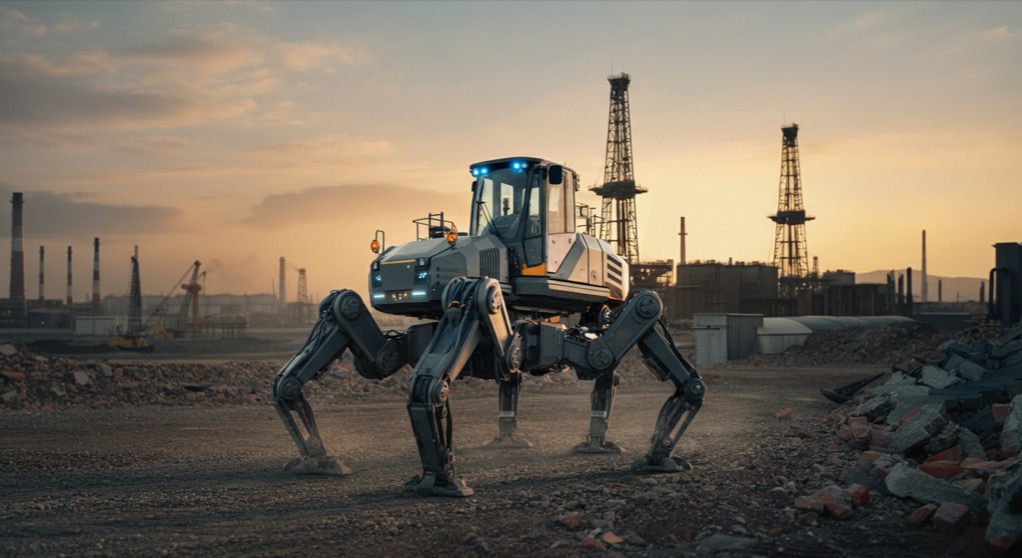
What do you do when a wheeled robot cannot climb the stairs, cross the rubble, or carry the equipment? For a growing number of industrial operators, the answer is a quadruped robot from Strider Robotics, a Bengaluru-based startup that just demonstrated a 40 kg payload legged robot and began commercial pilots with a major oil and gas company and an automotive manufacturer. The 40 kg figure matters: it is roughly double the payload of Boston Dynamics' Spot (which carries about 14 kg) and opens up use cases in heavy equipment transport, tool delivery on construction sites, and payloaded inspection rounds in hazardous environments. Strider has a full-stack AI platform that combines autonomous navigation, mission planning, asset monitoring, and analytics software, and it runs on the company's own robots and third-party quadrupeds. That hardware-agnostic bet might be the most interesting part for founders watching the physical AI space.
Strider claims its latest robot contains more than 80 percent indigenous content by component cost, a stat that reflects India's push to build domestic robotics manufacturing capability rather than import from US or Chinese suppliers. The company was incubated at ARTPARK, the AI and robotics innovation hub at the Indian Institute of Science (IISc) Bengaluru, and its founders have been researching legged robotics since 2015 through work at IISc and IIT Madras. That seven-year research run before commercial launch is itself a lesson for founders chasing physical AI markets.
The Hardware: Quadruped Robots Built for Industrial Abuse
Quadruped robots are not new. Boston Dynamics has been making them dance on YouTube for over a decade. What is new is that they are entering commercial service with real payload capacity, not just viral video potential. Strider's robot can carry 40 kg of equipment across stairs, gravel, mud, and inclined surfaces that would stop a wheeled robot cold. The use cases are specific and high-value: oil and gas pipeline inspection where a human would need to walk miles of rough terrain carrying sensors, mining operations where hazardous gas pockets make human presence dangerous, and construction site monitoring where equipment, tools, and sensors need to move between floors and across uneven ground.
The autonomous navigation system uses AI-driven terrain assessment to plan paths in real time. The robot does not follow a pre-mapped route. It assesses the ground beneath each foot, adjusts stride length and foot placement dynamically, and reroutes around obstacles that appear mid-mission. This is where Strider differentiates from simpler remote-controlled quadrupeds: the AI layer handles the locomotion decisions so that the operator focuses on the inspection data, not on keeping the robot upright.
The Software: Hardware-Agnostic AI Platform
Strider's software stack is designed to work independently of its own robot hardware. The company offers an AI-powered inspection, navigation, and analytics platform that runs on third-party quadruped robots as well. This is a strategic bet that mirrors the Android playbook: capture the software layer and let hardware commoditize. If Boston Dynamics owns the premium hardware brand, and Chinese manufacturers push prices down on quadruped hardware, Strider wants to be the platform that runs inspection missions across all of them.
The platform includes mission planning tools where operators draw a route on a map and the robot executes autonomous patrols, asset monitoring that tracks equipment temperature, vibration, and gas levels during rounds, and analytics that flag anomalies in inspection data. For an oil and gas operator running daily pipeline inspections, the value is not just replacing a human walker. It is capturing structured data from every inspection and comparing it over time to predict failures before they happen.
This is the pattern founders should watch: hardware is the entry point; software and data are the recurring revenue. If Strider can lock in oil and gas customers on its analytics platform, the robot itself becomes a loss leader.
The Market: Physical AI's Real Revenue Is Industrial, Not Consumer
The physical AI narrative has been dominated by humanoid robots, consumer drones, and companion bots. The actual revenue, so far, is in industrial applications where the ROI is measurable: an inspection robot costs less than a human safety team, never calls in sick, and generates data that a human inspector would not have time to record. Strider's commercial pilots with oil and gas and automotive customers suggest the company is following the same playbook that made Boston Dynamics' Spot a commercial product: sell to enterprises that already spend millions on safety compliance and asset maintenance.
India is not an obvious robotics manufacturing hub, but Strider's 80 percent indigenous content claim points to a deliberate supply chain strategy. By sourcing motors, actuators, sensors, and structural components domestically, Strider keeps costs lower than US competitors and avoids export control complications that could block sales in Asia, Africa, and the Middle East. For founders building hardware, the supply chain strategy may matter more than the technical specs.
The competitive landscape includes Boston Dynamics (US, Spot, 14 kg payload), Unitree Robotics (China, B2, ~20 kg payload), and ANYbotics (Switzerland, ANYmal, ~10 kg payload). Strider's 40 kg claim puts it at the top of the payload range for commercially available quadrupeds, though the real test is whether the robot can sustain that payload over a full shift in real industrial conditions, not just in a demo.
What This Means for Founders
Strider Robotics is a case study in three patterns that matter for physical AI founders. First, build for a specific industrial problem, not for general-purpose locomotion. Strider started with industrial inspection, a market where customers already budget for safety compliance and asset monitoring. Second, make your software hardware-agnostic if you can. The platform play has higher margins and survives hardware commoditization. Third, own your supply chain. Strider's indigenous manufacturing strategy protects it from tariff shocks, export controls, and logistics disruptions that could kill a hardware startup dependent on Chinese or US components.
The real question is whether Strider can convert its commercial pilots into recurring platform contracts before Boston Dynamics or Unitree ship competitive software stacks. Physical AI is entering the phase where execution on go-to-market matters more than technical differentiation. For founders watching this space, Strider's next 12 months will tell us whether a full-stack approach or a platform-only approach wins in industrial robotics.