
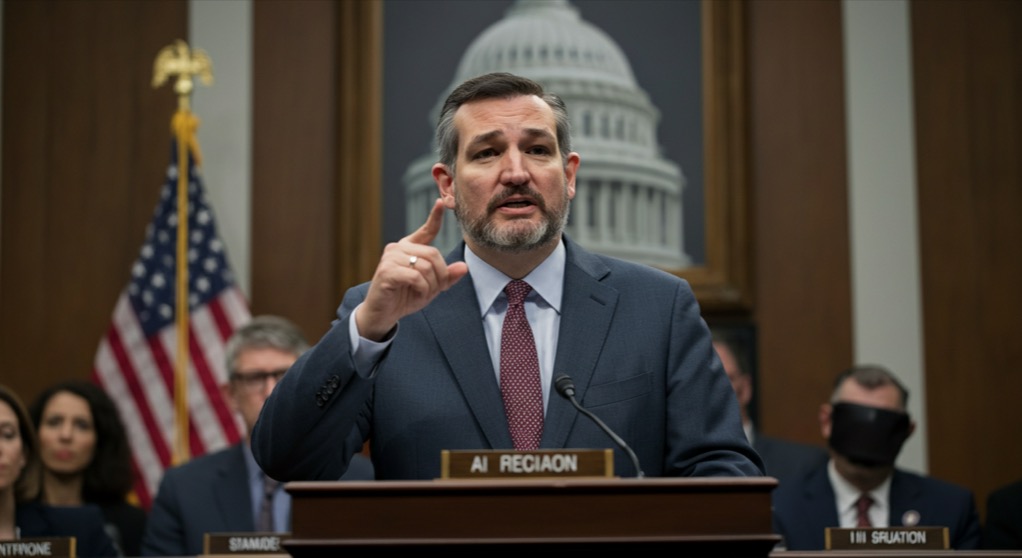
The question that will define the next decade for AI founders is not which model wins or which application takes off. It is this: who controls the rules of the game? The answer, according to a Politico report published July 17, is Senator Ted Cruz of Texas. The Republican from the Lone Star State has quietly positioned himself as the single most important figure in the federal AI regulation debate, holding the power to make or break any bipartisan legislation that reaches the Senate floor.
Cruz chairs the Senate Commerce Committee's subcommittee on AI, a perch that would be unremarkable if AI regulation were a sleeping issue. It is not. With the 2026 midterm elections approaching, a growing patchwork of state-level AI laws creating compliance chaos, and both the White House and industry leaders calling for federal action, the window to pass national AI regulation is narrow. Cruz has become the gatekeeper.
Why Cruz Holds the Cards
Cruz's position is built on a simple political reality: in a closely divided Senate, any AI bill needs bipartisan support to reach 60 votes. Cruz has staked out a middle ground that makes him indispensable to both sides. He advocates for light-touch regulation that prioritizes innovation and US competitiveness while still addressing AI safety concerns, a position that puts him at odds with the progressive wing demanding strong federal guardrails and the libertarian wing wanting no regulation at all.
That middle ground makes him the dealmaker. Progressives cannot pass an AI bill without Republican support, and the libertarian wing cannot block one if Cruz brings votes. Behind closed doors, Politico reports, Cruz has been negotiating with the White House, Senate Majority Leader Chuck Schumer, and key industry players including OpenAI and Anthropic. The core of his proposal: federal AI regulation that preempts the emerging patchwork of state laws while leaving room for innovation.
The State Preemption Question Is Existential
The single most consequential issue in the federal AI debate is whether a national law would override state-level AI regulations. Colorado has already enacted transparency requirements for AI systems. Hawaii just signed new AI protection laws covering deepfakes, chatbots, and generative AI safeguards. California, New York, and Illinois have bills in various stages of advancement. For an AI startup serving customers across all 50 states, the cost of complying with 50 different AI regulatory regimes is not theoretical. It is existential.
Cruz's position is clear: federal law should preempt state AI regulations, creating a single national standard. This is a massive win for AI companies if it passes. One compliance framework instead of fifty. One legal team instead of a regulatory department. For early-stage founders, the difference between a preemptive federal law and a state-by-state patchwork could be the difference between a viable business and one strangled by compliance overhead before it reaches product-market fit.
But there is a catch. Preemption cuts both ways. A federal law that preempts state regulations also locks in whatever standards that law sets. If the federal standard is weak, states that wanted stronger protections cannot add them. For AI safety advocates, this is the central tension: accepting a lighter federal framework in exchange for uniformity, or fighting for stronger state laws at the cost of fragmentation.
The Texas Angle and the 2028 Factor
Cruz's emergence as the AI power broker is not accidental. Texas is home to a growing AI ecosystem including the Texas AI Research Center, a cluster of AI startups in Austin, and major corporate AI operations. Cruz's tech-policy positions have historically tracked Texas business interests, and his light-touch approach reflects the state's broader regulatory philosophy. For founders, this means Cruz is not just a dealmaker but a constituency representative: he is carrying water for Texas AI interests, which happen to align closely with what most US AI founders want.
There is also a longer timeline at play. Politico notes that Cruz is positioning himself as a potential 2028 presidential candidate, and the AI regulation debate gives him a national platform on a cross-partisan issue. If Cruz brokers a major AI bill, he enters the 2028 race with a signature legislative achievement that cuts across traditional political lines. That personal ambition creates both opportunity and risk for founders. It gives Cruz a strong incentive to actually pass something, rather than letting the issue die in committee. But it also means his positioning is shaped by electoral calculations, not just policy goals.
What Founders Need to Watch
Three concrete developments will tell you whether federal AI regulation is actually happening or just being discussed. First, watch for a bill text to emerge from Cruz's subcommittee in the next 60 to 90 days. The 2026 midterms create a natural deadline: legislation that has not passed by September is unlikely to pass before the election. Second, watch which states push back on the preemption question. If California or New York signal they will fight federal preemption of their AI laws, the political calculus shifts dramatically. Third, watch the industry response. If OpenAI, Anthropic, and Google DeepMind publicly endorse Cruz's framework, it becomes very difficult for progressives to block it without being painted as anti-innovation.
For founders, the practical advice is straightforward. If you are building an AI company that serves customers across multiple US states, you should be tracking the Cruz-Schumer negotiations closely. The regulatory regime that emerges will determine whether you need one compliance team or fifty. It will determine how much of your legal budget goes to regulatory compliance versus intellectual property protection. And it will determine whether you can launch nationally on day one or spend your first year navigating a maze of state-level requirements. The next 90 days will tell you which future you are building toward.