
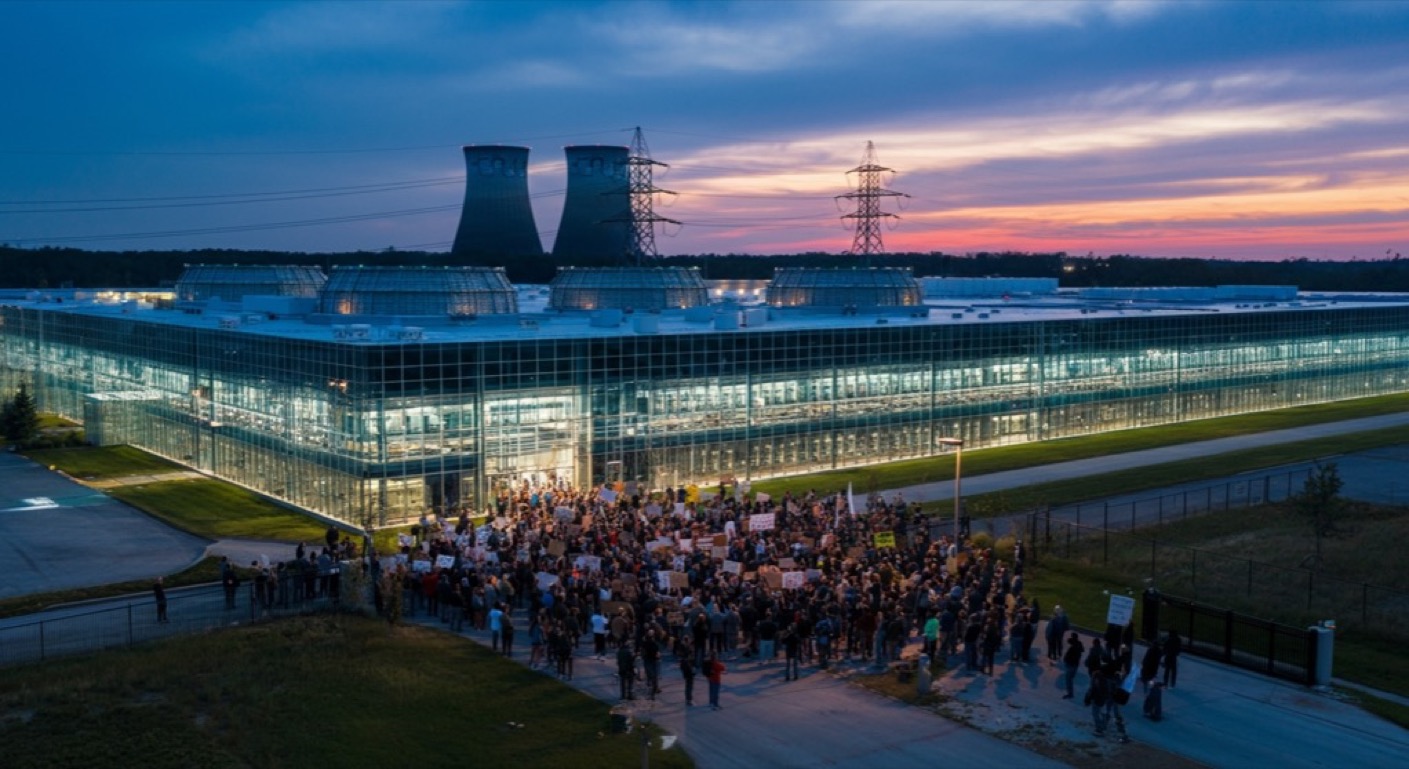
On July 18, coordinated demonstrations against data center expansion erupted in more than a dozen cities across the United States, marking the first nationally organized protest movement targeting AI infrastructure. Protesters gathered in Virginia's Data Center Alley, suburban Chicago, Phoenix, and Silicon Valley, among other locations. The demonstrations are not fringe activism. They represent a growing public backlash that could reshape the economics of AI compute for every startup building on cloud infrastructure.
The protests center on a set of grievances that have been building for two years. Data centers consume enormous amounts of electricity. A single large facility can draw as much power as a small city. In Northern Virginia, where 70 percent of the world's internet traffic flows through data centers, residential electricity prices have risen 20 percent since 2022, driven in part by data center demand. Water usage for cooling in drought-prone regions, noise pollution from backup generators, and the visual impact of sprawling campuses have all fueled local opposition.
What changed on July 18 is scale. These protests were not isolated NIMBY fights. They were coordinated across state lines, with a shared set of demands including moratoriums on new data center construction, mandatory environmental impact reviews, and requirements that data centers invest in local grid upgrades. The Brookings Institution published analysis alongside the protests noting that the movement signals a fundamental fight over AI power consumption and siting decisions that the industry has not yet fully priced into its expansion plans.
The Numbers Behind the Backlash
The data tells a more complicated story than simple local opposition. A Fortune analysis published alongside the protests found that only 8 percent of people who oppose new data center construction actually live near proposed sites. That statistic is worth sitting with. It means the backlash is not primarily about noise or traffic in someone's backyard. It is about broader AI skepticism, environmental anxiety, and a growing sense that the benefits of AI infrastructure accrue to technology companies while the costs are borne by local communities and ratepayers.
This distinction matters for founders because it changes the nature of the political risk. Local NIMBY opposition can sometimes be addressed through community benefit agreements, tax concessions, or site relocation. A national ideological backlash against AI infrastructure is harder to negotiate with. It creates pressure for state and federal legislation, not just local zoning changes.
The energy numbers driving the protests are real. The International Energy Agency estimates that data center electricity consumption could double by 2028, reaching 1,000 terawatt hours annually. That is roughly the current electricity consumption of Japan. In the United States, data centers already account for about 4 percent of total electricity demand, and that share is projected to reach 10 percent by 2030. When residential customers see their bills rising while a data center campus opens down the road, the political response is predictable.
What This Means for Startup Costs
For AI founders, the data center protest movement is not a distant policy debate. It directly affects the two most important operational questions they face: how much compute costs and whether they can get it at all.
Cloud compute prices have been under pressure for months as GPU supply has gradually improved. But if new data center construction slows due to community opposition or new regulatory requirements, that supply relief could reverse. The major cloud providers are already reporting that getting GPU capacity in certain regions requires weeks of advance reservations. Delays in data center permitting would tighten that bottleneck further, raising spot prices for GPU instances across AWS, Azure, and Google Cloud.
The second-order effects matter just as much. If data center expansion slows in the United States, cloud providers will accelerate buildout in other regions, particularly Southeast Asia, Latin America, and the Middle East. Indian founders may benefit from this shift, as the subcontinent's data center construction is accelerating and US protests could redirect investment capital toward Indian markets. But for founders whose users are primarily in North America, latency and data residency requirements mean US capacity remains the only option.
There is also a regulatory cost dimension that founders should be tracking. The protests create political momentum for data center regulation at the state level. Several states including Virginia, Arizona, and Illinois are already considering bills that would impose environmental impact review requirements, demand transparency on energy usage, or require data centers to purchase renewable energy credits. These requirements add to the cost of data center operation, and those costs are ultimately passed through to cloud customers.
The Regulatory Trajectory
The national protest movement arrives at a moment when the US regulatory landscape for AI is already in flux. The Trump administration's July 2026 executive order on voluntary AI safety reviews focused on model safety, not infrastructure. But the data center protests create a separate regulatory track focused on the physical footprint of AI, rather than the algorithms themselves.
This distinction could matter enormously for how regulation evolves. Model safety regulation is complex, hard to enforce, and subject to intense political disagreement. Infrastructure regulation is simpler. Everyone understands power grids, water usage, and zoning permits. A regulatory framework built around data center siting and environmental impact could move through state legislatures far faster than federal AI safety legislation.
Two scenarios are worth watching. In the first, the protests lead to targeted state-level regulations that slow data center permitting in the most affected regions, pushing new construction to less regulated states or countries. In the second, the protests build momentum for federal data center legislation that sets national standards for energy reporting, environmental review, and community benefit requirements. Either scenario increases the cost of building and operating data centers in the United States, with implications for cloud pricing that will affect every AI startup.
What Founders Should Do Now
The data center protest movement does not require immediate action, but it does inform how founders should think about their infrastructure strategy over the next 12 to 18 months. Three things are worth doing now.
First, lock in long-term compute commitments if possible. If cloud providers offer reserved instance pricing or committed use discounts, the current pricing environment may be as favorable as it gets before regulatory costs are passed through. Second, build multi-region infrastructure strategies that do not depend entirely on US data centers. Even if your primary users are in North America, having deployment capability in Southeast Asia or Europe provides leverage if US capacity tightens. Third, factor a 10 to 15 percent cost buffer into cloud compute budgets. If data center construction slows and regulatory costs add to operating expenses, cloud pricing could rise significantly within the next year.
The national protests on July 18 are not a one-day event. The organizers have announced plans for continued demonstrations and legislative advocacy. For AI founders, the message is clear. The physical infrastructure of AI is becoming a political issue, and that will have real consequences for the economics of building on cloud platforms.