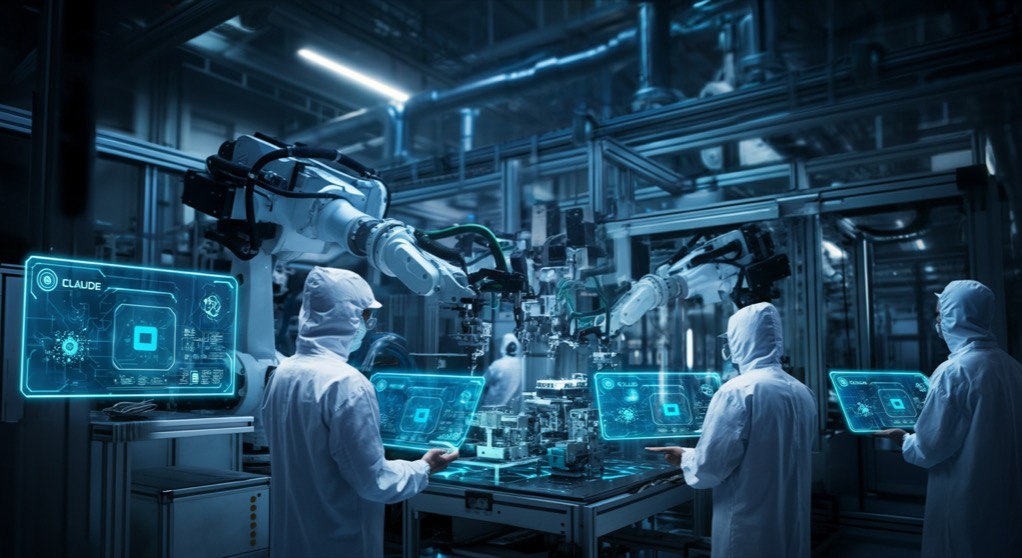
Before a factory commits to manufacturing millions of chips, engineers stress-test the design in the fabrication plant. Before a product ships, a fault on the assembly line has to be caught before it becomes a recall. These are the high-stakes environments where a single undetected flaw can cost a production run, and where Anthropic's Claude is now being deployed for the first time at industrial scale. On July 9, Anthropic announced a partnership with UST, a global technology and engineering services company, to bring Claude into physical AI: intelligence built into the equipment, engineering processes, and factory systems that produce the physical things people use every day.
What UST Actually Does
UST is not a household name, but it operates inside the engineering environments of some of the world's largest semiconductor, automotive, manufacturing, telecom, embedded, and IoT companies. The firm builds and runs the systems those companies depend on to verify their chip designs, validate their silicon, run their factories, and service their products once they are deployed in the field. These are multi-step engineering workflows where an early mistake gets exponentially more expensive with every stage that follows. A design flaw caught during verification costs an engineer an afternoon to fix. The same flaw caught after a factory has committed to a production run costs millions in scrapped wafers, delayed shipments, and reworked supply chains.
This is the environment where UST is deploying Claude. The partnership represents Anthropic's first major push into industrial and physical AI applications, moving beyond the chatbots, coding assistants, and enterprise document processing that have defined frontier LLM use cases to date. According to Anthropic's announcement, UST is training 20,000 of its engineers, architects, and consultants on Claude worldwide, signaling a bet that Claude's reasoning capabilities translate directly to the engineering workflows that underpin physical product development.
How Claude Enters the Industrial Workflow
The most concrete example of the partnership is UST's integration of Claude into its iDEC platform, a validation and engineering system that UST's engineers use to prove that hardware and silicon designs actually behave the way their designers intended. Chip validation is arduous work: engineers write test scripts by hand, run them against the design, read the results, identify regressions, and repeat the cycle many times over across weeks or months of development.
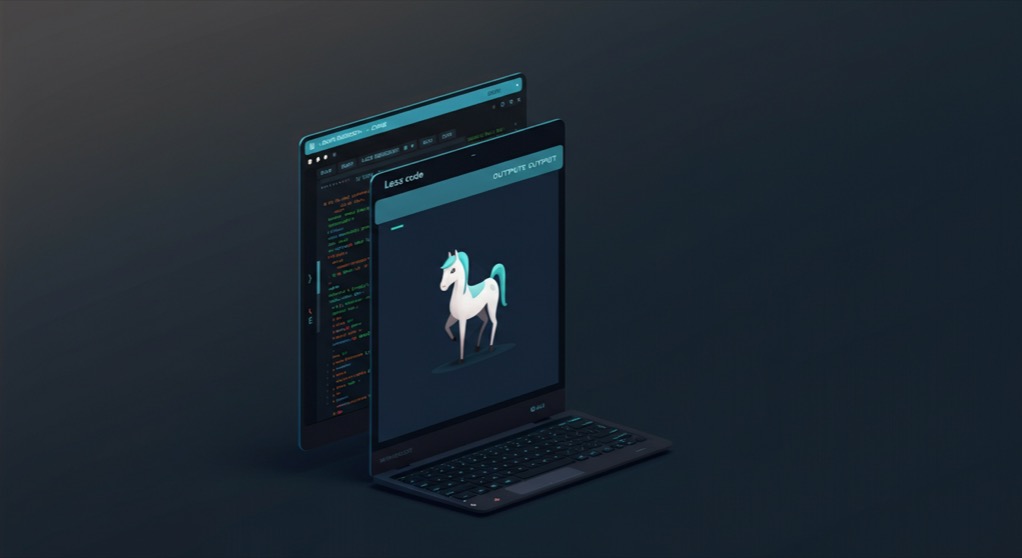
Claude Code, Anthropic's coding agent, is now reading chip pinouts and hardware schematics directly inside the iDEC pipeline. It writes and runs regression tests the checks that confirm a change to a design did not cause an unintended downstream effect that engineers previously had to script by hand. Claude also compares live data streaming from real manufacturing equipment against its digital twin the software model of how that hardware is supposed to behave and flags firmware regressions and signal-integrity faults in real time. The goal is to eliminate hand-scripted test creation, catch defects earlier in the design cycle, and give engineers a reasoning layer that can hold the context of a complex hardware design across hours-long validation tasks.
UST reports that iDEC's closed-loop pipeline, which reads hardware designs, generates and runs regression tests, and compares live equipment data against digital twin models to flag issues early, already cuts validation cycle times by 50 to 70 percent. Standard four-day turnaround times are condensing into 48 hours. With Claude integrated as the reasoning layer, UST expects those numbers to improve further as fewer tests need manual scripting and more faults are caught before they become production problems.
Why Physical AI Is the Next Frontier for LLMs
Physical AI manufacturing, logistics, industrial automation, and hardware engineering represents a trillion-dollar market opportunity that frontier LLM companies have barely begun to address. Most of the attention in AI has gone to software use cases: code generation, customer support chatbots, document analysis, marketing content. But the physical economy producing chips, cars, factory equipment, and connected devices is where the largest revenue pools sit, and where AI has historically been underpenetrated compared to software.
Anthropic's partnership with UST signals that the company sees physical AI as a major revenue vector, not a research experiment. The decision to train 20,000 engineers on Claude is a deployment strategy, not a pilot program. By embedding Claude into the engineering toolchain that semiconductor and automotive companies already use, Anthropic is betting that the best way to sell AI into industrial markets is through the engineering services layer that already has those relationships. UST's clients do not need to learn new tools or adopt new platforms; Claude shows up inside the validation pipeline they already run.
For founders building in the physical AI space, the UST deal offers a clear pattern. The companies that will win in industrial AI are not necessarily the ones building the most capable models. They are the ones that embed their intelligence into the existing workflows, tools, and engineering cultures of the companies that make physical things. The engineering services layer the companies that already run the validation, testing, and manufacturing infrastructure for the world's biggest hardware firms is the distribution channel for physical AI.
Key Lessons for Founders
The UST-Anthropic partnership holds several lessons for founders building AI products for the physical economy. First, distribution through existing engineering services partners is faster than direct enterprise sales. UST already has relationships with the world's largest semiconductor and automotive companies; Claude arrives inside those relationships rather than needing to build new ones. Second, the metrics that matter in physical AI are not benchmark scores or token throughput. They are cycle time reductions and defect catch rates. UST's 50 to 70 percent validation cycle improvement is the kind of metric that industrial customers care about. Third, training the workforce matters as much as training the model. Anthropic is investing in training 20,000 UST engineers on Claude, recognizing that adoption at industrial scale requires human capability building, not just API access. For founders selling AI into industrial markets, the playbook is clear: partner with the engineering services firms, speak in cycle time and defect rate metrics, and invest in workforce training as a core part of the product.