
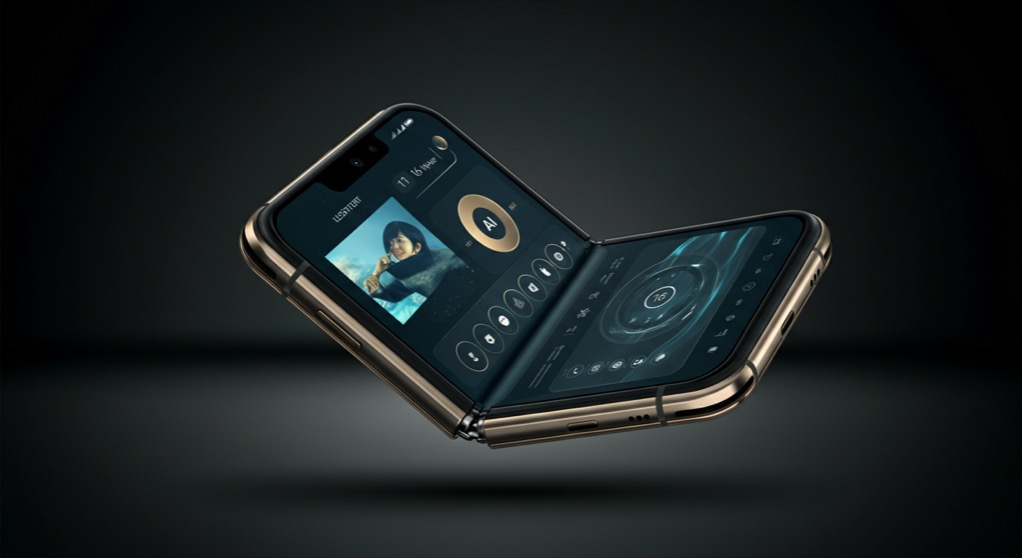
Vertu, the British luxury phone maker known for hand-finished devices that can cost as much as a car, has released a $6,880 foldable smartphone called the Alphafold. The headline feature is not the calfskin leather back, the titanium frame, or even the alligator belly leather option. It is the pre-installed AI agent built on the open-source Hermes project, designed to handle executive workflows like document analysis, spreadsheet review, trip planning, and task automation. TechCrunch spent several days testing the device against a Samsung Galaxy Z Fold 7 running Google Gemini, and the results raise a question that matters for every founder building in the AI space: is the AI agent a new product category, or a feature that belongs inside every smartphone?
What the Alphafold Actually Delivers for Executives
The Alphafold runs Hermes Agent, an AI assistant that goes beyond the prompt-response pattern of standard smartphone AI. Instead of asking it to write an email or answer a trivia question, an executive can hand it a spreadsheet for analysis, ask it to draft a contract summary, or chain multiple tasks together across different apps. Hermes Agent can remember past conversations and hand off complex requests to a human concierge service when it reaches its limits. In testing, the agent performed well on structured tasks like data extraction from spreadsheets and document summarization. It handled multi-step workflows that would have required switching between three or four apps on a standard phone. But the performance was not always consistent. Early software builds showed signs of a product still finding its footing, and the gap between what the agent promises and what it reliably delivers was noticeable in edge cases.
Physically, the Alphafold is a 264-gram device wrapped in genuine calfskin leather with titanium accents, noticeably heavier than the 215-gram Galaxy Z Fold 7. The curved frame makes it easier to unfold than Samsung's flatter design, though Samsung's device feels more comfortable for one-handed use when folded. Vertu confirmed to TechCrunch that the Alphafold was developed through a supply-chain partnership involving ZTE's Nubia hardware platform, meaning the core foldable technology inside the $6,880 device shares its foundation with a $1,100 phone. Vertu's differentiation comes entirely from the luxury materials, the software experience, and the after-sales service. This is the same playbook Vertu has used since its Nokia-era days: sell status, not specifications.
Why This Matters Beyond a Single Review
For founders building AI products, the Alphafold is more interesting as a market signal than as a gadget review. Vertu is betting that a specific demographic high-net-worth executives will pay a significant premium for an AI assistant that is hardware-integrated rather than app-based. This validates a thesis that many AI startups are chasing: that AI agents are becoming a standalone value proposition strong enough to justify dedicated hardware. If Vertu can sell even a few thousand units at $6,880 each, it proves that the executive AI assistant market has both willingness to pay and a hardware channel. The counterargument is equally important. The same AI agent capabilities that Vertu is selling for a five-figure price premium can be replicated on any modern smartphone using existing tools. Google Gemini on a Galaxy Z Fold 7 handles document analysis, scheduling, and email drafting. Microsoft Copilot runs on any device with a browser. The AI agent is becoming a software commodity, and Vertu is trying to sell it as a luxury good. That bet works only if the hardware experience adds real value beyond the software layer.
The broader pattern here extends beyond Vertu. OpenAI is reportedly building a screenless speaker that moves, positioning it as an AI companion rather than a smart speaker. Multiple startups are experimenting with AI-first hardware form factors. The race is on to define what hardware looks like when AI is the primary interface rather than a feature. Vertu's approach luxury materials plus an AI agent wrapped around a commodity foldable is one version of that future. It may not be the winning version, but it is a useful data point for anyone trying to understand how the AI hardware market is evolving.
What Founders Should Watch Next
The Alphafold story surfaces three signals for founders. First, the AI agent market is segmenting by price point and demographic. Vertu is going after the top 0.1 percent, leaving the mass market open for disruption. There is room for a mid-tier AI agent hardware play at the $500 to $1,000 price point that does not require luxury materials to compete. Second, the hardware integration thesis depends on whether the AI agent becomes meaningfully better when embedded in the device versus running as an app. If Hermes Agent on the Alphafold performs identically to the same software running on a Samsung phone, the hardware premium collapses. Third, the ZTE partnership reveals that Vertu is not investing in hardware R&D for its AI play. It is layering software on existing platforms. That is a viable go-to-market strategy, but it means Vertu's moat depends entirely on brand, materials, and concierge services not on AI technology that competitors cannot replicate.
The most important question the Alphafold raises is whether AI agents are a feature destined for every smartphone or a new category that requires dedicated hardware to reach its full potential. If the answer is the former, then Vertu is selling an expensive version of something that will be free on every Android phone within two years. If the answer is the latter, then the Alphafold is the first experiment in a much larger market shift, and the $6,880 price tag is the cost of being early. For founders, the smartest position is to track which startups are building AI agent software for existing devices and which are betting on new hardware form factors. The two paths will converge, and the companies that understand the interface shift before it happens will capture the most value. Vertu has placed its bet. The results will tell us something about where the AI hardware market is heading, whether or not the Alphafold itself succeeds.