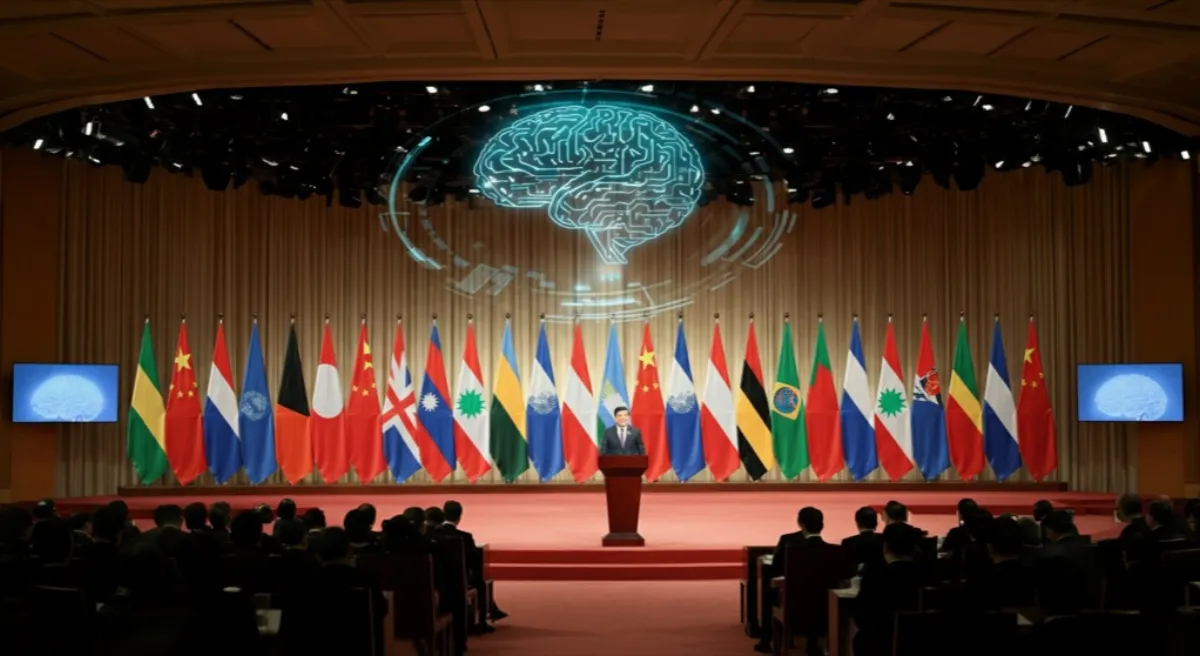
Twenty-nine nations signed on to the World Artificial Intelligence Cooperation Organisation (WAICO) on July 16, the same week that Chinese President Xi Jinping made his first in-person appearance at Shanghai's World Artificial Intelligence Conference. The timing was deliberate. What China has built is not just another multilateral body. It is the scaffolding for an entirely separate AI governance ecosystem, one that could force technology companies to choose which set of rules they operate under.
The founding members read like a list of Global South heavyweights: Indonesia, Brazil, Malaysia, South Africa, Senegal, Russia, and Pakistan. None of them are coincidences. Beijing has spent years cultivating these relationships through infrastructure investment, digital cooperation pacts, and diplomatic outreach. The payoff is a voting bloc that Washington cannot control and a headquarters in Shanghai that will set AI standards, safety protocols, and regulatory frameworks for countries representing a significant share of the world's population.
The Symphony Doctrine
Xi's speech at WAIC 2026 was a masterclass in strategic framing. He called on countries to embrace the historic opportunity of open-source AI and declared that AI development should not be a solo performance by a single country but a symphony of international cooperation. The subtext was unmistakable. The solo performer in Xi's framing is the United States, which has pursued a strategy of export controls, chip sanctions, and restricted access to frontier AI models aimed at containing China's technological rise.
Xi also stressed a people-centred approach to AI, arguing that the technology must always remain under human control through regulations, technological monitoring, and early warning systems. This framing serves dual purposes. It positions China as the responsible steward of AI safety to developing nations wary of American tech dominance, while providing rhetorical cover for Beijing's own extensive surveillance infrastructure and state-directed AI development.
The contrast with Washington's approach could not be sharper. The Biden and Trump administrations both pursued containment strategies that restricted Chinese access to advanced semiconductors, AI chips, and cloud infrastructure. In May, the US Department of Commerce affirmed that restrictions on AI chip shipments apply to Chinese companies even when they operate outside China. Beijing retaliated by barring exports of dual-use technology and critical minerals to US firms. The battle lines are drawn, and WAICO is China's countermove.
What WAICO Means for AI Builders
For founders and technology companies operating globally, WAICO represents a new compliance reality. If the alliance gains traction at the United Nations, it could effectively split the AI regulatory landscape into two spheres. Companies building frontier AI models may need to certify their systems under both US-led frameworks and WAICO standards to access markets in the Global South. That means dual compliance costs, separate safety audits, and potentially incompatible technical requirements for things like model transparency, data localization, and bias testing.
The stakes are particularly high for companies that rely on global AI talent and open-source distribution. China is already home to increasingly competitive open-weight models that rival or surpass closed American alternatives. Xi explicitly endorsed open-source AI in his speech, framing it as a tool for equitable access that prevents new historical injustices against developing countries. This is clever positioning. By championing open-source, China taps into a genuine sentiment among Global South nations that closed, proprietary AI systems concentrated in American companies reinforce digital colonialism.
There is a structural advantage at play here that goes beyond diplomacy. China generates more than twice as much electricity as the United States, and that gap is widening as Beijing pours state investment into its energy grid. AI's insatiable power demands make cheap energy a strategic asset. While American tech giants face rising electricity costs and grid constraints, China's state-backed energy system can power data centers at a fraction of the cost. This gives Beijing a fundamental cost advantage in the AI infrastructure race that no amount of export controls can neutralize.
The Race to Shape Global AI Rules
Governance expert Arindrajit Basu of the Carnegie Endowment for International Peace has noted that Washington is rapidly retreating from global cyber and AI norms-setting processes while withdrawing financial backing for cyber diplomacy. Beijing, by contrast, is keen to demonstrate global leadership. WAICO fills the vacuum that the United States is leaving behind.
Chinese Premier Li Qiang first unveiled plans for WAICO in July 2025, giving Beijing a full year to build the coalition before the formal launch. The attendance of UN Secretary-General Antonio Guterres at the Shanghai event signals that WAICO is being treated as a serious multilateral initiative rather than a propaganda exercise. Analysts widely expect China to use the alliance to shape how AI policies are framed at the UN, particularly around issues of data sovereignty, model regulation, and the governance of autonomous systems.
For technology leaders watching from the sidelines, the message is clear. The era of a single global AI standard is ending. The question is not whether two governance frameworks will emerge, but how quickly and how divergently. Companies that build exclusively for one framework may find themselves locked out of the other. The smart play is to build adaptable systems that can comply with both, while watching the diplomatic signals that will determine which framework wins the middle ground.
WAICO is not a threat to American AI leadership by itself. But combined with China's energy advantage, its growing open-source ecosystem, and its cultivation of Global South allies, it represents the most credible alternative governance structure since the internet was born. Founders who ignore it are betting that geopolitics does not matter to technology. That bet has never been a safe one.