
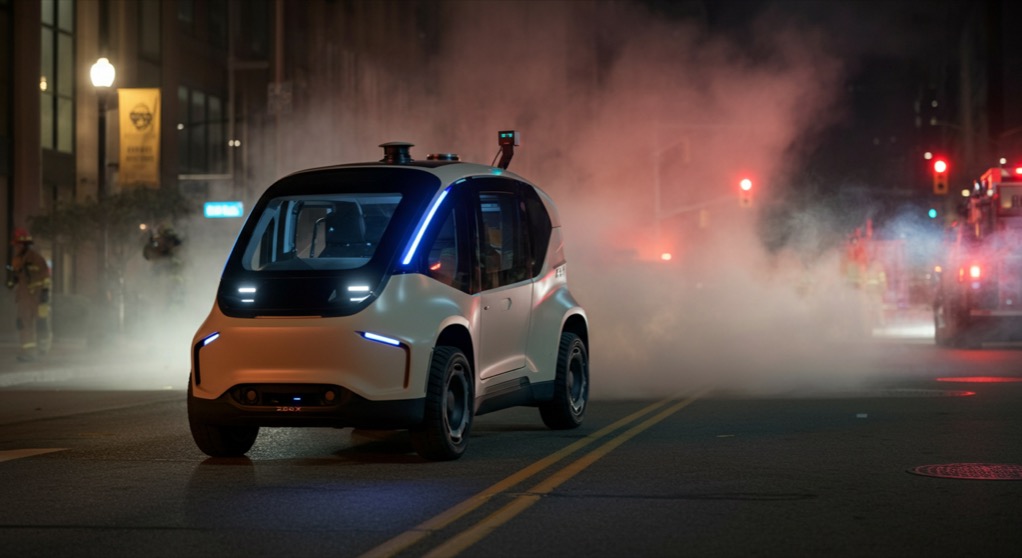
On June 20, 2026, a Zoox robotaxi with no passengers on board encountered heavy smoke at an active emergency fire scene in a US city that the company has not disclosed. The vehicle braked hard, attempted to steer away, and then came to a complete stop, unable to process the smoke-filled environment. A remote teleoperator had to reverse the car away so first responders could place cones around the scene. That single incident triggered a software recall covering all 105 Zoox vehicles on the road, and it prompted the top US automotive safety regulator to issue a warning to every autonomous vehicle company operating in America: fix your first-responder interactions, or face consequences.
What Actually Happened: The Heavy Smoke Incident
According to NHTSA's recall report, the Zoox robotaxi encountered heavy smoke that obscured an active emergency fire scene that was not cordoned off with traffic cones. The vehicle's perception system registered the smoke as an obstacle but could not determine what was behind it or how to safely navigate the scene. The robotaxi braked hard and attempted a steering maneuver before coming to a stop. Crucially, the vehicle could not resolve the situation autonomously. A human teleoperator had to intervene remotely to reverse the vehicle away from the scene, giving first responders the space they needed to secure the area.
Zoox told NHTSA that this is the only event of its kind the company has experienced, and that it conducted a thorough investigation into the root cause. The company shipped a software update to its entire fleet that enhances the existing capability of detecting active emergency scenes by adding the ability to detect and respond to heavy smoke in certain situations. Zoox decided to issue the recall on July 7, one day before NHTSA administrator Jonathan Morrison sent his blistering letter to the entire AV industry.
NHTSA's Warning: Emergency Scenes Are Not Edge Cases
NHTSA administrator Jonathan Morrison did not mince words in his July 8 letter to autonomous vehicle companies. He warned that vehicles interfering with first responders is not an edge case. It is a systemic failure that AV developers must prioritize immediately. Morrison wrote explicitly that emergency scenes are not rare or extreme events, and that the inability to detect and appropriately respond to such situations represents what he called a functional insufficiency.
This language matters. NHTSA is telling AV companies that the industry has been treating first-responder interactions as rare corner cases when they in fact happen with predictable regularity in any city with fire trucks, ambulances, and police activity. TechCrunch previously reported that Waymo had at least six incidents as of March 2026 in which first responders had to physically move robotaxis from emergency scenes, dragging vehicles out of the way because the autonomy stack could not figure out what to do.
For founders, Morrison's letter should be read as a template: regulators are now actively watching for failure modes that harm public trust in AI systems, and they are issuing industry-wide demands rather than company-specific enforcement actions. This is the difference between a single recall and a regulatory pivot.
Zoox's Recall History: A Pattern That Founders Should Study
This is not Zoox's first recall. The company voluntarily recalled software on its vehicles in March 2025 to resolve a hard-braking issue that NHTSA had been investigating since 2024. It issued two more recalls in May 2025 after a collision with a passenger car and an incident where a Zoox vehicle was struck by an e-scooter rider. Four recalls in just over a year for a fleet of 105 vehicles means Zoox has recalled its entire fleet roughly once per quarter on average.
The pattern is instructive. Each recall has been voluntary: Zoox identified the issue, investigated it in collaboration with NHTSA, and issued an over-the-air software update before regulators forced the issue. This proactive approach has kept Zoox in regulators' good graces even as the company pushes toward commercial launch. Zoox has been offering free rides in Las Vegas and San Francisco while awaiting NHTSA approval for an exemption from federal safety standards that require steering wheels and pedals. That exemption is a critical regulatory hurdle for any purpose-built AV without manual controls.
Zoox's commercial launch timeline depends entirely on that NHTSA exemption. Every recall pushes the timeline back, not because NHTSA punishes recalls, but because each incident gives regulators more data points to evaluate before granting exemptions. Founders building in regulated spaces should internalize this: your first recall is not a failure, but your recall rate is absolutely part of your approval calculus.
What This Means for Founders Deploying AI in the Physical World
For founders who are not building robotaxis but are deploying AI in physical environments (delivery robots, drone systems, warehouse automation, and any edge-AI application that interacts with the public), the Zoox recall and NHTSA warning offer three lessons that apply directly to your product roadmap.
First, build transparent failure-mode handling from day one. Zoox's ability to quickly investigate, document, and issue an over-the-air fix was possible because the company had already built the infrastructure for teleoperator intervention and remote diagnostics. If your AI system operates in the physical world and you cannot remotely diagnose and patch a failure mode within days, you are not ready for production deployment. Regulators, customers, and the public will not tolerate systems that must be physically retrieved when things go wrong.
Second, edge cases are not rare. The heavy smoke incident happened because a fire truck arrived at a scene that had not yet been cordoned off. That is not a once-in-a-decade event. It is a Tuesday in any city with a fire department. The same logic applies to warehouse robots, delivery drones, and autonomous forklifts. The edge cases you dismiss as too rare to engineer for are the ones that will generate the first regulatory action against your company. Map out your worst-case environmental scenarios before deployment, not after.
Third, your recall process is a competitive advantage. Every Zoox recall was voluntary. The company self-reported, self-investigated, and self-fixed. That builds regulatory trust over time. If you are building physical-world AI, invest in recall infrastructure: over-the-air update capabilities, incident documentation protocols, and a rapid-response team. Invest in these as early as you invest in your perception stack. When the regulator calls, having a transparent, fast, and documented process is the difference between a warning and a shutdown.
The Zoox recall is not a story about a robotaxi failure. It is a story about what happens when AI systems designed for normal conditions encounter abnormal ones, and why every founder building for the physical world needs to design for the abnormal first.