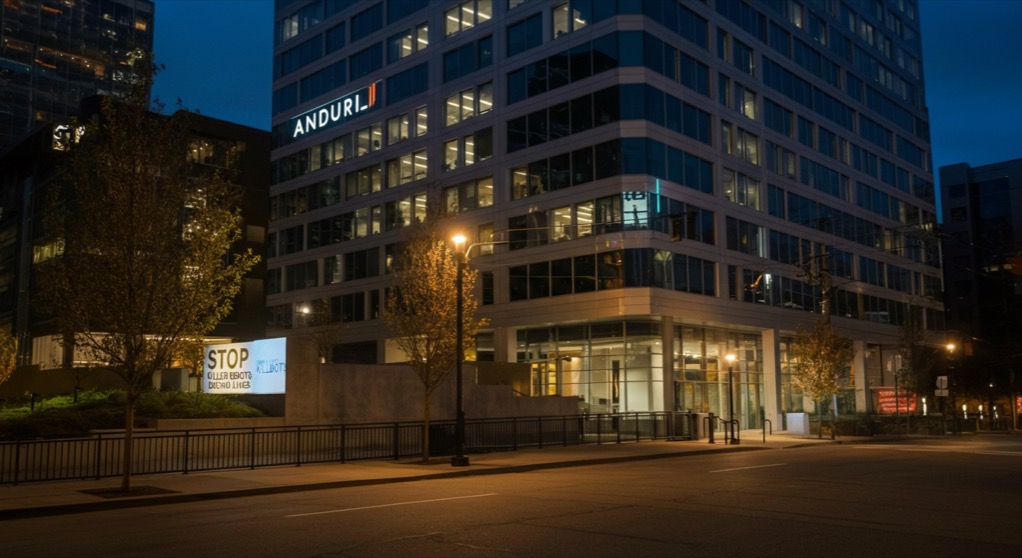
On Saturday morning, a crowd is expected to gather outside Anduril Industries' Seattle office carrying signs that say things like "Stop Killer Robots" and "Don't Let Algorithms Decide Who Lives." The protest, organized by a coalition of human rights groups and technology ethics organizations, is the latest and most visible escalation in a growing public backlash against AI-powered autonomous weapons. And it raises a question that every founder building defense AI or selling to military customers needs to answer: how do you build products for a market that a significant portion of the public finds morally unacceptable?
The protest is not an isolated event. It arrives at a moment when the autonomous weapons debate is reaching a fever pitch across multiple fronts. The U.S. Senate panel approved new rules for AI in defense just days ago. The United Nations is debating a treaty on lethal autonomous weapons systems. And companies like Anduril, valued at over $14 billion, have become the public face of an industry that is growing faster than the ethical frameworks meant to govern it. The convergence of these forces means that the autonomous weapons debate is no longer a fringe concern. It is a mainstream political issue with real consequences for business strategy, hiring, and fundraising.
The Protest and the Signal It Sends
The Seattle protest is significant not because of its size, but because of what it represents. Anduril's Seattle office handles software engineering, AI research, and product development, not manufacturing or assembly. Activists are targeting the engineers and researchers who build the technology, not just the executives who sign the contracts. That is a deliberate message: the people writing the code are being held accountable for how it is used.
This mirrors patterns seen in other technology controversies. When Google employees protested Project Maven in 2018, the company ultimately chose not to renew its contract with the Department of Defense. When Amazon shareholders pushed for a vote on Rekognition's sale to law enforcement, the company eventually paused sales to police. The pattern is consistent: public pressure, amplified by employee dissent, leads to corporate policy changes. Anduril has not faced this level of organized public scrutiny before. The Seattle protest may be the first of many.
For founders, the lesson is clear: the "move fast and build" ethos that drives early-stage defense AI startups can collide with public sentiment in ways that are difficult to predict and expensive to manage. A single well-organized protest can generate headlines that spook investors, trigger customer inquiries, and force leadership into defensive mode. The cost of ignoring public perception is not just reputational. It is operational.
Anduril's Position in the Defense AI Ecosystem
Anduril occupies a unique position in the defense technology landscape. Founded by Palmer Luckey, the company has grown from a niche player to a major defense contractor through a combination of aggressive product development, strategic acquisitions, and a culture that proudly embraces its mission of "building the future of defense." Its products include AI-powered drones, autonomous surveillance towers, and the Lattice software platform that integrates data from multiple sensor types into a single battlefield operating picture.
The company has raised over $5 billion and secured contracts with the Pentagon, U.S. Border Patrol, and allied defense forces. Its valuation of $14 billion makes it one of the most valuable private defense companies in the world. But its visibility also makes it the most prominent target for activists. Every contract signing is a news cycle. Every product deployment is a potential protest. Anduril cannot operate under the radar, and its success has made it the symbol of everything critics dislike about autonomous weapons.
This creates an asymmetric dynamic. Activists do not need to change government policy to hurt Anduril. They only need to make the company's association with autonomous weapons politically costly enough that defense customers become hesitant, that engineering talent refuses to join, or that IPO plans are delayed. For a company whose primary asset is its ability to attract top-tier engineering talent and government trust, these are existential risks.
The Broader Autonomous Weapons Debate
The Anduril protest is happening against the backdrop of a rapidly evolving regulatory landscape. The U.S. Senate panel's approval of new AI defense rules creates a federal framework where none existed before. The proposed rules require pre-deployment testing, human oversight mechanisms, and incident reporting for AI systems used in defense contexts. While these rules apply broadly across the defense industry, companies like Anduril that are most visible in the autonomous weapons space will face the most scrutiny.
Internationally, the debate is even more advanced. The United Nations has been negotiating a treaty on lethal autonomous weapons systems for years, and momentum is building toward a binding agreement. The European Union's AI Act already classifies autonomous weapons as unacceptable risk, effectively banning them within EU member states. China and Russia have pursued autonomous weapons development aggressively while supporting treaty language that would ban systems they do not have while protecting systems they do. The geopolitical chess match over autonomous weapons is intensifying, and each new protest adds political pressure to move faster toward regulation.
For founders building any AI product that could be used in defense or law enforcement, the regulatory trajectory is clear. The question is not whether autonomous weapons will be regulated. It is how strict the regulations will be, how quickly they will be implemented, and whether your company will be caught off guard when they arrive.
What This Means for Founders
The Anduril protest contains three lessons for founders building in or adjacent to defense AI. First, public perception is a risk factor that must be managed proactively, not reactively. If your product has a military application, you need a narrative that explains why it is necessary, what safeguards exist, and how you engage with ethical concerns before they become protest signs. Waiting until activists show up outside your office is too late.
Second, talent acquisition in defense AI is about to get harder. Engineers who are comfortable building military technology are already a small subset of the talent pool. As protests like the one planned for Anduril's Seattle office generate headlines, even engineers who were indifferent may start questioning whether they want their names associated with autonomous weapons projects. Recruiting in this environment requires more than competitive compensation. It requires a value proposition that engineers can defend to their peers.
Third, the regulatory window is closing. The Senate panel's approval of defense AI rules is the beginning, not the end. Founders should assume that within two years, any AI system sold to a defense customer will require pre-deployment certification, ongoing audit obligations, and human oversight guarantees. Building those capabilities into your product architecture now is cheaper and faster than retrofitting them later. The companies that treat regulation as a product requirement rather than an afterthought will have a structural advantage when the rules take effect.