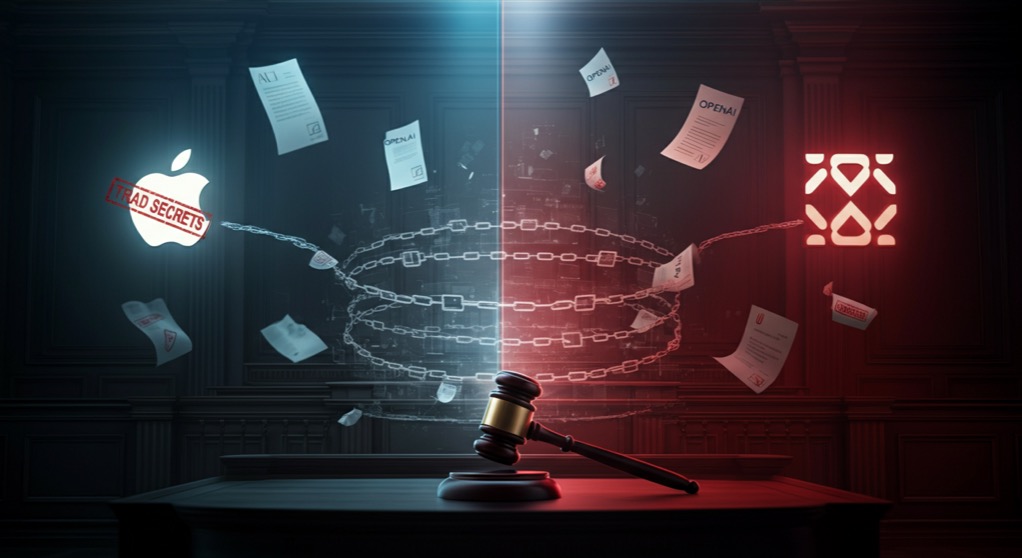
More than 400 former Apple employees now work at OpenAI. That single data point, buried in a 41-page complaint filed in federal court on Friday, frames what may become the defining intellectual property lawsuit of the AI era. Apple is not suing a former engineer who walked out with schematics. It is suing OpenAI for what it describes as a systematic, leadership-directed campaign of trade secret theft that allegedly used job interviews as intelligence-gathering missions, Slack channels as coordination hubs, and Apple's own hardware as extraction tools.
The complaint, filed in the Northern District of California, names OpenAI along with two former Apple employees who now work there: Chang Liu, a senior systems electrical engineer, and Ahmad Ghaddar, a senior product manager for sensing. It also names io, the design firm founded by former Apple employees including Jony Ive that OpenAI acquired last year for $6.5 billion. The allegations are unusually specific for a trade secrets case. Apple does not just claim theft happened. It claims it has the Slack messages, the laptop data, and the internal OpenAI communications to prove it.
How Apple Says the Scheme Worked
The complaint paints a detailed picture of what it calls a playbook for extracting confidential information. Apple alleges that OpenAI targeted Apple employees with a multi-step process. First, job candidates were asked to bring Apple prototypes, CAD files, and design artifacts to their interviews. One candidate allegedly expressed surprise at being asked to bring actual Apple hardware, texting that he "didn't even know we could take those from the office."
Second, Apple claims that OpenAI coached departing employees on how to evade Apple's security procedures. The complaint specifically references an internal Apple document, marked "Need to know," that made its way to OpenAI. The document supposedly contained advice on how to avoid what Apple calls the "dreaded walkout" , the practice of immediately removing an employee after they give notice. By avoiding immediate removal, departing employees would retain access to Apple's systems for an additional two weeks, giving them more time to extract information.
Third, Apple says that OpenAI instructed departing employees that if Apple asked them to sign anything during their exit interview, they should not sign and should notify OpenAI "asap." The company then allegedly advised them on how to proceed.
The most eyebrow-raising allegation involves access to Apple's internal network storage. According to the complaint, Liu discovered he could still access Apple's systems after leaving the company by exploiting an authentication bug. He allegedly texted Peng, an Apple employee who was acting as a conduit, saying: "LOL, I found out I can access the [network storage], so funny." Peng allegedly replied: "I'm ready." Liu is said to have accessed the system from Peng's Apple-issued work computer.
The Bigger Picture: A Leadership Problem, Not Rogue Employees
Apple is careful to frame this as a company-wide pattern rather than a few bad actors. The complaint describes the alleged misconduct as "normalized and exemplified by leadership" at OpenAI. It says that Tang Yew Tan, OpenAI's chief hardware officer who spent 24 years at Apple most recently as VP of product design for iPhone and Apple Watch, personally directed job candidates to bring Apple parts to interviews.
This matters because Apple is not just seeking damages. It is asking the court to force OpenAI to hand over all products and hardware that were allegedly developed using Apple's trade secrets. Given that OpenAI is rumored to be building its own smartphone and has already released hardware like the Codex keyboard and a screenless AI speaker, the potential scope of that remedy is enormous.
Apple even works a rotten fruit analogy into its argument: "OpenAI's nascent hardware business now rests on the shakiest of foundations, rotten to its core by its illegal reliance on misappropriated trade secrets." The irony of Apple using the term "rotten" in a case against the company whose name starts with "Open" is either intentional or a happy accident for the legal team.
The complaint also reveals the depth of the talent drain. More than 400 former Apple employees now work at OpenAI, and Apple argues that suggests the scale of the problem is far larger than the specific incidents it has documented so far. The company states: "Discovery will expose that the misappropriation has been occurring on a scale many times greater than the several instances described below."
What This Means for AI Founders
This lawsuit is not just an Apple-OpenAI dispute. It is a test case for how trade secret law applies to AI companies that aggressively hire from competitors. For founders building AI products, several implications are immediate.
First, the standard for what constitutes trade secret misappropriation is about to get much clearer. If Apple wins, hiring a competitor's key employees and discussing their former employer's confidential information during interviews could become legally perilous. Every startup that hires from a competitor, which is essentially every startup, needs to look at its onboarding and interview practices.
Second, the case tests whether Slack messages and internal communications can be used to prove a pattern of misconduct. Apple has documented alleged communications that show employees joking about unauthorized access. For founders, this is a reminder that internal chat logs are discoverable and can become the centerpiece of litigation. A Slack message that seems like harmless banter today could be quoted in a federal complaint tomorrow.
Third, the involvement of io and the allegations about metal-finishing techniques raise questions about whether acquiring a company that was founded by ex-employees of a competitor creates inherited liability. OpenAI bought io for $6.5 billion. If io's technology was built using Apple's trade secrets, OpenAI may now own a lawsuit rather than an asset.
Apple has stated that it first contacted OpenAI in February 2026 to raise its concerns and received no response. The lawsuit followed five months later. OpenAI's public response has been a single statement on X: "We have no interest in other companies' trade secrets. We remain focused on building innovative technology that empowers people everywhere."
What Founders Should Do Now
This case will take months or years to resolve, but the strategic implications are immediate. Every founder hiring from a competitor should review their interview practices. Asking candidates to bring prototypes or internal documents from their current employer is not just unethical. It could be the central allegation in a future lawsuit.
Founders should also ensure that their onboarding processes include clear documentation about what information new hires can and cannot use from their previous roles. A simple nondisclosure agreement signed at onboarding may not be enough if the company's leadership has been signaling that competitor intelligence is welcome.
The Apple v. OpenAI case is the shot across the bow for trade secret enforcement in AI. The outcome will define the boundaries of competitive intelligence, employee mobility, and intellectual property for the rest of the decade. Founders who pay attention to the details of this case will understand the rules of the road before they are written into precedent.