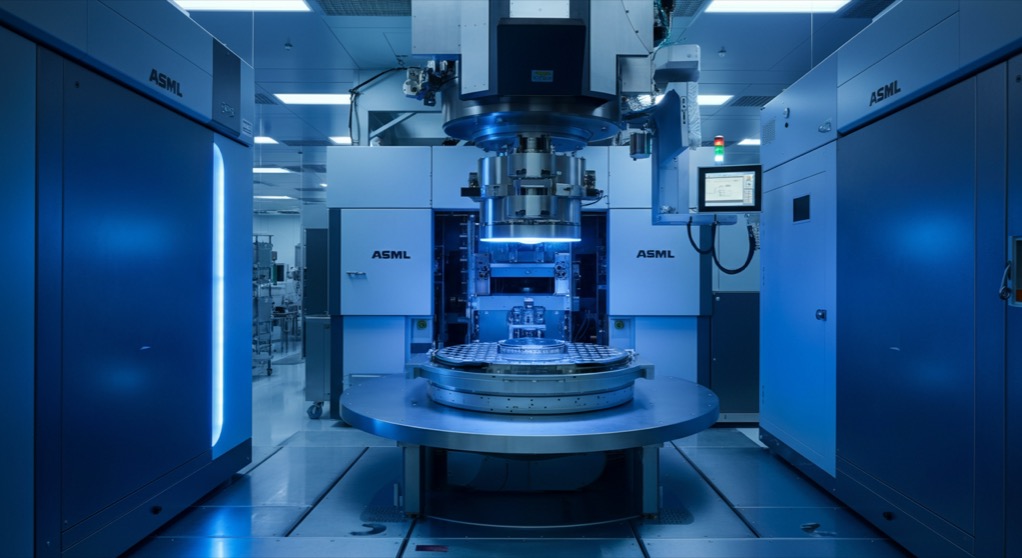
ASML reported its Q2 2026 earnings on Friday and the numbers were stunning by any measure. Revenue surged past analyst expectations on the back of booming AI chip production demand from TSMC, Samsung, and Intel. But CEO Christophe Fouquet used the word 'tightrope' to describe the company's current position, and the image captures the broader tension perfectly. ASML is the single most important company in the AI hardware supply chain that most people have never heard of, and it is now caught in a geopolitical vise that will determine who gets advanced AI chips and who does not.
ASML makes the extreme ultraviolet (EUV) lithography machines that are required to manufacture the world's most advanced semiconductors. No other company on the planet produces EUV systems. If you want to fab a chip at 3nm or below, you need an ASML machine. TSMC uses them to make Nvidia's B200 GPUs. Samsung uses them for its own AI accelerator chips. Intel needs them for its upcoming AI inference silicon. Without ASML's machines, frontier AI chips cannot exist.
The Numbers Are Booming But the Pressure Is Building
ASML's Q2 beat was driven almost entirely by AI demand. The company reported record net bookings for its EUV systems, with chipmakers placing orders months and even years in advance to lock in production capacity. The AI boom has created a scramble for advanced fabrication capacity that has pushed ASML's order book to unprecedented levels. TSMC alone has committed to multiple new fabs that will require dozens of EUV systems each.
But the headline numbers mask a growing vulnerability. China is ASML's third-largest market, accounting for a significant percentage of its total revenue. Chinese chipmakers have been racing to stockpile ASML's lithography equipment before additional U.S.-led export restrictions take effect. The Biden administration has been pressuring the Dutch government to tighten controls on ASML's sales to China, including maintenance and repair services for equipment already installed at Chinese fabs. The message from Washington is clear: no advanced chip-making technology should reach Beijing.
The Tightrope Has No Safety Net
Fouquet's 'tightrope' framing reveals the impossible position ASML occupies. On one side: record AI-driven orders from the West's largest chipmakers. On the other side: the political risk of losing the entire China market, which would cost billions in annual revenue and hand Beijing an incentive to accelerate its domestic lithography alternatives.
For ASML, the choice is not simply commercial. The company is Dutch, not American, which gives it some diplomatic wiggle room. But the Netherlands is a U.S. ally, and the American position on China technology transfer has hardened significantly over the past 18 months. The Dutch government has already restricted ASML's ability to export its most advanced EUV systems to China. Now the pressure is extending to older deep ultraviolet (DUV) systems and, more critically, to after-sales support. If ASML cannot service the machines it has already sold to Chinese customers, those fabs will eventually grind to a halt.
What This Means for AI Compute Availability
The ASML story is not just a corporate earnings narrative. It is the single best leading indicator of AI chip supply constraints for the next 12 to 18 months. Here is why founders should care.
Every AI product that relies on GPU compute is ultimately dependent on the availability of advanced chips. Those chips are fabbed using ASML lithography systems. If ASML's China export licenses get cut further, Chinese AI chip production slows. That might sound like a win for American and Taiwanese chipmakers, but the reality is more complex. China's response to supply restrictions has been to stockpile aggressively, creating artificial demand that squeezes global supply. The more machines China buys before restrictions hit, the fewer are available for TSMC and Samsung to expand their capacity for Western customers.
Meanwhile, China's domestic chipmaking push, including efforts by SMIC and Huawei-backed fabs, is buying time. The consensus among semiconductor analysts is that Chinese lithography alternatives remain 3 to 5 years behind ASML's current generation. But every year of restricted access accelerates Chinese investment in domestic alternatives, and the gap is narrowing faster than many in Washington expected.
For founders building AI products: the price and availability of GPU compute 18 months from now will be shaped by decisions the Dutch and American governments make about ASML's export licenses in the next 90 days. Watch the permit announcements. They are a better signal than most earnings calls.
The Bigger Pattern: Weaponizing the Supply Chain
ASML's position is the clearest example yet of how the AI hardware supply chain has become a weapon in the U.S.-China technology cold war. The same pattern is playing out across other critical nodes: Nvidia's GPU exports to China are restricted. Advanced memory chips from Samsung and SK Hynix face similar controls. Even cloud computing services for Chinese AI labs are being scrutinized.
The strategic logic is understandable. Whoever controls advanced chip manufacturing controls access to frontier AI capabilities. But the consequence is a bifurcated global market where American and Chinese AI ecosystems develop on separate hardware stacks. For startups, this means two sets of infrastructure costs, two supply chains to navigate, and a geopolitical risk factor that no hedge can fully eliminate.
ASML's Q2 earnings proved one thing: the AI hardware boom is real and accelerating. But the company's 'tightrope' warning should give every founder pause. The most critical machine in the AI supply chain is now a geopolitical bargaining chip, and the fallout from that reality has not fully arrived yet.