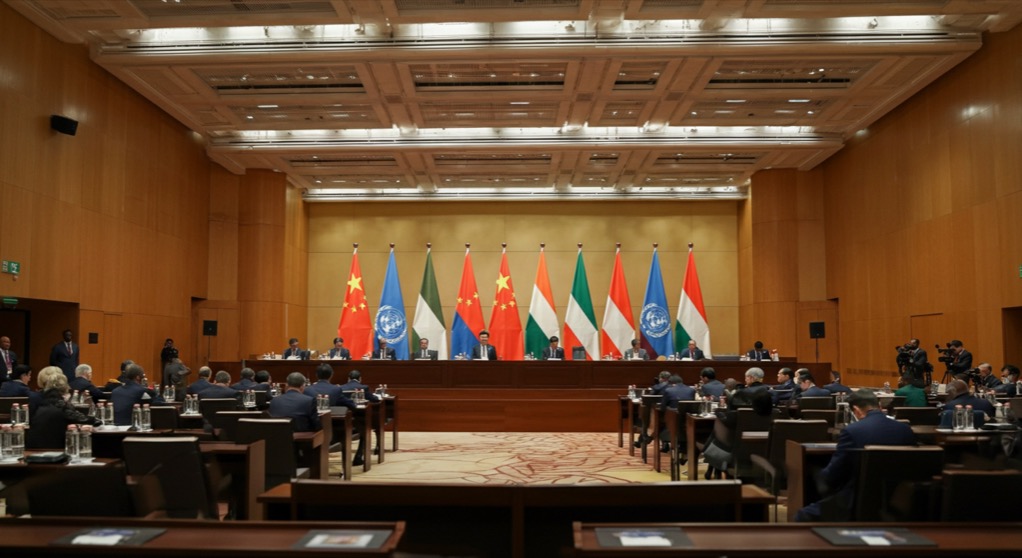
What would you do with 5,000 newly trained AI practitioners spread across dozens of developing countries, all of whom learned their craft on your platforms and tools? That is the bet China just made. At the 2026 World AI Conference in Shanghai, President Xi Jinping announced that China will offer 5,000 AI training slots to developing nations, launching the World Artificial Intelligence Cooperation Organization (WAICO) with 29 founding countries in the process. The announcement represents the most ambitious AI soft power initiative ever attempted by any nation, and it comes at a moment when the United States has been actively restricting AI technology access to many of the same countries through export controls and chip embargoes.
The Belt and Road Playbook, Applied to AI
China's training program is not a philanthropic gesture. It follows the exact same playbook Beijing used with the Belt and Road Initiative: build infrastructure first, then let influence follow. The training slots cover three critical areas: AI model development (teaching practitioners how to build and fine-tune large language models), data center operations (the physical infrastructure that runs AI workloads), and applied AI use cases (deploying AI in agriculture, healthcare, logistics, and education). Each of these domains creates dependency on Chinese AI platforms, Chinese cloud infrastructure, and Chinese model architectures.
The timing is no coincidence. WAICO, the organization Xi formally launched with 29 founding nations, gives China a multilateral framework for AI cooperation that excludes the United States entirely. CNBC reports that Xi used his keynote to position China as a collaborative AI partner, warning against what he framed as security overreach by other powers. The subtext is unmistakable: the U.S. restricts AI chip exports to developing nations; China offers free training. The U.S. imposes licensing requirements on advanced AI models; China releases open-weight alternatives like Moonshot AI's Kimi K3. The contrast is so stark that Global South governments face an increasingly binary choice between American restrictions and Chinese access.
The Numbers Tell the Story
Five thousand training slots over what period? China has not specified a timeline, but even a conservative estimate of 1,000 trained AI practitioners per year across 29 countries means roughly 35 trained professionals per country annually. Over five years, that is 175 senior AI engineers per country who were trained on Chinese AI platforms, certified by Chinese institutions, and networked into China's AI ecosystem. Those engineers become the natural champions for Chinese AI tools and platforms when their governments make procurement decisions.
Compare this to the U.S. approach. America's primary AI engagement with developing nations has been through export controls on Nvidia GPUs, restrictions on cloud compute access, and limited visa pathways for AI researchers. The CHIPS Act and the AI executive order framework focus on domestic competitiveness rather than global capacity building. There are no U.S. government programs offering free AI training to developing nations at scale. No American equivalent of WAICO exists. On paper, the U.S. has more advanced AI models and infrastructure. In practice, China is building the human capital pipelines that will determine which AI ecosystem dominates in emerging markets for the next decade.
What This Means for US AI Leadership
The direct implication for American AI companies and their founders is uncomfortable but unavoidable. The Global South represents the next billion AI users. As AI adoption spreads beyond the developed world, the platforms and tools that dominate emerging markets will determine long-term market structure. If India, Brazil, Indonesia, and African nations standardize on Chinese AI platforms because their engineers were trained on them, U.S. AI companies will compete with an entrenched competitor that has a decade-long head start on ecosystem lock-in.
There is also a regulatory dimension. WAICO gives China a forum to shape international AI governance standards. With 29 founding nations, China can set norms around data sovereignty, model transparency, and AI safety that reflect Beijing's preferences rather than Washington's. The U.S. has no comparable multilateral body for AI governance. The EU has the AI Act, but it is a regional regulation, not a global framework. The Global AI Summit process has been largely symbolic. China just created the world's largest active diplomatic vehicle for AI governance, and it did so without the United States.
What Founders Need to Watch
For startup founders building AI products targeting emerging markets, three developments deserve close attention. First, monitor which AI platforms are adopted by the practitioners trained through this program. If Chinese model APIs become the default choice for AI-powered applications in developing countries, it will reshape the competitive landscape for every AI startup serving those markets. Second, watch for regulatory alignment. Countries that join WAICO may adopt China-inspired AI governance frameworks, creating compliance requirements that differ from U.S. or EU standards. Third, expect subsidized competition. Just as China's open-weight models undercut U.S. API pricing by 5-10x in developed markets, the same dynamics will play out in emerging markets where Chinese AI tools may be offered at zero cost as part of the training program.
The AI training program is not a short-term announcement. It is a long-term investment in human capital that will pay returns for a decade or more. The United States has no equivalent program, no counterpart to WAICO, and no obvious strategy for countering China's deepening AI relationships with the developing world. For founders building globally, the message is clear: the geopolitical AI divide is no longer theoretical. It is operational, and it determines which platforms your future customers will use.