What if your AI coding agent spent $0.026 per task instead of $0.146, with zero sacrifice in accuracy? That is exactly what KlaatCode, an open-source terminal-native AI coding agent from KlaatAI, is delivering. And the numbers are reproducible by anyone who clones the repo.
KlaatCode launched on GitHub under the Apache 2.0 license and has already gathered 136 stars. But beyond the early traction, what makes this project worth watching is its core architectural bet: smart model routing. Instead of sending every request to one large, expensive model (the way Claude Code or Codex CLI do), KlaatCode uses a small routing model called Klaatu-o1 that reads each request, decides which model tier should handle it, and dispatches accordingly per request.
The Architecture: Why Smart Routing Changes the Economics
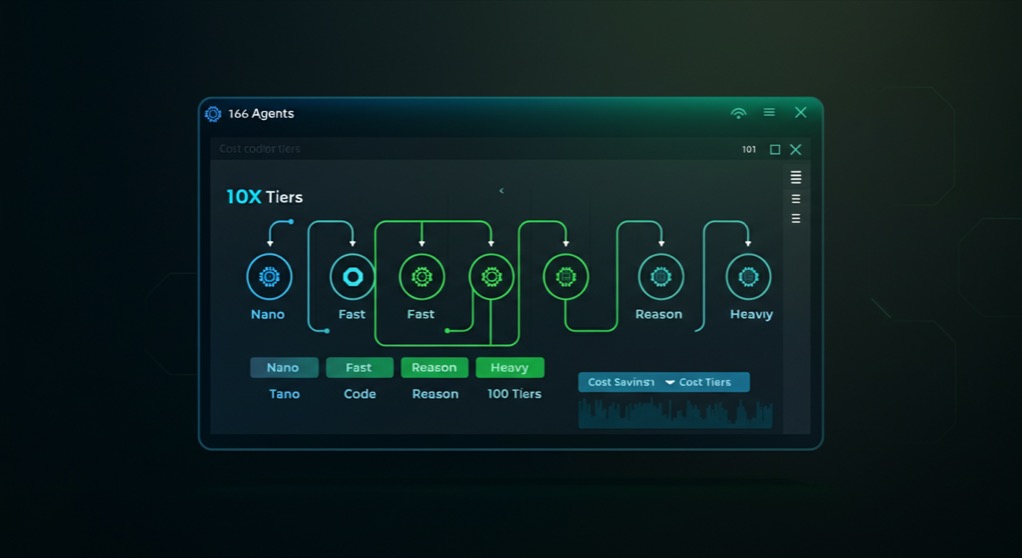
KlaatAI is built around Klaatu-o1, a small, fast, agentic router model that lives as a hosted service at klaatai.com. When you send a message from Klaat Code, Klaatu classifies it and routes it through one of five cost tiers: nano for trivial turns and completions, fast for quick questions and small edits, code as the default for most coding work, reason for debugging and architecture decisions, and heavy for large refactors and the hardest problems.
The router escalates automatically when a task turns out harder than it looked and de-escalates when you no longer need the big guns. Tool calls inside a single request (reads, edits, shell commands, searches) are free; only user messages count against quota. This is the architectural reason Klaat Code can be open source without giving away its secret sauce: the client is a thin terminal to a service, the same relationship the GitHub CLI has to GitHub. The intelligence lives server-side.
For solo founders and small teams burning through API budgets on single-model coding agents, this approach offers a practical alternative. You get frontier-level results on the tasks that require it and use cost-effective inference for everything else, without manually switching between tools.
Benchmarks: Reproducible Cost Savings
The most impressive part of KlaatCode's launch is not a claim. It is a reproduction challenge. The project includes a benchmark harness that runs the same 30 fixtures against KlaatCode, Claude Code, opencode, and Grok Build. Anyone can clone the repo and verify the numbers themselves.
The results tell a clear story: KlaatCode solved 30 out of 30 tasks, matching Claude Code's accuracy exactly. But the cost per solved task was $0.026 for KlaatCode versus $0.146 for Claude Code, a cost ratio of 18%. Token consumption was just 28% of Claude Code's. Equal accuracy at roughly 5.5 times cheaper.
These savings come from two innovations working together. First, the smart routing means simple edits are handled by cheap, fast models while only complex reasoning tasks trigger expensive frontier models. Second, KlaatCode indexes your project into a call graph with semantic search, allowing the agent to query symbols, callers, callees, and blast radius instead of reading whole files. This typically consumes 5 to 15 times fewer tokens per task than a grep-based approach.
Feature Set: What You Get Out of the Box
KlaatCode installs as a standalone compiled binary via npm, Homebrew, or a one-line installer. No Node or Bun runtime required at runtime. Once installed, it provides a full suite of developer tools that go well beyond basic code generation.
The agent includes built-in tools for reading and writing files, surgical string replacement, multi-file patching applied atomically, glob and grep search, shell command execution with permission gating, web fetch and search, and even a persistent task list it maintains on its own. It supports MCP (Model Context Protocol) with both stdio and Streamable HTTP transports, including full OAuth 2.1 support for remote servers.
For team workflows, KlaatCode provides git integration with diff, review, commit, undo, checkpoint, and rollback commands. It includes a Plan mode that restricts the agent to read-only tools so you can research and propose changes before executing them. Multi-agent workflows let you delegate scoped work to sub-agents running with their own context, keeping your main conversation small and cheap.
The terminal UI itself is polished: streaming responses with live token and cost counters, slash-command autocomplete with fuzzy filtering, collapsible tool output and thinking blocks, full mouse support, 13 themes including Dracula, Nord, Catppuccin, and Synthwave, and even Vim keybindings.
How It Compares to Alternatives
KlaatCode sits in a crowded category alongside Claude Code, opencode, Codex CLI, Aider, Grok Build, and Kimi CLI. All offer the same agentic loop and terminal-first philosophy. The differentiators that matter are threefold.
First, no other tool routes per-message to a cost tier. Claude Code uses Claude exclusively. Codex CLI uses GPT models. Aider lets you pick a model per session but does not dynamically switch between tiers based on task complexity. KlaatCode's routing is the only approach that automatically matches cost to complexity.
Second, the code knowledge graph approach reduces token consumption by an order of magnitude compared to grep-based file reading. For large codebases, this is the difference between a $0.10 task and a $0.01 task.
Third, the benchmark is publicly reproducible. Most AI coding tools make performance claims backed by cherry-picked examples. KlaatCode ships the same test harness used in their benchmarks and invites anyone to verify. In an industry drowning in marketing benchmarks, that transparency is rare and valuable.
Who This Is For
KlaatCode is designed for three types of users. Solo founders and early-stage startups where every dollar of API spend matters. The 5.5x cost savings can mean the difference between bootstrapping and needing a funding round just to cover AI costs. Engineering teams at growing companies who want to give every developer an AI coding agent without the sticker shock of enterprise-wide Claude Code or Codex licenses. And open-source contributors and maintainers who need a capable, cost-effective coding assistant that runs locally and respects their privacy.
The fact that KlaatCode is Apache 2.0 licensed means the broader ecosystem can build on it, extend it with custom plugins, and contribute back. For a tool category that has been dominated by closed-source products with opaque pricing, KlaatCode represents a genuinely open alternative. The economics are transparent, the benchmarks are reproducible, and the model routing strategy points the way toward the next generation of cost-efficient AI developer tools.