
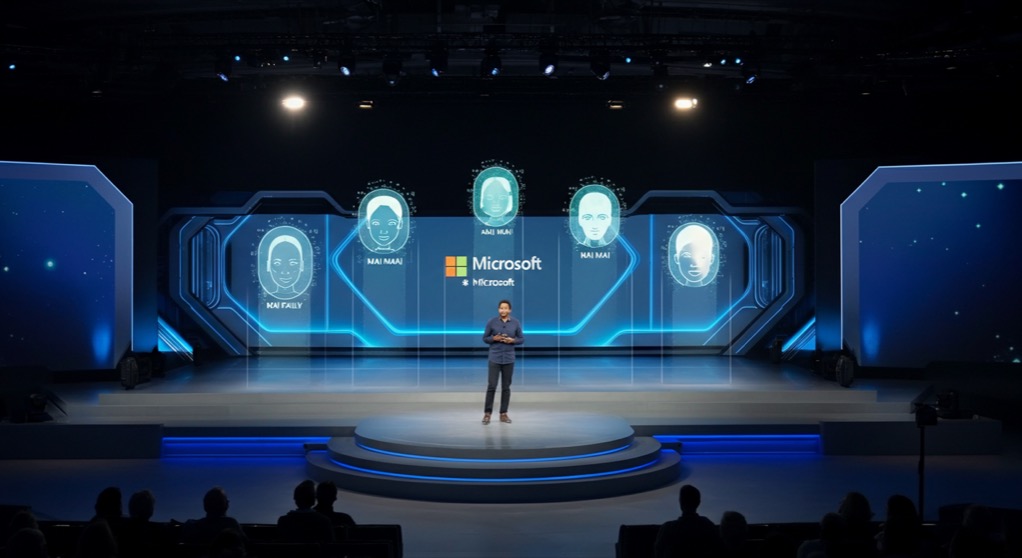
At Build 2026, Microsoft AI CEO Mustafa Suleyman stood on stage and announced something the company has spent two years quietly building: a family of seven in-house AI models designed to reduce Microsoft's dependence on the very AI partners it has poured $13 billion into. The announcement marks the most aggressive push yet by any major tech company to build sovereign AI capabilities while maintaining partnerships with the same companies it is now competing against. The move fundamentally rewrites the rules of the AI platform game.
The seven-model MAI family spans reasoning, coding, image generation, voice, and transcription, with the flagship MAI-Thinking-1 reasoning model performing competitively against Anthropic's Claude Sonnet 4.6 in blind human evaluation. For founders building on top of Microsoft's ecosystem, this is not just a product launch. It is a signal that the era of single-provider AI dependency is ending.
The Seven Models What Microsoft Actually Built
Microsoft unveiled the MAI (Microsoft AI) model family at Build 2026, with each model targeting a specific capability. The flagship model, MAI-Thinking-1, is a reasoning model that Microsoft claims matches Anthropic's Claude Sonnet 4.6 in blind human preference testing and equals the more capable Claude Opus 4.6 on a widely used coding benchmark. Suleyman stressed that MAI-Thinking-1 was trained from the ground up with no distillation from other companies' models, directly addressing enterprise concerns about clean data lineage and IP contamination.
The second most immediately impactful model is MAI-Code-1-Flash, a 5-billion-parameter coding model now rolling out in Visual Studio Code and GitHub Copilot. This positions Microsoft to reduce its reliance on OpenAI's Codex and Anthropic's Claude for code generation within its own developer tools. MAI-Image-2.5, the image generation model, ranks second on a leading image-editing leaderboard, ahead of Google's Nano Banana Pro. The remaining models cover voice synthesis, transcription, embedding, and a lightweight inference model optimized for edge deployment.
All seven models are available in private preview on Microsoft Foundry, the same platform where the company hosts the latest models from OpenAI and Anthropic, including the recently released Claude Opus 4.8. The juxtaposition is deliberate. Microsoft is telling enterprise customers: we can give you best-in-class models from multiple providers, but we also own the stack.
Why Microsoft Decided to Build In-House
Microsoft's decision to build its own frontier models is the culmination of a strategic tension that has been building since the company invested its first billion into OpenAI. The core problem is structural. Microsoft is OpenAI's largest investor at $13 billion cumulative, but OpenAI has been expanding its direct enterprise relationships, competing with Microsoft for the same commercial accounts. Simultaneously, OpenAI has grown increasingly cozy with Amazon, Microsoft's primary cloud rival, raising questions about the exclusivity and longevity of the partnership.
The situation with Anthropic is equally complicated. Microsoft invested up to $5 billion in Anthropic last year and integrated its technology into the Copilot Cowork AI assistant. But Anthropic is also backed by Google and Amazon, creating overlapping and sometimes conflicting allegiances. Microsoft needed models it could control, modify, and deploy without negotiating with partners who may have competing priorities.
The financial calculus also drives the decision. Every Office 365 prompt routed to OpenAI or Anthropic carries a per-token cost that cuts into Microsoft's margins. CNBC reported that Microsoft is quietly shifting thousands of Office prompts to in-house AI models to reduce inference costs. For a company processing billions of AI queries daily across Office, Azure, GitHub, and Windows, even marginal per-query savings translate to hundreds of millions in annual margin improvement.
What This Means for the OpenAI Partnership
The $13 billion Microsoft-OpenAI partnership is not ending. But it is fundamentally changing shape. Microsoft will continue to offer OpenAI models through Azure and Foundry, and OpenAI will continue to train on Azure infrastructure. However, the relationship is shifting from exclusive dependency to a multi-provider marketplace where Microsoft's own models compete alongside OpenAI's for the same enterprise workloads.
This creates an unprecedented dynamic. Microsoft is simultaneously OpenAI's largest investor, its primary compute provider, and now its direct competitor. For enterprise customers, this complexity introduces both opportunity and risk. On one side, having Microsoft's in-house models as an option creates pricing leverage and supply redundancy. On the other side, the conflict of interest means customers must carefully evaluate which model provider is truly acting in their best interest when Microsoft recommends a model for a given workload.
The 'divorce watch' narrative that has followed the OpenAI-Microsoft relationship for the past year is now grounded in real product decisions. If Microsoft's MAI models prove competitive across the full capability spectrum, the incentive for Microsoft to prioritize its own models over OpenAI's will only grow stronger. For OpenAI, this means the partnership that gave it the compute resources to build frontier models is now incubating its most formidable competitor.
What This Means for AI Founders
The fragmentation of the AI model market accelerates with Microsoft's entry. Three massive implications follow for founders building on AI.
First, single-provider dependency is now a strategic risk. If Microsoft, OpenAI's largest investor and customer, is diversifying away, so should you. Build abstraction layers that let you swap model providers without rewriting your application. The seven MAI models, combined with offerings from Google, Anthropic, Amazon, and open-source alternatives, mean the multi-model future is here.
Second, pricing pressure will intensify. Microsoft is entering the market with the explicit strategy of undercutting its partners on cost. For startups building AI products, this is a near-term tailwind. Inference costs that were already falling will drop further as Microsoft, Google, and Amazon all race to capture market share with competitive pricing. The winners will be companies that can pass these savings to customers or reinvest them in product quality.
Third, the platform lock-in calculus has changed. When your AI infrastructure is also your primary competitor's infrastructure, you need a migration plan. Founders should ensure their model serving, fine-tuning, and data pipelines are portable across cloud providers. The next twelve months will see the most aggressive model price war in AI history, and the companies that can seamlessly switch between providers will capture the most value.