NVIDIA just assembled an alliance that includes 20 of Japan's most powerful industrial companies into a single Physical AI initiative. Toyota, Fanuc, Kawasaki Heavy Industries, Sony, SoftBank, Hitachi, Fujitsu, and Yaskawa Electric are all building on NVIDIA's Cosmos platform to deploy AI-powered robots and autonomous systems in factories. Jensen Huang called it a once-in-a-generation opportunity for Japan. He is not exaggerating.
The announcement, made on July 15, 2026, is the most significant integration of AI into industrial robotics the world has seen. Japan has long been the global leader in precision manufacturing and robotics. Fanuc alone has installed over 4 million industrial robots worldwide. Yaskawa pioneered servo motor technology that powers modern automation. Kawasaki builds the heavy robots that assemble cars and aircraft. Now these companies are not just building robots. They are building robots that can see, reason, and act autonomously using AI models that run on the edge.
The Scale of the Opportunity: Physical AI as the Next Frontier
Physical AI refers to artificial intelligence that operates in the physical world through robots, autonomous vehicles, and intelligent infrastructure. It is widely considered the next frontier after large language models, and Jensen Huang has publicly called it the next trillion-dollar opportunity. Japan is uniquely positioned to lead this transition for three structural reasons.
First, Japan has the densest concentration of industrial robotics in the world. The country operates more than 400 industrial robots per 10,000 manufacturing employees, the highest ratio globally. Second, Japan faces a demographic crisis that creates urgent demand for automation. Its population has been shrinking for over a decade, and the manufacturing workforce is aging faster than any other developed economy. Third, Japan's companies have spent decades perfecting precision manufacturing at a level that no other country has matched. Adding AI to this infrastructure is not replacing human workers with robots. It is giving the existing robots the ability to perceive, plan, and adapt.
The Cosmos Coalition, which NVIDIA first launched as an initiative to advance open world models, has now expanded to include Japanese members. The coalition's goal is to build open frontier physical AI models that any company can use as a foundation. This is significant because it signals that Japan's industrial leaders see shared infrastructure as the path forward rather than building proprietary, siloed AI systems.
Cosmos 3 Edge: A 4-Billion-Parameter Model That Runs on the Factory Floor
The technical centerpiece of the announcement is NVIDIA Cosmos 3 Edge, a 4-billion-parameter model built on the Nemotron architecture. Unlike cloud-based AI models that require constant internet connectivity, Cosmos 3 Edge is designed to run directly on NVIDIA's Jetson Thor edge computers. This matters for manufacturing because factory floors cannot afford the latency, reliability risk, or bandwidth cost of sending every camera feed to the cloud for processing.
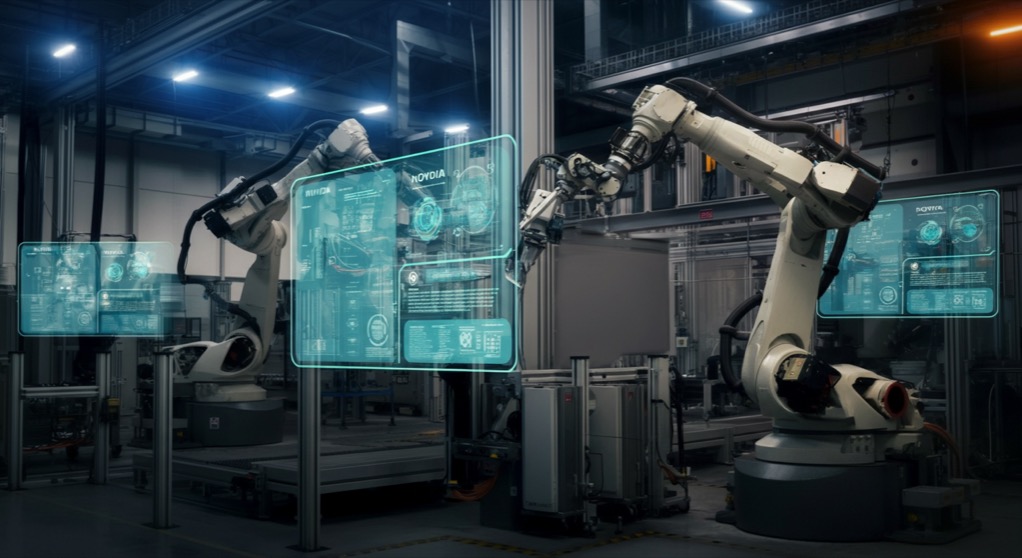
Cosmos 3 Edge brings vision reasoning and robot policy generation to the edge. A robot equipped with this model can look at a part on an assembly line, understand whether it is correctly positioned, reason about the next action, and execute that action in real time. NVIDIA says developers can adapt the model for specific robots, vehicles, sensors, and environments in about a day. It runs across NVIDIA RTX GPUs, DGX systems, and the newly announced Jetson T2000 and T3000 modules.
NVIDIA also announced new Metropolis libraries that help developers build vision AI agents up to six times faster using coding agents that write, train, and deploy video intelligence systems. The combination of Cosmos 3 Edge on the edge and Metropolis in the backend creates a complete stack for building intelligent machines that can operate independently in dynamic environments.
Japan's Ecosystem Unites Around a Common AI Platform
The breadth of Japanese companies joining the Cosmos Coalition is remarkable. The list spans robotics manufacturers (Fanuc, Yaskawa, Kawasaki), automotive giants (Toyota, Honda R&D), electronics and telecommunications leaders (Sony, Hitachi, NEC, Fujitsu, SoftBank), and construction and agriculture specialists (Shimizu Corporation, Kubota). It also includes startups like Telexistence, which builds remote-controlled robots for retail, and GROOVE X, which makes companion robots for elderly care.
Fujitsu is leading an initiative to build a collaborative control platform for physical AI, integrating NVIDIA's stack to bridge digital and physical operations across industries. This platform would allow different robots from different manufacturers to coordinate through a shared AI layer rather than requiring bespoke integration for every pair of systems. If successful, it could become the operating system for Japan's industrial automation the way Android became the operating system for smartphones.
The inclusion of SoftBank is particularly notable. SoftBank has been one of the most aggressive investors in AI and robotics globally, and its participation suggests that the Cosmos Coalition is not just about technology but also about financing and go-to-market support for physical AI startups in Japan.
Key Lessons for Founders
This announcement has direct implications for founders building in AI, robotics, manufacturing, and infrastructure software.
Physical AI infrastructure is being standardized now. NVIDIA's Cosmos platform is positioning itself as the de facto operating system for embodied AI. The same playbook NVIDIA used to make CUDA the standard for AI training is now being applied to physical AI. Founders building robotics middleware, simulation tools, or factory automation software should integrate with Cosmos rather than building competing infrastructure.
Edge AI is the unlock for manufacturing. The fact that Cosmos 3 Edge runs on Jetson Thor is not a niche detail. It is the key insight that makes factory deployment viable. Founders building for industrial environments should design for edge-first architectures, not cloud-dependent ones. Latency, reliability, and data sovereignty requirements in manufacturing are fundamentally different from SaaS.
Japan's demographic crisis creates a real market pull. This is not a technology push story. Japan genuinely needs AI-powered automation because its workforce is shrinking. For founders, the Japanese market for physical AI is not speculative. Companies are buying now because they have no choice. The tools, middleware, and specialized models needed to make physical AI work at scale are still nascent, and the window to enter this market is open.
The platform battle for physical AI is underway. The Cosmos Coalition is effectively creating a shared infrastructure layer that competing companies (Fanuc vs. Yaskawa, Sony vs. Hitachi) can build on without building their own AI from scratch. For founders, this means the differentiation will happen at the application layer, not the model layer. The winners will be companies that build the best applications on top of this emerging standard, not companies that try to compete with NVIDIA on infrastructure.