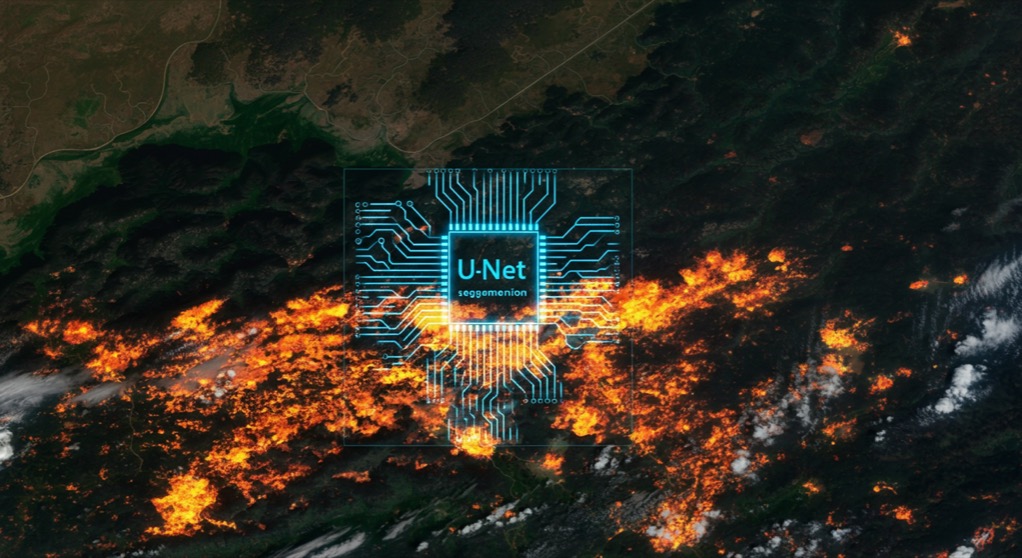
Can quantum machine learning help us detect wildfires from space faster and more accurately than classical computer vision? A team of 13 researchers from the University of Maryland and IonQ has published a paper on arXiv that suggests the answer might be yes. Their model, QFireNet, injects variational quantum circuits into the bottleneck of a U-Net architecture to segment wildfires from Sentinel-2 satellite imagery. Under matched conditions, both quantum-enhanced variants outperformed the classical U-Net baseline, with the QB-Net ansatz achieving an F1 score of 31.18 against the classical baseline of 28.71. That is an 8.6% improvement in a domain where every correctly classified pixel can mean faster fire response and saved property.
The paper addresses a genuine operational challenge. Wildfire detection from satellite data is hard because fire pixels are rare compared to non-fire pixels (severe class imbalance), the spectral signatures of smoke and fire vary across terrain and atmospheric conditions, and models must generalize across geographically diverse regions. Most quantum machine learning papers stay in toy domains or simplified benchmark datasets. QFireNet is different: it works with real Sentinel-2 multispectral imagery and validates its findings on two independent datasets, including cross-dataset transfer on the California Burned Areas dataset.
What QFireNet Does: Quantum Circuits in the U-Net Bottleneck
The core architectural idea is elegant. A standard U-Net has an encoder that compresses the input image into a low-dimensional bottleneck representation, and a decoder that reconstructs the segmentation mask from that bottleneck. QFireNet replaces the classical bottleneck with a variational quantum circuit, specifically testing two ansatz designs: QuFeX and QB-Net. Both are parameterized quantum circuits that transform the high-dimensional spectral feature space of the Sentinel-2 imagery in ways that classical convolutional layers struggle to model efficiently.
The intuition is that wildfire signatures live in a complex, high-dimensional spectral space. Sentinel-2 captures 13 spectral bands including visible, near-infrared, and shortwave infrared channels. Fire pixels have distinctive signatures across these bands, but the relationships are nonlinear and involve correlations that classical models may not capture well with limited parameters. A variational quantum circuit, with its ability to represent exponentially rich feature spaces via superposition and entanglement, can potentially model these spectral relationships more expressively than a classical layer of the same parameter count.
The team trained QFireNet on the Sen2Fire dataset, a curated collection of Sentinel-2 imagery with wildfire segmentation labels. They benchmarked against two classical baselines: a standard U-Net and a Feature Pyramid Network. The results are telling. Under matched conditions (same training setup, no data mixing), QB-Net achieved an F1 of 31.18 and QuFeX achieved 30.79, both outperforming the classical U-Net baseline of 28.71. The classical FPN scored 31.13, competitive with the quantum variants.
However, the most striking finding came from data mixing. When the researchers applied uniform mixing of input data to remove a domain shift between geographically separated training and test sets, the classical FPN jumped to an F1 of 39.76. This suggests that data preprocessing quality currently matters more than architectural choice in this task. The quantum advantage exists, but it is incremental compared to the gains available from better data pipelines.
Cross-Dataset Validation and Real-World Implications
One of the stronger aspects of the paper is cross-dataset validation. The team tested QFireNet on the California Burned Areas dataset without retraining, confirming that the quantum-enhanced architecture generalizes beyond the Sen2Fire dataset. This matters because satellite-based wildfire models must work across different geographies, climates, and sensor configurations. A model that only works on its training region is not operationally useful.
The paper also explores classical improvements alongside the quantum approach, including parameter compression, alternative loss functions (focal loss to address class imbalance), and the aforementioned data mixing. This honest comparison is refreshing. The authors do not claim quantum supremacy. They show that quantum circuits provide a modest but real advantage over classical U-Net under matched conditions, and they identify where classical methods with better data engineering can close or exceed that gap.
For the broader field of quantum machine learning, QFireNet is significant because it works on a genuine operational problem with real-world data. Most quantum ML papers use synthetic datasets or simplified problems. QFireNet uses real satellite imagery, real fire labels, and tests on real held-out geography. That is a higher standard of evidence than most papers in this space meet.
What This Means for Builders
Three takeaways for AI founders and operators building in computer vision, climate tech, or quantum-adjacent spaces. First, quantum-classical hybrid architectures are becoming practical enough to apply to real problems. The variational quantum circuit in U-Net is a replicable pattern that could generalize to other remote sensing tasks: flood mapping, deforestation tracking, crop health monitoring, and urban heat island analysis. If you are building a computer vision product for satellite or aerial imagery, the quantum bottleneck pattern is worth experimenting with, especially if your data has high spectral dimensionality.
Second, the paper confirms a hard truth: data quality beats model architecture. The data mixing experiment boosted classical FPN performance from 31.13 to 39.76, a gain of 8.63 points. The best quantum circuit gained 2.47 points over the classical U-Net baseline. If you are allocating engineering resources, invest first in data pipelines and preprocessing. Quantum architectures can provide an edge, but only after the classical foundation is optimized.
Third, the paper signals that quantum computing for environmental monitoring is an emerging niche worth tracking. The collaboration between a university team and IonQ (a publicly traded quantum computing company) suggests that quantum hardware vendors are actively looking for real-world use cases to validate their systems. Founders building climate tech products should watch this space: if quantum advantage in satellite imagery segmentation holds up at scale, it could create a defensible moat for companies that integrate quantum-classical hybrid models before their competitors do.