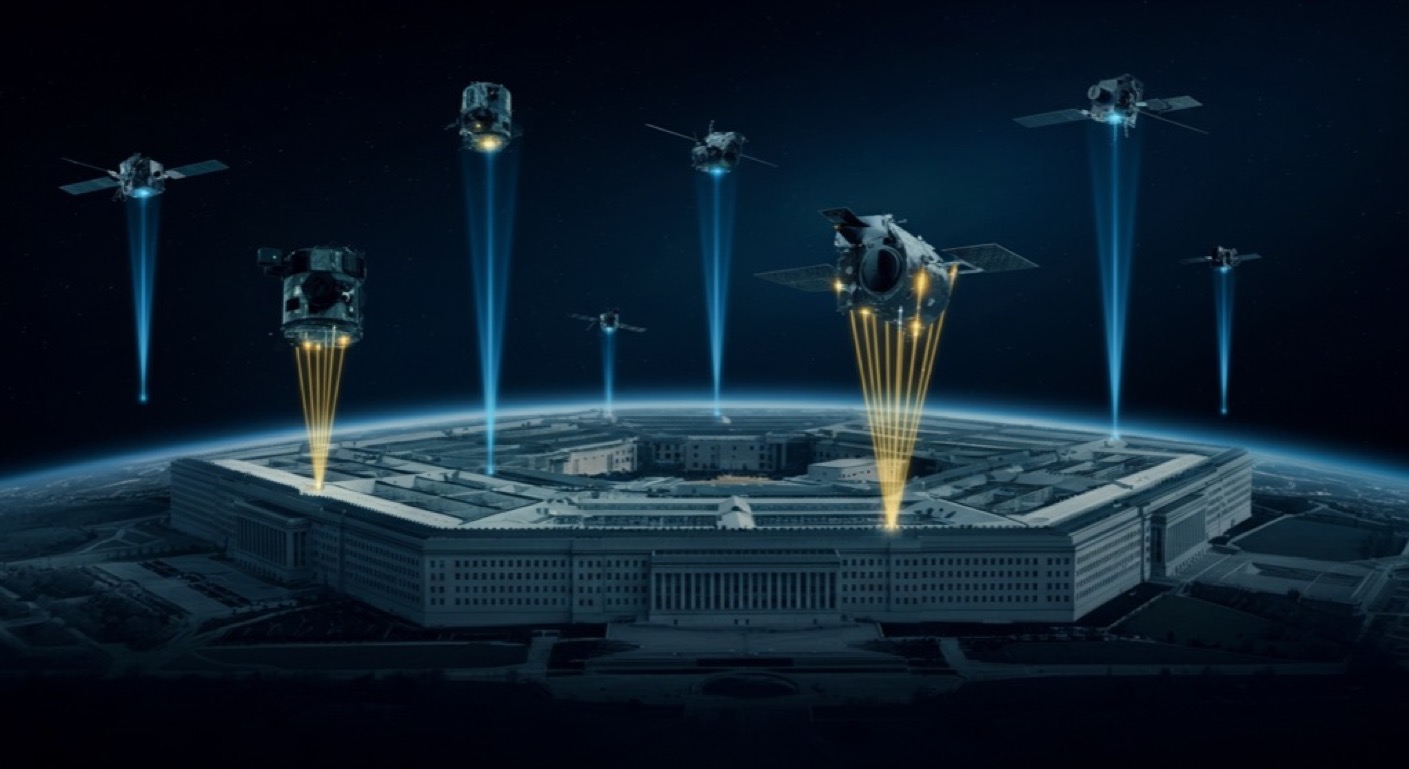
What happens when the most advanced satellite constellation on Earth becomes a distributed supercomputer in space? According to a Wall Street Journal exclusive, that is exactly what SpaceX and the U.S. Department of Defense are actively exploring. The talks envision transforming Starlink's network of over 6,000 low-Earth orbit satellites into a space-based AI compute grid capable of running inference workloads directly in orbit, processing data from drone feeds, surveillance systems, and battlefield sensors without ever touching a ground station. The implications reach far beyond defense: if successful, this architecture could redefine how we think about cloud computing, edge inference, and the geography of AI itself.
SpaceX is not proposing to launch new satellites with beefed-up GPUs. Instead, the company is looking at the existing Starlink v2 and Starshield satellites, which already carry significant onboard processing capability, inter-satellite laser links for high-bandwidth mesh networking, and modular payload bays. The ask is architectural: repurpose the distributed compute resources already in orbit to run AI workloads where the data is being collected. A Predator drone over the Indian Ocean would no longer need to beam full-resolution video feeds to a data center in Virginia. The satellite above it could run the object detection model directly on the drone's feed, transmit only the coordinates of identified targets, and cut the decision loop from seconds to milliseconds.
The Architecture: A Mesh Network of Orbital AI Nodes
The technical blueprint under discussion leverages Starlink's inter-satellite laser links as the backbone of a distributed compute fabric. Each Starlink satellite becomes an edge node in a Kubernetes-style cluster spread across orbital shells approximately 550 kilometers above Earth. AI inference tasks are routed to the satellite with the best line-of-sight to the data source, processed onboard, and the results are relayed through the mesh to the nearest ground station or directly to end users. This is fundamentally different from today's cloud architecture, where data travels from collection point to ground station to fiber backbone to data center and back a latency chain spanning thousands of kilometers and multiple seconds. In the SpaceX model, the compute unit and the data collector are within the same orbital neighborhood, often within 50 milliseconds of physical distance.
The security advantages are equally significant. A centralized data center is a single point of failure a target for physical attack, cyber intrusion, or natural disaster. A distributed mesh of thousands of independently operating compute nodes spread across orbital shells has no single point of failure. To degrade the network, an adversary would need to disable satellites across multiple orbital planes simultaneously, which is far beyond the antisatellite capabilities of any current military power. The architecture is resilient by geometry: even if 30 percent of the constellation were disabled, the remaining satellites could reroute compute workloads through alternative paths using the laser mesh.
This move comes as the Pentagon accelerates its Combined Joint All-Domain Command and Control (CJADC2) initiative, which aims to connect sensors from all military branches Army, Navy, Air Force, Marines, Space Force into a unified AI-enhanced command and control network. CJADC2's biggest bottleneck is not data collection or analysis, but data transport. Sensors generate far more data than existing communication links can handle. Process-in-orbit computing directly solves this: rather than transmitting raw data, the system transmits only the AI's inference results, compressing multi-gigabyte surveillance feeds into kilobyte-sized reports.
Why Space-Based AI Compute Matters for Founders
For startup founders, this development signals the emergence of an entirely new infrastructure category: orbital edge computing. While SpaceX's initial customer is the Pentagon, the enabling technology is not inherently military. Once SpaceX proves that running AI inference on Starlink satellites is reliable and cost-effective, commercial applications follow naturally. Remote sensing companies currently processing satellite imagery on the ground could instead run classification models in orbit and download only the detected features. Maritime monitoring operations tracking illegal fishing across the Pacific could process AIS and radar data in the orbital mesh and receive alerts in real time. Disaster response teams could task the network to analyze wildfire satellite feeds and map containment lines without waiting for ground-based processing.
The commercial play is especially compelling for Starlink's Starshield division, the military-focused variant that already serves the Department of Defense with encrypted communications. Adding AI compute as a service would give Starshield a differentiated product that no other space company can match. Amazon's Project Kuiper is still years away from meaningful orbital deployment. OneWeb's constellation lacks inter-satellite laser links. SpaceX has a multi-year head start on a network that is already operational and generating revenue. Adding AI compute to existing satellites is a software and firmware upgrade, not a hardware relaunch.
What This Means for the AI Infrastructure Landscape
The broader signal is about where AI workloads will run in the future. For the last five years, the AI compute industry has been defined by a centralization trend: bigger clusters, larger data centers, hyperscaler concentration. The Starlink-Pentagon talks point in the opposite direction. They suggest that the next frontier of AI infrastructure is not a larger data center in Northern Virginia but a distributed mesh of compute nodes operating in the most physically resilient environment available: space.
This has direct implications for how founders should think about AI architecture. If latency-sensitive inference workloads can be processed in orbit, then the assumption that AI needs terrestrial data centers begins to crack. Applications in defense, remote sensing, telecommunications, and logistics that currently accept multi-second latency because they have no alternative could soon compete with near-instant inference. The companies that build the middleware, orchestration layers, and developer tools for orbital AI compute will be well positioned for the decade ahead.
Ultimately, the significance of the SpaceX-Pentagon talks is not whether this specific deal closes. It is the direction it reveals: the next great migration of AI workloads is not to a cloud region but to a constellation.